On Thursday, October 4, 2012 I was the guest speaker at the kickoff to a film discussion series hosted by Penn State Wilkes-Barre at Movies 14 in Wilkes-Barre, Pennsylvania. The overall theme of the series is movies that have to do with the end of the world. The first film chosen was Stanley Kubrick's Dr. Strangelove: Or, How I Learned To Stop Worrying And Love The Bomb. Since the film deals with the "Doomsday" scenario of World War III and (spoiler alert!) ends with a global nuclear holocaust, it is a fitting kick-off to the series.
My role was to share some thoughtful remarks about the movie and ask questions aimed at stimulating discussion among the 50 or so people in attendance. The audience was made up of students from the local Penn State campus, a local parochial school, and interested members of the community. What follows is my introductory remarks, followed by some of the questions I asked.
******************************************************************
I have watched Dr. Strangelove at least 20 times. Growing up in the Philadelphia area, it was often shown on the now-defunct Channel 48. I have also taught the movie to my history classes at Wyoming Seminary College Preparatory School in Kingston, Pennsylvania. This film resonates with me on many levels, including:
- the setting of the U.S. Air Force of the 1960's and the tensions of the Cold War
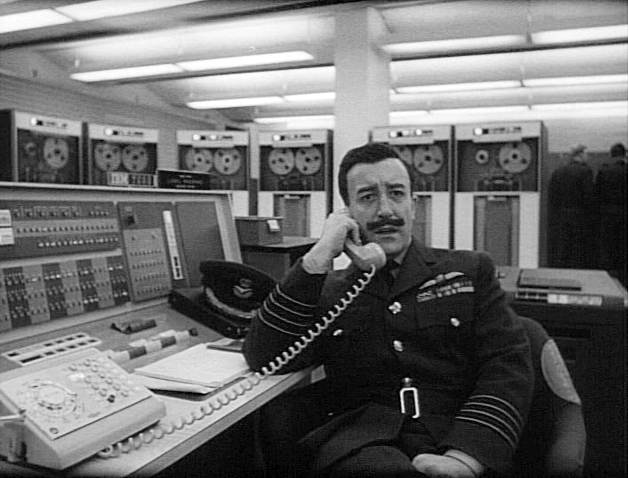
- the comedic stylings of Peter Sellers (who plays the roles of Group Captain Lionel Mandrake (RAF), President Merkin Muffley and nuclear scientist Dr. Strangelove), George C. Scott, who plays the quintessential All-American boy grown up to be a Cold Warrior, General Buck Turgidson, and Slim Pickens, as rustic B-52 pilot Major "King" Kong
- the many lines of the script that I cannot get out of my head. I think about this movie all the time, and I am glad to be able to talk about it with you tonight.
When the movie premiered in 1964 (it's original debut at Christmas 1963 was delayed after the murder of President Kennedy) my father was an Airman First Class stationed at a U.S. Air Force base in England. As a child I always enjoyed playing with his old uniform, and seeing people on screen wearing those exact clothes was quite interesting; it made me empathize with the Air Force personnel in the film who die defending Burpleson Air Force Base from the Army.
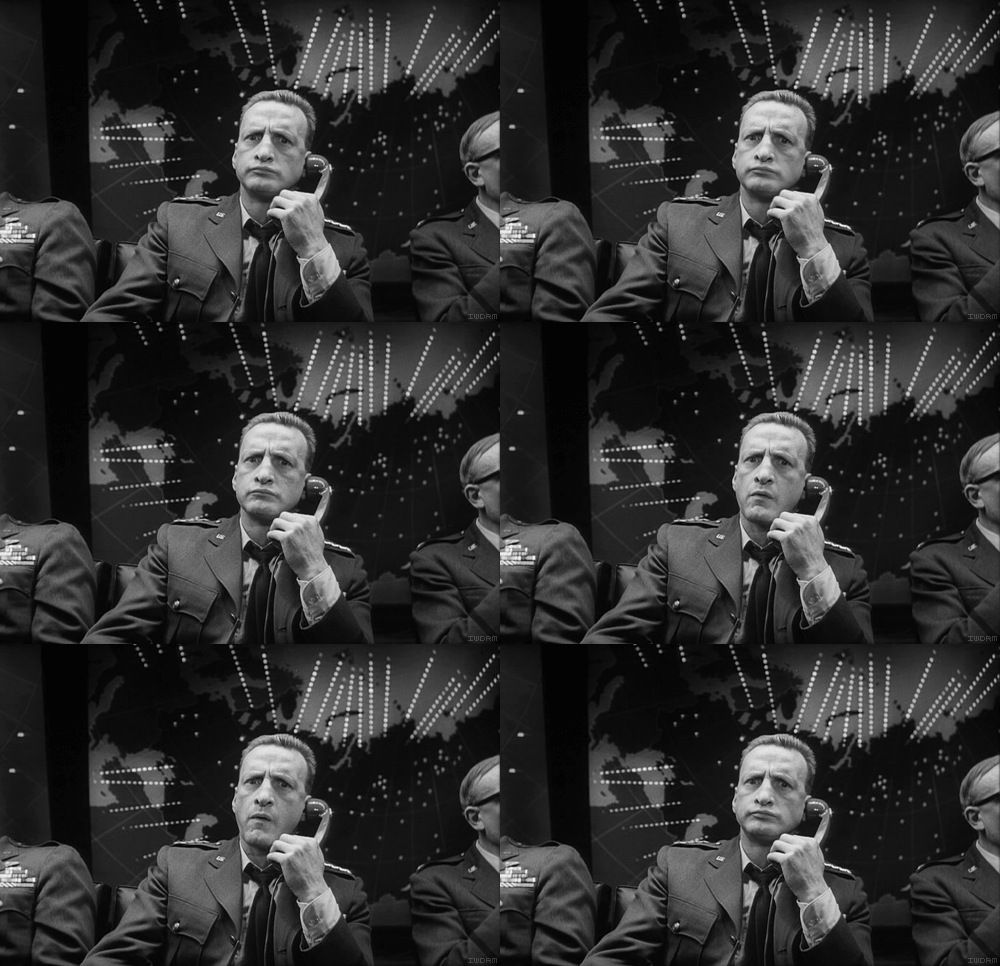
 The Air Force personnel shown in the movie are either boringly competent functionaries (like the crew of the B-52), paranoid crazies, or both. Scott's characterization of Turgidson is a tour-de-force. Famous critic Roger Ebert has praised the performance as "the funniest thing in the movie, better even than the inspired triple performance by Peter Sellers or the nutjob general played by Sterling Hayden." Ebert notes that he was especially impressed by the "tics and twitches, the grimaces and eybrow archings, the sardonic smiles and gum chewing..." that help us understand the kind of man Gen. Turgidson is. From the first moment we see him, in the midst of an evening tryst with his secretary (played by Tracy Reed, whose Playboy centerfold was being ogled by Major Kong during his first appearance on screen) it is obvious that he is all id, and that his lack of impulse control is a foreshadowing of his lack of control over the Air Force.
It is somewhat interesting that each of the Air Force officers featured in the movie are preoccupied with sex. From the aptly named "Buck Turgidson", to girlie-mag loving Maj. Kong who notes that with "...one issue of prophylactics; three lipsticks; three pair of nylon stockings. Shoot, a fella' could have a pretty good weekend in Vegas ..." to the sexually impotent General Jack D. Ripper, who blames his failure to perform in bed to a "post-war Commie conspiracy" to weaken Americans' "essence" through fluoridation of the water supply. The movie seems intent on pointing out the psycho-sexual import of the Air Force, especially considering the opening credits, which is about as explicit a sex scene as you could get in 1964:
******************************************************************
Mid-20th century technology plays a vital role in the movie, advancing the storyline inexorably until the world faces nuclear annihilation via computer (with, perhaps, a potential survival plan that also relies on computers to choose "survivors" based on, among other factors, "sexual fertility"). But technologies like radar, jet aircraft, and the "Big Board" in the War Room are also important. Watching the movie again recently surprised me that so many key moments of the movie involve a character talking into the phone! Mandrake's lack of a dime to call Washington and call back the bombers is funny as well as an historical anachronism that many young people (who carry phones in their pockets) might not appreciate. My favorite is when the effete President Merkin Muffley (a "merkin" is a wig for the pubic region that actors wear during nude scenes) has to brief the drunk, womanizing Soviet Premier Kissoff. This scene is a clear take off on the then-current comic routines of Bob Newhart, whose stand-up comedy consisted of listening to one side of a phone call.
Speaking of anachronisms, to young people watching the movie today, it may be hard to relate to the oppressive air of doom that hung over the world during the Cold War. In his inaugural address, President Kennedy referred to the "uncertain balance of terror that stays the hand of mankind's final war". Everyone was certain that a nuclear war between the U.S. and the U.S.S.R. was inevitable and that the deterrence which was based on the doctrine of Mutually Assured Destruction would ultimately fail. Of course in the movie, it doesn't so much fail, as get carried out to it's most logical conclusion. During the 1960's, soldiers like my father were issued these "pocket computers" that would calculate the yield and destructive force of a nuclear attack--they were also given out as part of the presskit for Dr. Strangelove. Young people were taught to take shelter under schooldesks or in doorways when a surprise attack occurred. And during the 1960 election, voters were warned of a growing "missile gap", where the Soviets were building significantly more nuclear missiles than the U.S. (in actuality, the American arsenal outnumbered the Soviets' by 17 to 1). 1960's era worries about "gaps" (like the missile gap, the generation gap and later the credibility gap) definitely informed the black humor of the final scene, when a desperate Gen. Turgidson berates President Muffley over a putative "mineshaft gap" 100 years in the future.
******************************************************************
I have incorporated many lines of dialogue from this movie into my daily life. Some are merely references, such as when I speak the word "computer" in a Dr. Strangelove accent. Or, referencing the scene where Gen. Ripper is shooting an M-60 at the Army assault team and he asks his British attache to give him ammunition; when I am very hungry I will appropriate the line "Feed me, Mandrake". Then there are the quotes, such as when I got out of bed after my recent back surgery, and said "Mein Fuhrer! I can walk!" Similarly, I cannot drive in the direction of the Northeast Extension past Geisinger Hospital without hearing Slim Pickens' vow to "get them [bomb bay] doors open if it harelips everyone on Bear Creek". By all accounts, the screenplay (which is credited to Kubrick, Terry Southern and Peter George (who wrote the book upon which the movie is based) was augmented quite a bit by ad-libs from the actors. Regardless of who is responsible for what, it is a very well written film.
Do you think that these names were chosen consciously to make a point, or do you think it was just the writers horsing around?
******************************************************************
- My first question to you tonight is: did you find the movie funny? If so, what parts, and why? Or if not, why not?
"I found myself at the edge of tears as I watched a series of nuclear explosions fill the screen, and heard a sweet female voice singing 'We'll meet again/ don't know where, don't know when/ but I know we'll meet again some sunny day.'...Was I sad that the movie's world was ending? Was I having an attack of hysterics brought on by the film's repeated and stunning outrages? Or had I suddenly arrived after prolonged laughter at a glimpse of some awful truth?"
What do you think of the ending of the movie? Is it sad? Is it a "good" ending, or do you find it anti-climactic?
- Next question: reaction to the movie in 1964 was often very critical. The New York Times printed a letter to the editor saying "Dr. Strangelove is straight propaganda, and dangerous propaganda at that. It is an anti-American tract unmatched in invective by even our declared enemies." Another letter added that the film "indulges in the most insidious and highly dangerous form of public opinion tampering concerning a vital sector of our national life...which needs public funds, public understanding and public support to do its job." Even the official reviewer for the Times worried that the movie was "a bit too contemptuous of our defense establishment for my comfort and taste." Were these people right or wrong? Was the movie "anti-American"? Did it weaken the country's defenses by showing incompetents and buffoons in high places? Did it show a lack of respect toward the people in charge?
- The Washington Post's review made a fascinating remark. Writing on January 30, 1964, Robert Estabrook noted:
President Kennedy saw Dr. Strangelove shortly before his death, and it would be interesting to know his full reaction. Perhaps Mr. Kubrick accomplishes his objective in getting people talking. But it is worth asking what constructive purpose there is in exaggerating a complex problem so as to portray men who have served the free world well as a bunch of irrational simpletons.What do you think JFK would have thought about this, coming only a year or so after the Cuban Missile Crisis, and the disputes that led to the erection of the Berlin Wall? And is it wrong to poke fun at people in positions of responsibility?
- There is definitely a lot of exaggeration in the movie, from Dr. Strangelove's mysterious disability, to Mandrake's stiff upper lip. But according to Kubrick in an article in the Los Angeles Times,
"I kept coming up with things and found myself saying I can't do this, people will laugh at it. But by being realistic...it shows that the leaders are just human beings subject to the same banalities and absurdities as the rest of us.
I found it good to nurture this to achieve what I call nightmare comedy. This was the tone that fit the situation--the state of the world. Very few of the laughs are jokes. I think people laugh at a sudden sense---perhaps the truth--of what you might call the human equation.
It's a brink of doom situation and they're confronted with the same elements of everyday life. You suddenly realize the folly of man..."Do you think that Kubrick was serious about making a "realistic" movie?
- Despite the negative reviews, the film set box office records when it came out, and it was nominated for Best Picture, Best Director, and Best Adapted Screenplay at the 1964 Academy Awards (Peter Sellers was also nominated for Best Actor). It is also listed in the "Top 100 Films" by filmsite.org. Do you think that the film deserved these nominations? Is it a "great film"? If so, why? If not, why not?
- Another scholar has written about the music in the movie. Caran Wakefield writes:
When the crew receives the fatal plan of attack, the traditional battle hymn "When Johnny Comes Marching Home" rings majestically in the background as homage to the misguided soldiers. This sonorous brass fanfare provides the only background music in the entire film, highlighting the heroic qualities of courage and loyalty that the crew demonstrates...[t]he music absolves these characters...Kubrick presents them not as culprits but as victims of an irony beyond their ability to comprehend.Pretty deep stuff. What do you think? Was the air crew heroic? Or were they to blame for the destruction they (unwittingly, thanks to the Doomsday device) unleashed?
- One thing that many observers point out about the movie is the sexual connotations of character's names. According to our friends at filmsite.org, this includes the following:
| Jack D. Ripper | a notorious English psychopathic killer of prostitutes, or a killer in general | Sterling Hayden |
| Mandrake | a medicinal plant root or herb, said to encourage fertility, conception or potency - an aphrodisiac | Peter Sellers |
| Buck Turgidson | a "buck" is a male animal or stud; "turgid" means distended or swollen; and his delayed love-making to a real-life Playboy centerfold Tracy Reed - theonly woman in the entire film | George C. Scott |
| Merkin Muffley | merkin = slang for female pubic area or pudendum; muff = a woman's pubic area or genitalia, or specifically, the pubic hair/fur/wig for the female crotch | Peter Sellers |
| Col. 'Bat' Guano | bat excrement | Keenan Wynn |
| Soviet premier Dmitri Kissof | "kiss-off", literally means 'start of disaster', or to dump or scorn | Voice only |
| Ambassador Desadeski | named after the Marquis de Sade - an infamous and perverted sexual lover and sadist in the 18th century (sade-ism) | Peter Bull |
| Maj. T.J. "King" Kong | signifying a male beast with a primitive, destructive, obsessive lust | Slim Pickens |
| Dr. Strange-love | perverted love | Peter Sellers |
| The bombs | Inscribed with "Dear John" and "Hi There" |
- In a review of the film from 1965, Tony Macklin stated that "Dr. Strangelove is a sex allegory: from foreplay to explosion in the mechanized world." He lists examples ranging from Gen. Ripper's "phallic" cigar and machine gun to the "womb-like" War Room, to the "mechanized" Dr. Strangelove, "whose name captures the essence of the film". He closes the review by writing:
The film concludes with a panorama of beautiful mushroom clouds destroying the world, as Vera Lynn sweetly sings 'We'll Meet Again'. Impotence is no more. Warped sex has been erased. Civilization can go back to its beginnings. Dr. Strangelove...ends in an orgiastic purgation. Kauffmann says 'This film says ...the real Doomsday Machine is men'. Actually, the real Doomsday Machine is sex. As King Kong, Buck Turgidson, and Dr. Strangelove himself would chorus, 'What a Way to Go!' Love that bomb.Do you agree that the the film is an allegory? If so, why? If not, why not?
- The director of photography (cinematographer) for the movie was Gilbert Taylor, who among other films also shot Star Wars, The Omen, and several episodes of The Avengers. But most intriguing to me is that he also shot the Beatles' first film, A Hard Days' Night, which has several things in common with this movie (shot in England, in black and white, directed by an American, with lots of ad libbed dialogue). When I learned this connection it instantly clicked. I encourage you to watch AHDN and see how similar the "look" of the film is--there is definitely a "Gilbert Taylor touch" at work.
- Susan Sontag reviewed the movie upon its release and wrote that "intellectuals and adolescents both love it. But the 16-year olds who are lining up to see it understand the film and its real virtues, better than the intellectuals, who vastly overpraise it." Jeremy Boxen, in "Just What The Doctor Ordered: Cold War Purging, Political Dissent and the Right Hand of Dr. Strangelove", goes on to write:
In the later part of the decade, these 16-year olds would become the university students who dominated the movement of political protest and counter-culture lifestyle that resulted in the large, anti-war demonstrations in New York, Chicago and Washington. 500,000 of these young adults would turn up at the Woodstock concert in 1969, which was as much of a defining event of the late 1960's as the Vietnam protest in Washington, occurring a few months later in the same year and drawing the same number of people. As much as any film can claim to influence a society, 'Dr. Strangelove' helped to fuel a generation of dissent.Do you think this is true? Was this film's jaundiced look at authority and America's armed forces a catalyst for the youth movement of the 1960's?