Sunday, January 20, 2013

Notes From The Classroom, pt. II--Civil War Casualties

As I mentioned in my last post, I spend a lot of time teaching my high school students about the American Civil War.  Or, to be more accurate, I should say "the Civil War era".  As I tell them on the first day of the school year, I'm a pacifist, and I don't like war.  As a result, I spend a lot of time talking about life during wartime, and the effects of wars on American society, but not a lot of time on the "bang bang, shoot shoot" part.  This usually disappoints a few students (mostly boys) but of course I still make time to cover certain major battles as well as key military leaders and their tactics, so even the more "bloodthirsty" kids have something to look forward to.

This past week I taught the kids about the scale of Civil War casualties, as well as the terrible conditions faced by soldiers of that era, especially those who were wounded in battle. When I teach this class, I have several goals in mind; first, to put the event into a global perspective, and second, to try to relate the information to the wars the United States have been fighting for most of their lives.

I find it helpful to put the Civil War into a global perspective for a couple of reasons.  Primarily, since I teach students from all over the world (my school draws from over 20 nations) I don't want to seem chauvinistic.  And secondly, if I am successful in driving home the point that the Civil War was the most significant event in our nation's history, it stands to reason that civil wars in other countries are equally important.  I start the class by sharing the following facts with the class:

  • 3,000,000 soldiers (USA and CSA) fought in the Civil War, which was about 10% of the total population. 
  • Approximately 620,000 soldiers died in the war (about 2% of the total population). An equivalent today would be  six million deaths.

I then share the casualty totals of some significant 20th Century civil wars for comparison:


These numbers typically elicit a strong response, but someone usually raises the significant differences between 19th and 20th century technology.  So I mention that contemporary with the US Civil War was the Taiping Rebellion in China. This civil conflict lasted from 1850-1864 and claimed at least 20 million lives. 

After this perspective, I try to make a comparison to something with which they should be familiar, the terror attacks of Sept. 11, 2001.  At this point I am teaching students who were only four or five years old in 2001, so their recollections are naturally hazy.  But they are quite aware that 9/11 changed their world. Nearly 3,000 people died that day (with many more dying since then, especially rescue workers at Ground Zero).   Our country was horrified by the carnage in 2001, but (thank God) nothing similar has happened to America since then.  But imagine living here 150 years ago.  In the space of four and a half months in 1863, the following battles took place (among others): 

Chancellorsville, Virginia: May 1-4 1863: 30,099 casualties (17,278 USA / 12,821 CSA)

Gettysburg, Pennsylvania: July 1-3 1863: 51,112 casualties (23,049 USA / 28.063 CSA)

Chickamauga, Georgia:Sept. 19-20 1863: 32,624 casualties (16,170 USA / 18,464 CSA)

and that was after two hard years of war, with another year and a half to go.  I ask the students to consider what it must have been like to live in the country back then.  I imagine that people must have been almost in a state of shock.  Everyone must have known someone connected to the war and the tension of never knowing when a loved one's name would show up in the newspaper's death rolls must have been terrible. 

And that is a useful point of contrast to the wars in Afghanistan and Iraq, which have gone on for most of  my students' lives. According to The New York Times, during the last decade, less than 1% of the total population has been on active military duty, compared to 9% during WWII and 10% in the Civil War. This makes it easier for people to have an "out of sight, out of mind" approach to war.  

I also spend time discussing medical science and technological advances in the last 150 years.  We talk about how wounds to the extremities were the most common injury in the Civil War, and that most resulted in amputation.  After grossing the students out with discussions of the highly septic conditions of operating rooms 150 years ago, I ask if they know what the most common injuries are for American soldiers today. According to Catherine Lutz of Brown University, [.pdf] they fall into four categories:

  • Traumatic Brain Injury:  A Rand report in 2008 found 19 percent of returning service members reported having experienced a possible traumatic brain injury...Whatever the true number, TBI cases range from severe, penetrating TBI to the more common mild TBI which can display itself in psychosocial dysfunction, seizures, irritability and aggression, depression, confusion and memory loss.
  • Post-Traumatic Stress Disorder: Mental injuries, including PTSD, have also been common.  The Veterans  Administration reported 192,114 veterans of the wars in Iraq and Afghanistan had been diagnosed with PTSD through the end of 2010, with these numbers, however, excluding anyone diagnosed and treated outside the VA system...Several features of these two wars have made emotional and cognitive impairment more common, including multiple and extended deployments with less rest between deployments (39 percent of all soldiers who have been to Iraq and Afghanistan have had two or more deployments, even after wounding, and more exposure to handling body parts and seeing friends killed, surviving with more grievous wounds, and higher rates of  TBI.  Other predictors for PTSD include “killing of innocent bystanders, or having to  witness such killings without the ability to intercede, [which] is also associated with more intense psychiatric manifestations. This is of significant concern due to the large numbers  of civilians killed during this current conflict by both coalition forces and the insurgency.”
  • Amputation:  More soldiers survive their wounds now than ever before in human history. The widespread use of body armor protecting the vital organs has also  meant an unusually high number of wounded soldiers with multiple amputations (including limbs and genitals) and complex combinations of injuries, including burns,  blindness and deafness, and massive facial injuries.  According to the Army Office of the Surgeon-General, there were 1,621 amputations among US troops in Iraq, Afghanistan, and “unaffiliated conflicts” through September 1, 2010. Half of these were caused by  improvised explosive devices (IEDs). Blast injuries from IEDs often combine penetrating, blunt, and burn injuries. IED shrapnel can include nails, dirt, and clothing and create enough small wounds to exsanguinate the victim. There has also been a high incidence of blinding injuries. 
  • Spinal Cord Injury: US News reports that  "explosions are the main cause of spine injuries among wounded U.S. military personnel...Researchers analyzed more than eight years of data on back, spinal column and spinal cord injuries suffered by American military personnel serving in Iraq or Afghanistan. Of nearly 11,000 evacuated casualties, about 600 (nearly 5.5 percent) had a total of more than 2,100 spinal injuries. Explosions accounted for 56 percent of spine injuries, motor vehicle collisions for 29 percent and gunshots for 15 percent, the study found. In 17 percent of spine injuries, the spinal cord also was injured. Fifty-three percent of gunshot wounds to the spine led to a spinal cord injury. 


One of my students pointed out that it is a shame that since so many injuries are "invisible" it will be hard to recognize and thank these veterans for their service to the country.  I thought that was an excellent example of being able to discuss "current events" in the context of a history class.  Thanks for reading!


Saturday, January 19, 2013

Notes From The Classroom, Pt. I-Slavery Footprint

So in my day job I teach American history (and since I work at a boarding school, it is often my night job as well). One of my classes is a survey course on U.S. history.  I believe that it is impossible to understand America without understanding the Civil War, so every year in the winter I spend about seven weeks covering the Civil War (about four weeks on the lead-up to the war, and the rest on the conflict itself) followed by another two weeks on Reconstruction (you can see my full syllabus for details).  Most of my students are 10th and 11th graders and I strive to try to make the material that we cover relevant to their daily lives.  As the slogan on my history webpage says, we study history to make sense of our world today. 

This week we covered the midpoint of the war.  The students wrote an essay evaluating whether Lincoln or the slaves themselves deserve the most credit for emancipation, and we also discussed the Gettysburg Address.  It also helps that the movie Lincoln has been so well-received this winter; my school took all of our students to see the film, which led me to write a "who's who" of the characters.  Because this month is the 150th anniversary of the Emancipation Proclamation, numerous articles have been published discussing the significance of that landmark declaration.   One article that I found especially compelling, entitled "How Many Slaves Work For You?"  was in the New York Times on Dec. 31, 2012.  In it, Louis Masur, a history professor at Rutgers proposed that it was time for a new Emancipation Proclamation one "written for our times".  

Masur draws our attention to the problem of human trafficking, which President Obama has correctly identified as modern slavery.  Estimates are that up to 27 million people worldwide are enslaved right now; these people are exploited for their labor and their bodies.  "Trafficking" can include forced labor, bonded labor, debt bondage among migrant workers, child labor, involuntary domestic servitude and sex trafficking.  I don't usually share my personal viewpoints with my students, but I have traditionally revealed that I consider the kidnapping and sale of 13.5 million Africans from roughly 1450-1850 the worst thing ever.  But twice that many people are enslaved right now!  

Masur linked to a very provocative website , slaveryfootprint.org.  The site uses clever animations and informative blurbs to educate visitors about the scope of human trafficking, and more importantly, to show how our modern Western lifestyles benefit from the labor of the victims of modern slavery.  When I took the test I was told: 


So this week I shared the site with my students, asking them to take the survey for homework, and to write a response.  I was very interested to see what they would say.  I teach at a private school, where many of the students come from relatively privileged backgrounds.  Further, I have students from 8 different countries in my classes (our school draws from over 20 nations).  The responses were quite gratifying:  the students took the project seriously, and several wrote deeply meaningful responses.

One American boy wrote: 

Upon completion of the slavery activity I found that I have 102 slaves working for me. The main contributers to this score included, in order, Lightbulbs, Ibuprophen, Cars, T-shirts, and Ballpoint pens. 
This number is very disappointing. The number of companies involved with slavery was quite extensive. This activity proved the reality of slavery. Slavery is still a major issue in not only foreign countries but also in our homeland. Human trafficking is a major issue in the US as well as around the world. This activity has shown me that people are still living under slave-like conditions and that there are options to end this maltreatment.... The US is a leading cause of the slavery in these areas because of our demand for their products. If the US and other countries refused to buy products manufactured by slaves the slaves would be freed form their bondage....I feel that the Slave Footprint activity was a great way to relate how slavery was back then and how it is now since these periods are very similar and require the same legislation and human effort to end slavery. 
An American girl wrote:

63 slaves work for me.  
This is a great program. It makes it visually appealing so anyone would be interested in taking the survey, and it's really eye-opening.  Even if it doesn't make people give away anything or stop buying anything, at least they can have a greater appreciation for what they have. 
A Chinese boy wrote:

The place I chose was not Shanghai, instead, I chose my hometown Zhengzhou. It is a city in northern China. It is no doubt that China is the “World Factory”. 60% of commodities we use have the label of “Made in China”. It is true that Chinese economy booms and people think that Chinese people are getting rich. It is true that the families which can send their kids to our school are already rich. Radically speaking, it is also true that those families are those 5% people who hold 90% of the wealth of China. 
I was born in a very little town in northern China and I knew what the circumstance it was ten years ago. My father only had two hundred dollars when he got out from college and those money were his entire family property. 10 years, things changed. From a little town without more than 20 apartments and fancy cars to crowded shiny business buildings and Mercedes and BMW cars. People do become rich; however, does everyone get rich? Absolutely not. There is a lot to say the negative impact of the increasing economy. So I decided to pick one example. I am an electronic geek. Computers, headphones, speakers, cameras and programing equipment are my favorite. Apparently 95% of them are made in China. Every Chinese knows a company knows a company called Foxconn. My home town Zhengzhou has the largest Foxconn factory in China. I believe every student at least owns one product from Foxconn. If you flip your iPhone or Macbook, you will read: “Designed by California. Assembled in China”. Foxconn, the largest electronics assembler on the earth. People believe their iPhones were made by machines and robots. True, but only 5% of the jobs are done by machines. The other 95% percent of the work are entirely done by hands. The workers in Foxconn only have the wages 1600 Chinese Yuan (240 USD) per month. 
Nowadays slavery is given  a new definition. Those “slaves” are free. They can talk they can do whatever they want. However, their wages do not equal to the amount of work. An American can make at least 7 dollars an hour but for those workers they can only make 7 dollars a day (12 hours working). I traveled from one of the poorest town on the earth to New York and this is what I do several times. It is very frustrating once you have this kind of experience. 
A Vietnamese girl wrote:

After I did the survey I got the result that approximately 42 slaves worked for me. Although the survey is not 100% correct, it does reflect the truth that slavery exists within modern society and in our daily life. By looking at the estimated number of “slaves” working for us from Slavery Footprint, it seems hard to believe that somewhere in the world people still have to suffer from social inequality. Last November, I had the chance to join the simulation of the UN Human Rights Council at Brown’s Model UN conference. One of the three topics I had to work on that time was the issue of unpaid bondage in Southeast Asia. In the process of preparing for the conference and writing up my position papers, I had the opportunity to read a lot of articles and useful information on unpaid bondage....According to the International Labor Organization, there are about 20.9 million victims at any time. I was totally shocked the first time I saw that number in ILO’s report. More surprisingly, 11.7 million of them, making up about 56% of the total, are from the Asia and Pacific region. These numbers should alert people about the seriousness of this issue. This is the consequence of social hierarchy and the lack of legal protections in this region....Anyway, I think that everyone should be aware of this issue and take it seriously. Moreover, we should all maybe avoid using products that are the results of forced labors. Although the issue of modern slavery requires long-term solutions, I believe that small changes can make a huge difference! 
An American daughter of Indian immigrants wrote:

My slavery footprint was 51 slaves.  This made me sad.  I know--or at least I have a general idea--of who they might be, where they might come from.  I've seen the kind of people that might be forced to work under slavish conditions, sat in taxis driving by them.  I've listened to them beg and been told not to get too close.  In India, giant megacities like Kolkata and Bombay they are everywhere.  Except for the malls--those are gleaming white things with security guards at the doors, meant strictly for the rising middle class.   
...I sit in some aunt's house  and I listen and I watch.  And there are people who aren't slaves, who technically are paid, but still... 
[My grandparent's house], it's normal by our standards but for them it's huge.  So there's a woman who comes and cleans the rooms and does other chores.  After a week of staying with them, we took a train back to Kolkata...The tickets might have cost a few hundred rupees (rupees are 40-50 to a dollar).  I was told that the train tickets were equivalent to one month's salary for the woman.  Not quite slavery, but not the ideal life either... 
And how to respond to this sort of thing?  It might be possible for people to cut back on some products associated with slaves, but not completely.  Inequality has been a part of the world since the beginning of time.  And we're all just teenagers.  What can we do?  So yes, it made me sad.  
 These responses are only a few examples.  I feel proud that I was able to make the students aware of a serious issue, and that I was able to do it in a "holistic" way that meshed with the syllabus and was a natural outgrowth of the historical material.  As a follow-up, I also shared the following links with the class:


Feel free to share this with your children, your worship communities and your friends.  Hopefully if more of us have our consciousness raised we will be able to make a contribution to curbing this scourge.  As Prof. Masur wrote at the conclusion of his article, "today we should celebrate the extraordinary moment in the nation’s history when slavery yielded to freedom. But the work must continue. For those who insist they would have been abolitionists during the Civil War, now is the chance to become one."

Saturday, December 8, 2012

Six Month Update--Back to Basics

moreicinc in moreSix months ago today I had my back operation (a microdiscectomy and laminectomy of L5, if you don't remember). While the initial recovery had its ups and downs, overall I am reasonably pleased with my progress.  I saw my surgeon a few weeks ago and he told me that I should feel free to resume all of my normal activities, so that is in itself a pretty good sign. If I had to rate my satisfaction with the process of getting the surgery, I would say that I was 90% satisfied.

In the main, I am feeling a lot better.  I had been dealing with a herniated disc and related nerve pain for six years.  The pain would flare up and give me a really bad 3-4 months and then it would go away.  During these six years I have made lots of changes in my life, from sitting on a balance ball as much as possible (both at home watching TV and and my desk at work), to walking much more (3-4 miles per day 4-5 days per week).  I also spend a considerable amount of time off the ball doing "core" strengthening exercises.

In late October of 2011 I hurt my back again, and the pain was so bad, and required so much medication to get through my day, that I opted for the surgery.  I was also totally numb from hip to toe on my right leg.  Well, since the operation, the pain is almost totally gone, and the numbness has improved a lot.  For reasons unknown to me I had a terrible episode from mid-August to mid-September, where the nerve pain returned and combined with terrible spasming of my piriformis muscle.  I had to resume the full complement of medication just to get through the day (which was depressing) but thanks to exercising and patience it went away eventually.

At this point, though, I am doing fine.  Some days the numbness returns to pre-operative levels, but it is getting better all the time (though the doctor told me that it could take another year until my nerves are fully regenerated).  One thing I have noticed is that most days I have an incredible amount of stiffness and pain in bed and upon waking.  Stretching helps, but most days I take two Naproxen in the morning and two Tylenol later in the day to get relief, and some days I still need to take a Percocet (though this is increasingly rare, thank God).Fortunately the stiffness usually disappears within an hour or two of getting up, but I am thinking of visiting my chiropractor again to see if he has some suggested stretches to help with this issue.

So right now, the challenge is to decide just how far I want to take my doctor's permission to "resume normal activities".  For instance, I went to see a movie a couple of weeks ago (Lincoln--I highly recommend it) and after two and half hours in a reclining movie theatre seat I had two days of really bad back spasms.  So the next time I went to a movie I stood--no pain, but not a recipe for date night with the wife!  I have avoided lengthy car rides, though I've begun increasing my time on the road.  I am somewhat dreading the first heavy snowfall of the winter, and am more than a bit nervous about how I will do swinging a bat during the upcoming softball season (I coach a high school team).  When I mentioned my concerns about swinging a bat to the doctor, he said that he would never recommend that activity, but I should try it, and if I get hurt again he'd be happy to operate again.  I guess that passes for humor in the medical profession...

Well, unless something unexpectedly bad happens this will probably be the last post in this series.  I hope that other sciatic pain sufferers have had the chance to read these jottings, and that they have been helpful.  Feel free to leave comments if you wish, and good luck!

Thursday, October 4, 2012

Notes on Dr. Strangelove

On Thursday, October 4, 2012 I was the guest speaker at the kickoff to a film discussion series hosted by Penn State Wilkes-Barre at Movies 14 in Wilkes-Barre, Pennsylvania.  The overall theme of the series is movies that have to do with the end of the world.  The first film chosen was Stanley Kubrick's Dr. Strangelove: Or, How I Learned To Stop Worrying And  Love The Bomb.  Since the film deals with the "Doomsday" scenario of World War III and (spoiler alert!) ends with a global nuclear holocaust, it is a fitting kick-off to the series. 

My role was to share some thoughtful remarks about the movie and ask questions aimed at stimulating discussion among the 50 or so people in attendance.  The audience was made up of students from the local Penn State campus, a local parochial school, and interested members of the community.  What follows is my introductory remarks, followed by some of the questions I asked.

******************************************************************

I have watched Dr. Strangelove at least 20 times.  Growing up in the Philadelphia area, it was often shown on the now-defunct Channel 48. I have also taught the movie to my history classes at Wyoming Seminary College Preparatory School in Kingston, Pennsylvania.  This film resonates with me on many levels, including:

  •  the setting of the U.S. Air Force of the 1960's and the tensions of the Cold War
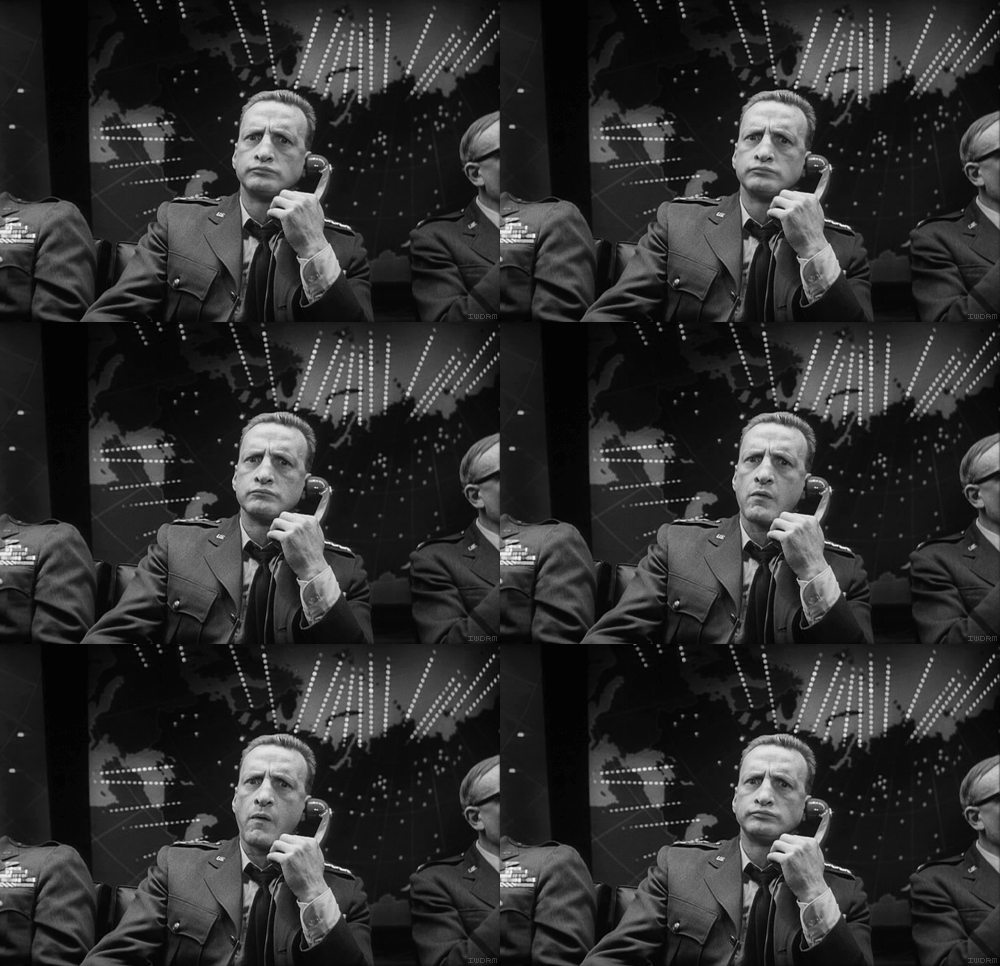
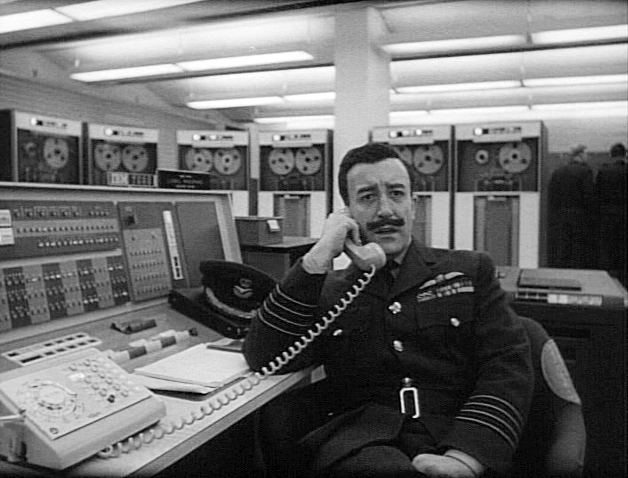
  • the comedic stylings of Peter Sellers (who plays the roles of Group Captain Lionel Mandrake (RAF), President Merkin Muffley and  nuclear scientist Dr. Strangelove), George C. Scott, who plays the quintessential All-American boy grown up to be a Cold Warrior, General Buck Turgidson, and Slim Pickens, as rustic B-52 pilot Major "King" Kong
  • the many lines of the script that I cannot get out of my head.  I think about this movie all the time, and I am glad to be able to talk about it with you tonight.

When the movie premiered in 1964 (it's original debut at Christmas 1963 was delayed after the murder of President Kennedy) my father was an Airman First Class stationed at a U.S. Air Force base in England.  As a child I always enjoyed playing with his old uniform, and seeing people on screen wearing those exact clothes was quite interesting; it made me empathize with the Air Force personnel in the film who die defending Burpleson Air Force Base from the Army.  

The Air Force personnel shown in the movie are either boringly competent functionaries (like the crew of the B-52), paranoid crazies, or both.  Scott's characterization of Turgidson is a tour-de-force.  Famous critic Roger Ebert has praised the performance as "the funniest thing in the movie, better even than the inspired triple performance by Peter Sellers or the nutjob general played by Sterling Hayden." Ebert notes that he was especially impressed by the "tics and twitches, the grimaces and eybrow archings, the sardonic smiles and gum chewing..."  that help us understand the kind of man Gen. Turgidson is.  From the first moment we see him, in the midst of an evening tryst with his secretary (played by Tracy Reed, whose Playboy centerfold was being ogled by Major Kong during his  first appearance on screen) it is obvious that he is all id, and that his lack of impulse control is a foreshadowing of his lack of control over the Air Force.  

It is somewhat interesting that each of the Air Force officers featured in the movie are preoccupied with sex.  From the aptly named "Buck Turgidson", to girlie-mag loving Maj. Kong who notes that with "...one issue of prophylactics; three lipsticks; three pair of nylon stockings. Shoot, a fella' could have a pretty good weekend in Vegas ..." to the sexually impotent General Jack D. Ripper, who blames his failure to perform in bed to a "post-war Commie conspiracy" to weaken Americans' "essence" through fluoridation of the water supply.  The movie seems intent on pointing out the psycho-sexual import of the Air Force, especially considering the opening credits, which is about as explicit a sex scene as you could get in 1964: 


******************************************************************
Mid-20th century technology plays a vital role in the movie, advancing the storyline inexorably until the world faces nuclear annihilation via computer (with, perhaps, a potential survival plan that also relies on computers to choose "survivors" based on, among other factors, "sexual fertility").  But technologies like radar, jet aircraft, and the "Big Board" in the War Room are also important.  Watching the movie again recently surprised me that so many key moments of the movie involve a character talking into the phone!  Mandrake's lack of a dime to call Washington and call back the bombers is funny as well as an historical anachronism that many young people (who carry phones in their pockets) might not appreciate.  My favorite is when the effete President Merkin Muffley (a "merkin" is a wig for the pubic region that actors wear during nude scenes) has to brief the drunk, womanizing Soviet Premier Kissoff.  This scene is  a clear take off on the then-current comic routines of Bob Newhart, whose stand-up comedy consisted of listening to one side of a phone call.


Speaking of anachronisms, to young people watching the movie today, it may be hard to relate to the oppressive air of doom that hung over the world during the Cold War.  In his inaugural address, President Kennedy referred to the "uncertain balance of terror that stays the hand of mankind's final war".  Everyone was certain that a nuclear war between the U.S. and the U.S.S.R. was inevitable and that the deterrence which was based on the doctrine of Mutually Assured Destruction would ultimately fail.  Of course in the movie, it doesn't so much fail, as get carried out to it's most logical conclusion.  During the 1960's,  soldiers like my father were issued these "pocket computers" that would calculate the  yield and destructive force of a nuclear attack--they were also given out as part of the presskit for Dr. Strangelove. Young people were taught to take shelter under schooldesks or in doorways when a surprise attack occurred. And during the 1960 election, voters were warned of a growing "missile gap", where the Soviets were building significantly more nuclear missiles than the U.S. (in actuality, the American arsenal outnumbered the Soviets' by 17 to 1).  1960's era worries about "gaps" (like the missile gap, the generation gap and later the credibility gap) definitely informed the black humor of the final scene, when a desperate Gen. Turgidson berates President Muffley over a putative "mineshaft gap" 100 years in the future.

******************************************************************
I have incorporated many lines of dialogue from this movie into my daily life.  Some are merely references, such as when I speak the word "computer" in a Dr. Strangelove accent.  Or, referencing the scene where Gen. Ripper is shooting an M-60 at the Army assault team and he asks his British attache to give him ammunition;  when I am very hungry I will appropriate the line "Feed me, Mandrake".  Then there are the quotes, such as when I got out of bed after my recent back surgery, and said "Mein Fuhrer!  I can walk!"  Similarly, I cannot drive in the direction of the Northeast Extension past Geisinger Hospital without hearing Slim Pickens' vow to "get them [bomb bay] doors open if it harelips everyone on Bear Creek".   By all accounts, the screenplay (which is credited to Kubrick, Terry Southern and Peter George (who wrote the book upon which the movie is based) was augmented quite a bit by ad-libs from the actors.  Regardless of who is responsible for what, it is a very well written film.

******************************************************************


  •  My first question to you tonight is: did you find the movie funny?  If so, what parts, and why?  Or if not, why not?
 "I found myself at the edge of tears as I watched a series of nuclear explosions fill the screen, and heard a sweet female voice singing 'We'll meet again/ don't know where, don't know when/ but I know we'll meet again some sunny day.'...Was I sad that the movie's world was ending?  Was I having an attack of hysterics brought on by the film's repeated and stunning outrages?  Or had I suddenly arrived after prolonged laughter at a glimpse of some awful truth?"  
What do you think of the ending of the movie?  Is it sad?  Is it a "good" ending, or do you find it anti-climactic?
  • Next question:  reaction to the movie in 1964 was often very critical.  The New York Times printed a letter to the editor saying "Dr. Strangelove is straight propaganda, and dangerous propaganda at that.  It is an anti-American tract unmatched in invective by even our declared enemies."  Another letter added that the film "indulges in the most insidious and highly dangerous form of public opinion tampering concerning a vital sector of our national life...which needs public funds, public understanding and public support to do its job."  Even the official reviewer for the Times worried that the movie was "a bit too contemptuous of our defense establishment for my comfort and taste."  Were these people right or wrong?  Was the movie "anti-American"?  Did it weaken the country's defenses by showing incompetents and buffoons in high places?  Did it show a lack of respect toward the people in charge?  
  • The Washington Post's review made a fascinating remark.  Writing on January 30, 1964, Robert Estabrook noted:
President Kennedy saw Dr. Strangelove shortly before his death, and it would be interesting to know his full reaction.  Perhaps Mr. Kubrick accomplishes his objective in getting people talking.  But it is worth asking what constructive purpose there is in exaggerating a complex problem so as to portray men who have served the free world well as a bunch of irrational simpletons.
What do you think JFK would have thought about this, coming only a year or so after the Cuban Missile Crisis, and the disputes that led to the erection of the Berlin Wall?  And is it wrong to poke fun at people in positions of responsibility?

  • There is definitely a lot of exaggeration in the movie, from Dr. Strangelove's mysterious disability, to Mandrake's stiff upper lip.  But according to Kubrick in an article in the Los Angeles Times, 
"I kept coming up with things and found myself saying I can't do this, people will laugh at it.  But by being realistic...it shows that the leaders are just human beings subject to the same banalities and absurdities as the rest of us. 
I found it good to nurture this to achieve what I call nightmare comedy.  This was the tone that fit the situation--the state of the world.  Very few of the laughs are jokes.  I think people laugh at a sudden sense---perhaps the truth--of what you might call the human equation.  
It's a brink of doom situation and they're confronted with the same elements of everyday life.  You suddenly realize the folly of man..." 
Do you think that Kubrick was serious about making a "realistic" movie?

  • Despite the negative reviews, the film set box office records when it came out, and it was nominated for Best Picture, Best Director, and Best Adapted Screenplay at the 1964 Academy Awards (Peter Sellers was also nominated for Best Actor). It is also listed in the "Top 100 Films" by filmsite.org.   Do you think that the film deserved these nominations?  Is it a "great film"?  If so, why?  If not, why not?

When the crew receives the fatal plan of attack, the traditional battle hymn "When Johnny Comes Marching Home" rings majestically in the background as homage to the misguided soldiers.  This sonorous brass fanfare provides the only background music in the entire film, highlighting the heroic qualities of courage and loyalty that the crew demonstrates...[t]he music absolves these characters...Kubrick presents them not as culprits but as victims of an irony beyond their ability to comprehend.
Pretty deep stuff.  What do you think?  Was the air crew heroic?  Or were they to blame for the destruction they (unwittingly, thanks to the Doomsday device) unleashed?


  • One thing that many observers point out about the movie is the sexual connotations of character's names.  According to our friends at filmsite.org, this includes the following:
Character Name
Sexual Connotation or Reference
Actor
Jack D. Rippera notorious English psychopathic killer of prostitutes, or a killer in generalSterling Hayden
Mandrakea medicinal plant root or herb, said to encourage fertility, conception or potency - an aphrodisiacPeter Sellers
Buck Turgidsona "buck" is a male animal or stud; "turgid" means distended or swollen; and his delayed love-making to a real-life Playboy centerfold Tracy Reed - theonly woman in the entire filmGeorge C. Scott
Merkin Muffleymerkin = slang for female pubic area or pudendum; muff = a woman's pubic area or genitalia, or specifically, the pubic hair/fur/wig for the female crotchPeter Sellers
Col. 'Bat' Guanobat excrementKeenan Wynn
Soviet premier Dmitri Kissof"kiss-off", literally means 'start of disaster', or to dump or scornVoice only
Ambassador Desadeskinamed after the Marquis de Sade - an infamous and perverted sexual lover and sadist in the 18th century (sade-ism)Peter Bull
Maj. T.J. "King" Kongsignifying a male beast with a primitive, destructive, obsessive lustSlim Pickens
Dr. Strange-loveperverted lovePeter Sellers
The bombsInscribed with "Dear John" and "Hi There"
Do you think that these names were chosen consciously to make a point, or do you think it was just the writers horsing around?

  • In a review of the film from 1965, Tony Macklin stated that "Dr. Strangelove is a sex allegory: from foreplay to explosion in the mechanized world."  He lists examples ranging from Gen. Ripper's "phallic" cigar and machine gun to the "womb-like" War Room, to the "mechanized" Dr. Strangelove, "whose name captures the essence of the film".  He closes the review by writing:
The film concludes with a panorama of beautiful mushroom clouds destroying the world, as Vera Lynn sweetly sings 'We'll Meet Again'.  Impotence is no more.  Warped sex has been erased.  Civilization can go back to its beginnings.  Dr. Strangelove...ends in an orgiastic purgation.  Kauffmann says 'This film says ...the real Doomsday Machine is men'.  Actually, the real Doomsday Machine is sex.  As King Kong, Buck Turgidson, and Dr. Strangelove himself would chorus, 'What a Way to Go!'  Love that bomb.
Do you agree that the the film is an allegory? If so, why?  If not, why not?

  • The director of photography (cinematographer) for the movie was Gilbert Taylor, who among other films also shot Star Wars, The Omen, and several episodes of The Avengers.  But most intriguing to me is that he also shot the Beatles' first film, A Hard Days' Night, which has several things in common with this movie (shot in England, in black and white, directed by an American, with lots of ad libbed dialogue).  When I learned this connection it instantly clicked.  I encourage you to watch AHDN and see how similar the "look" of the film is--there is definitely a "Gilbert Taylor touch" at work. 
  • Susan Sontag reviewed the movie upon its release and wrote that "intellectuals and adolescents both love it. But the 16-year olds who are lining up to see it understand the film and its real virtues, better than the intellectuals, who vastly overpraise it." Jeremy Boxen, in "Just What The Doctor Ordered: Cold War Purging, Political Dissent and the Right Hand of Dr. Strangelove",  goes on to write:
In the later part of the decade, these 16-year olds would become the university students who dominated the movement of political protest and counter-culture lifestyle that resulted in the large, anti-war demonstrations in New York, Chicago and Washington.  500,000 of these young adults would turn up at the Woodstock concert in 1969, which was as much of a defining event of the late 1960's as the Vietnam protest in Washington, occurring a few months later in the same year and drawing the same number of people. As much as any film can claim to influence a society, 'Dr. Strangelove' helped to fuel a generation of dissent.
Do you think this is true?  Was this film's jaundiced look at authority and America's armed forces  a catalyst for the youth movement of the 1960's?

Tuesday, September 4, 2012

My Tip to the Democrats...

So tonight is the first night of the quadrennial multi-day event known as the Laff-A-Lympics Democratic National Convention.  In typical fashion, the mistakes began well before the convention ever started---by scheduling the convention of the party of labor in a "right to work" state, with the lowest labor union membership in the nation.  Anyway, in the spirit of generosity for which I am known, I would like to offer some suggestions to the Democrats for how they can best carry out a successful convention.

Please understand that this is offered in a spirit of non-partisanship.  I am not a member of, nor do I affiliate with, either the Democratic or the Republican parties (isn't it interesting that the Democratic web domain is .org, and the Republican is .com?) But out of concern for the common weal, I have a simple suggestion.

To have the best possible result from this week's convention, the Democrats should tell the truth.  All the time.  And nothing but the truth.  Now obviously, "truth" is a somewhat subjective thing.  Sometimes, people can have reasonable disagreements about what is true.  But other things are objectively true such as the declining number of business bankruptcies over the last two years, despite the claim by Rep. Ryan that there were over 1 million.  Similarly, it is commonplace to accept the idea that politicians lie all the time. And whether the lie is actively spoken, such as  "I did not have sexual relations with that woman, Ms. Lewinsky", or merely a result of giving a speech in front of a misleading "Mission Accomplished" sign, it is still a lie.

And I suspect that the widespread belief that politicians lie is a major reason for the low turnout at elections.  If that is true, it stands to reason that it might help some politicians separate themselves from the herd if they simply told the truth.

And after last week's Republican Convention, that would be even more dramatic.  Talk is widespread that several speakers, particularly Rep. Ryan lied brazenly and shamelessly without any concern for the truth. And certainly several of Gov. Romney's standard stump speech claims (such as the totally false charge that President Obama "apologized for America") would fit into that category.

A way for the Democrats to differentiate themselves would be to tell the truth this week.  Now that might be difficult, and it will probably require people to re-write their speeches.  But it should be done.  Sometimes the truth may not be flattering, such as the Administration's patently illegal and unconstitutional position that the President can authorize the murder of American citizens, or the unemployment numbers.


But it is important that they hew to the truth unconditionally.  Because all it will take is one over-exuberant , not quite factual speech from Vice-President Biden to bring the media back into the false equivalency fallacy that one lie by one party is equal to many lies by another, so it is not important to focus on lies.   While it will take superhuman continence, if the Democrats can just tell the truth for 3 days, they may be able to earn the right to lie to us for the next four years.  Are they up to the challenge?  Time will tell...

Friday, July 27, 2012

Incredibly Stupid Letters to the Editor #1: Dream Team Nightmare

I have been planning this series of occasional blog posts for some time now.  My local newspaper, the Citizens' Voice of Wilkes-Barre, PA often features very silly letters to the editors.  In fact, I had planned that they would provide the source material for the inaugural post in this series until I read something incredibly stupid in the July 30, 2012 issue of Sports Illustrated.  

Earlier in the month, SI ran a very interesting article about the 1992 United States Men's Olympic Basketball team, otherwise known as the "Dream Team".  This was this first Olympics when NBA players were allowed to compete, and the Dream Team dominated the Barcelona Olympics.  In this week's issue, SI ran the following incredibly stupid letter to the editor:

What Could've Been
With all the hype over the 20th anniversary of the Dream Team, most fans are forgetting that there were two squads, the Soviet Union and Yugoslavia, that could have given the Dream Team a run for its money had their countries not dissolved just before the Barcelona Games.  The Soviets were the defending gold medalist from the 1988 Games, and Yugoslavia was the '90 FIBA  world champion.  It is a tragedy that colossal matchups among the three basketball superpowers never occurred in '92.
                                                     C. Fred Bergsten, Annandale, VA

If you just read the letter, I am sure that you can spot the stupidity:  essentially Mr. Bergsten is upset that the Iron Curtain fell because it cost him the chance to watch a basketball game.   Hey, any sports fan can relate to a certain degree.  I mean, what baseball fan wouldn't want to have the chance to see Ty Cobb bat against Roger Clemens?  What devotee of the sweet science wouldn't want to see how Joe Louis would handle himself against Mike Tyson?  But of course, this is impossible because time travel doesn't exist.  


On the other hand, Mr. Bergsten is not wishing for the chance to see long dead legends compete against modern stars; instead, he thinks it is a "tragedy" that the USSR couldn't put together a basketball team in 1992.  Most normal people would think it was a "tragedy" that the USSR was a communist, totalitarian state that jailed, persecuted and killed millions of its citizens in its seven decades of existence.  Most normal people would think that the end of the USSR was a victory for freedom and human rights, as well as the end of the Cold War that had forced the world to live under the threat of global thermonuclear war since the 1950's.

But C. Fred Bergsten is not "normal people".  I don't say this because I am trying to score cheap rhetorical points on a benighted basketball fan.  No.  This guy is actually a famous famous man.  In fact, I have given him short shrift above--I should have called him "Dr. Bergsten".

According to our friends at Wikipedia, there is a C. Fred Bergsten who "is an American economist, author, and political adviser. He has served as Assistant Secretary for International Affairs at the U.S. Treasury Department and has been director of the Peterson Institute for International Economics, formerly the Institute for International Economics, since its founding in 1981. In addition to his academic work he makes his opinions known to the policy making community and engages with the public with television appearances writing for influential periodicals such as Foreign Affairs magazine and by writing books."  That is pretty interesting, but there is no way that THIS C. Fred Bergsten could possibly be the person who wrote our incredibly stupid letter to the editor, right?

So then I used Google to search for "C. Fred Bergsten" and "Annandale".  It seems that there is a Mrs. Virginia Wood Bergsten who lives in Annandale with her husband Dr. C. Fred Bergsten.  That was confirmed in the Wikipedia entry.  And there seems to only be one C. Bergsten in Annandale, who lives in a very nice brick house built in 1964.  According to the Petersen Institute website, Dr. Bergsten "was the most widely quoted think-tank economist in the world during 1997–2005 ".  He is a prolific author as well.  But nowhere does it mention that this man, who "during 1969–71, starting at age 27...coordinated US foreign economic policy in the White House as assistant for international economic affairs to Dr. Henry Kissinger at the National Security Council." was sorry to see the end of the Soviet Union.  

Dr. Bergsten is still in the news, including a nice article in the recent edition of Foreign Policy, in which the  "éminence grise in the world of international political economics" complains that "[t]he problem is that the individuals who are at the top of the foreign-policy hierarchy, both at State and at the National Security Council, tend to be less than sophisticated, shall we say, about economic issues."  But fortunately these unsophisticated, naïve buffoons can turn to Dr. Bergsten.  Because there certainly has never been a more sophisticated analysis of the geopolitics of the Cold War than this:

It is a tragedy that colossal matchups among the three basketball superpowers never occurred in '92.
                                                     C. Fred Bergsten, Annandale, VA


Monday, July 23, 2012

Vacation--Gotta Get Away (NCAA remix)

As I write this (almost 1:00 PM on July 23), the NCAA penalties to Penn State's football program have been blowing up the Twitterverse and the rest of the interwebs.  A Google search turns up over 200,000 hits for "Penn State" and NCAA in just the past 24 hours.  Three of the top trending topics on Twitter are "Penn State", "PSU" and "NCAA".


There is little need to recap the events that led up to this, including the firing of the University's President, Vice-President, Athletic Director and legendary football coach Joe Paterno (who died shortly after from lung cancer) and the precipitating events, which were the decades of repeated cases of sexual abuse committed by assistant coach Jerry Sandusky (recently convicted and facing centuries in prison).   The full details of the penalties are rather striking:  Penn State will lose 20 scholarships over the next four years.  During that time they will be on probation, which means that they cannot play in bowl games (even totally meaningless ones) during that time.  In addition the Big 10 conference (of which PSU was the 11th member) will withhold bowl revenue during the four years (estimated to be about $13 million).   The university is also required to contribute $60 million (estimated to be one year's normal football revenue) to charities dealing with prevention of child sexual abuse (the Big 10 money will go to that cause as well).    It will be a small victory if the scandals at Penn State can help prevent future cases of child abuse and exploitation.


But what is getting the most attention today is the other part of the sanctions:  specifically, every game Penn State won from the time Paterno, et al first ignored Sandusky's actions until Paterno's death will have the outcome retroactively overturned.  Penn State will "vacate" all of their victories between 1998-2011.


While some people are mostly hot and bothered because this means that Paterno will no longer officially be the winningest college football coach (welcome back on top, Eddie Robinson!), I am disturbed by something else:  the idea of revisionist history.


Ever since I read 1984 back in 1983 (I wanted to be prepared), I have been struck by the idea of "doublethink".  Why people ranging from the leadership of totalitarian Communist states to the leadership of an intercollegiate athletic oversight organization can't understand that there is no such thing as a "memory hole" is beyond me.  Because here is the thing:  saying something is true ("We have always been at war with Eastasia"; "Penn State was winless for 15 years") doesn't make it true.


The NCAA seems to use this punishment often.  Whether the sport is basketball, football, or even less popular activities such as volleyball, this penalty has been used to show the ultimate repudiation of a coach's actions (or inactions) in the case of impermissible activities (illegal or otherwise).  And in some cases, it has been used to remove an award, as happened in 2010 to 2005 Heisman Trophy winner Reggie Bush.  Bush had violated some NCAA rules and so he was retroactively denied the award he justifiably won for being the outstanding college football player of the year. 


The problem with this is that everyone remembers the truth.  We KNOW that Penn State won those games, just like we know who won the Heisman.  And it is not like the teams that lost to Penn State will suddenly feel vindicated for their bad Saturday afternoons.  Heck, Vince Young (runner up in the 2005 Heisman votes) is well regarded as one of the dumbest football players ever, and even he knows what's what.


As a history teacher, this really concerns me.  I spend a lot of time teaching students to research using old newspapers and magazines.  As time has moved on, I have had to incorporate teaching how to assess other primary sources, such as web pages.  There are countless (as in, the number is too high to count) sources that refer to results of games, records, and other events that the NCAA would now have us believe never happened, or that the result was the opposite.  And there is no Ministry of Truth to expunge our records, and thus our memories.  How will people of the future reconcile the "new" record books with the "real" records of events?


I am not the first person to write about this, of course.  The following are just a few other examples:


"The Theory and Practice of Vacating Games" tries to explain the rationale behind this punishment.  The key quote is "The Division I Manual allows for the result of a game to be changed after the fact."

"If NCAA Violator's Victories Are Vacated, Did They Really Happen?" in which the writer (from the Bradenton, Florida Herald) notes somewhat alarmingly that "The NCAA is on a “vacate” rampage, and it has put a stranglehold on America."  He also raises an interesting point: "You wake up and the wins are vacated. It creates another dilemma; does that mean your bookie gives you 48 hours to make good on what you owe him?"

In "Vacating Wins: An Empty Punishment" the writer notes that in many cases people and institutions ignore the punishment.  Referring to the University of Massachusetts basketball program once led by John Calipari (who takes a lot of vacations) he observes: "Because of [Marcus] Camby’s “dealings” with an agent during his time in Amherst, Mass., the NCAA vacated UMass’ men’s basketball 1996 Final Four appearance. They also asked the school to remove the banner that commemorated the event, but UMass declined. If you go to the Mullins Center today, you will see a banner in honor of the 1996 Final Four run. This banner serves as a constant reminder of the ineffectual nature of the NCAA’s enforcement of its own rules."

The New York Times  weighed in on this topic a year ago in their article "NCAA Penalties Erase Records, Not Memories".  They mention USC's response to the Reggie Bush scandal in a way that sounds like they are looking for a memory hole: "Beyond that, all references at U.S.C. to Bush had to be removed. The university returned its copy of his Heisman Trophy, took down his jersey from display and even changed the wallpaper that featured Bush and other Trojans. “We’re not trying to erase history,” Tessalone said. “We’re trying to notate history. It’s appropriate. And it’s confusing. We had to vacate our appearance in the B.C.S. title game. In essence, we never lost to Texas.”

And then this morning, Forbes opined "On The Absurdity of Vacating Penn State's Wins".   Their author complained that  "The NCAA doesn’t like to treat anyone like an adult. Yes, Joe Paterno turned out to be a really bad person. But he won more games than any college coach in history. That’s a fact.Barry Bonds holds both the all-time and single season home run records in baseball. That’s a fact.We might not like either fact. But we should also be treated as mature and adult enough to be able to discern on our own the difference between sports heroes and villains."
Sigh. It is enough to make me want to take a vacation.