Showing posts with label Eric Clapton. Show all posts

Saturday, September 1, 2018

My Back Pages: Thirty Years Ago in Guitar Player (August 1988)


Welcome back to "30 Years Ago", where I take a close look at the issue of Guitar Player magazine from exactly thirty years prior to discuss what I gleaned from the issue at the time and what I learned from re-reading it so many decades later. I also provide a Spotify playlist that includes music that was mentioned in the month's issue. Click here to see all of the previous posts!


August 1988 was the last month I spent at home before moving to college where my life changed forever. I still spent my time working at a Caldor store in Warminster, PA and nervously throwing up whenever I dwelled too much on the thought of moving away for the first time. Music wise I continued my lessons with Jim McCarthy, was still listening to a mix of jazz and rock on Philadelphia radio, and practicing with my Epiphone Sheraton. By then I also had an acoustic Fender Avalon (a parlor sized, cherry red guitar with a Strat style headstock) along with my Peavey T-15. That's right: even at this stage of my life I had too many guitars for someone with too little talent to justify!


The August, 1988 issue of Guitar Player is a typical for the time diverse mix, which I'm sure I devoured the first time, but re-reading it now I found much of it boring.  The articles in this issue touch on Eric Clapton, the process involved in making the 6-LP Crossroads set, a photo-essay of rare classical guitars, an article about Norteno guitarist Lydia Mendoza and features on bassist Stu Hamm, Nashville guitar stalwart Fred Newell, more complex details about chord progressions and a primer on "copyright for guitarists".  There was also a very interesting article about the Fender "Nocaster" that is very complete.


******************

The July issue marked the first of two straight months of heavy Eric Clapton coverage and this month's cover story was actually two articles about Slowhand (and they gave away a signed Clapton signature Strat to boot). As I noted last month, I found a Spotify playlist that includes almost all of the content of the box set if you want to check it out. 


As I wrote last month "In 1988, Eric Clapton was 43 (five years younger than I am now). To teenage me, he was a contemporary musician with lots of great stuff in his back catalog, but it's interesting to see how the writers at Guitar Player (in this, and other articles) treat him as an old man. Think of all that he had yet to accomplish/experience: sobriety, the death of his young son, huge pop stardom with his Unplugged record, 10 more studio albums including multiple excellent "all blues" albums, three "Crossroads Guitar Festivals", happy marriage and the birth of three daughters and the sale of hundreds of instruments and memorabilia to fund his Crossroads 12 Step Treatment center in Antigua."  This month's issue continues to treat Clapton as an elder statesman, but does do him the credit of asking about future plans. 

The "Clapton At The Crossroads" interview with Dan Forte (who had been rather negative about the box set in the previous month's issue) was mostly focused on the box set and the August issue's special flexidisc "soundpage", a live version of Derek and the Dominoes doing Hendrix' "Little Wing" shortly after Jimi's death. You can hear this version on the soundtrack to the Clapton documentary "Life In 12 Bars" and is in this month's playlist below. 

Clapton has always seemed to be a very reflective man who is aware of his stature in music and on the debts he owes to others. This comes through loud and clear in the interview which covers four pages of the magazine. Here are some noteworthy highlights:


With [Crossroads] doing so well on the charts and there being so much interest in it, does it create a situation where you're in essence competing with your past?
 In a way, but I always was. Ever since I got through the Layla period, I was always aware that I had a lot of ground to cover, to make up for the vitality that was there in those days. So I've always had that problem in certain degrees...
Of all Hendrix' songs, why did you choose to cover "Little Wing"?
It just had such a powerful atmosphere. There was something very magical for me on his albums. I always went for the more dreamy things--as opposed to the more bluesy or heavy R&B or rock things. I found that his lyricism when he was writing ballads, like "Wind Cries Mary" or "Little Wing" was so different, in a way, that it was powerfully attractive to me. And I realized that those songs could be done by other people too; you didn't need to be the wizard that he was in order to play the song itself. Those songs in fact were much more structured than some of his other things, and more melodic too. As you know, Sting did "Little Wing" as well. The song itself, because of the way it was written, stands up so well--so anyone could do it. In a way, the song was more important to me than who did it, actually. I think that was what it was.
After Hendrix died, was it different performing that song live? 
It's pretty hard for me to remember how I was feeling, but knowing the way my attitude was, I mean, I shut off my emotions towards Jimi, in a way, because it was such a devastation for me after he died. If I was doing the song now, I imagine I would try to detach from the memory of it, because it would simply be too over-emotional to perform with Jimi's image in my head at the time. There's times when that can just distract you beyond belief. So I was probably doing it in as objective a way as I could. But that's not to say that it wasn't an emotional experience.
On [your last] tour you went back to being the only guitarist in the group. What prompted the return to solitary guitarist? 
Well, I find that sometimes I get very uptight around other guitar players. If they're younger than me, they're either in awe, or they have an attitude before they start, you know, which I have to kind of try to break down. Sometimes it means that they're going to be flying all my old licks at me, or kind of making me too aware of my past, and we get stuck with that. The only time this hasn't happened has been when I've worked with Mark Knopfler. Although he's very appreciative of what I've done, he's kind of a forward-looking guy and we're about the same age, so there's no competitiveness or anything like that. So we work very well together, and I think he'll probably be very much involved with what I'm doing from here on in--up to a point, anyway. 
Did you decide to retire your old Stratocaster, Blackie? Was that the reason for the switch to the Eric Clapton Signature Model Strat?
Yes. I was worried that if something happened to Blackie, I'd be out on a limb, you know. I mean, it's still playable, although not comfortably so. It's got a great character--the guitar itself is really a character--and it worried me, taking it around on the road. It just seemed to be unfair; it's like taking a very old man and expecting him to do the impossible every night [laughs]. So it was Fender's Dan Smith's idea to copy Blackie as closely as we could and update it with a little bit of electronic work, to give it a fatter sound, if I wanted it. Which is what one of the knobs does: it gives you a kind of graduation in compression. They duplicated the way Blackie felt, so I would have two or three Blackies, in effect.
The guitar that came to be called Blackie was pieced together from various Strats, right?
Yeah, a very kind of mongrel thing. I bought about five Strats in Nashville, in about 1969 or 1970, and built Blackie out of all of the best components of each guitar. So Blackie in itself was a hybrid, and now these new ones are copies of that hybrid. 
Do you still feel like you're at a crossroads?  
 Well, it's definitely not behind me. It's something I can see on the horizon all the time. There's always an option for me that's very tempting to take, whether it be shall I go on touring or shall I go into films, or shall I stay married or shall I run around. There's always kind of different avenues that are very tempting to me, and I don't think I'll ever get across the crossroads; it's always standing right there in front of me, you know.
 ******************
Back in the 80's cable tv's The Nashville Network (TNN) had lots of live music, including a daily talk show which featured live performances, called Nashville Now. I watched the show every night just to get exposed to country music (which wasn't easily available in Philadelphia) and I couldn't miss the house band's guitarist, Fred Newell. 


As was often the case with Guitar Player's interviews with top session men, Newell's interview shows how important professional networking and hard work were (and still are), especially in a time before any hot player could become a YouTube celebrity. 

Newell worked for Waylon Jennings playing steel licks on his Tele, which led to lengthy sideman gigs with Tompall Glaser, Lynn Anderson and Jerry Reed. Newell describes getting a big break as a studio musician with the "simple but ballsy" intro to "Heaven Is Just A Sin Away", by the Kendalls in 1977. 
"I've got to give credit where it's due. The producer, Brian Fisher, said 'I want you to do something on the low strings. I want that kind of sound.' Heck, I'd always thought that when you take a solo, you wanted to burn it up on the high end. Up until then I'd played a lot of different kinds of music, but I didn't really have a distinct style of my own, and Nashville hires stylists. He helped me develop a recognizable style."
 The description of Newell's role in the Nashville Now band is another great glimpse of life at the highest level of professionalism, and I think it's worth quoting from extensively:
Fred's official role is electric lead guitarist, doubling on harmonica when needed. The band also includes three other guitarists, John Clausi, who doubles on acoustic guitar and banjo, Larry "Wimpy" Sasser, who doubles on steel and dobro, and Hubert "Hoot" Hester, who plays acoustic rhythm guitar, mandolin and fiddle. Each member of the 13 piece band, which includes four backup singers was hired for versatility and steely nerves.
"It's a high-pressure situation," admits Fred. "Playing live really spooked me for about a month after we started the show. I'd done a lot of videotaped TV shows over the years, and that was pressure enough. But at least it could be done over if there was a real trainwreck. Finally I decided I just had to get in there, go for the throat, and let the chips fall as they may. You just try to do the best you can and stay ready to shift gears real quick. Sometimes singers will come in halfway through a turnaround and you have to go with them. We always try to make the artist sound and look good--that's what we're there for."
Nashville number charts for each tune are usually ready when the band begins rehearsal. These charts, which employ scale numbers to represent chords, are often quite detailed, and the musicians each add their own individual notes to them. "First they play a tape or record of the tune, and we make notations as we go. Parts are left up to the individual musician, but we usually try to get as close as we can to what's on the record. That's what the artist and audience is used to hearing. I've got a little tape recorder that I keep handy, and if I've got the intro to the song or have to play a real distinctive fill or lick, I hold the machine out there and tape it. Then I've got a little reminder that I can listen to right before we do the tune."
" I make my own notations on the chart to remind me of things like when and where I want to use effects, what guitar to use, or if I need a special tuning. I've learned to always mark the chart and never take for granted that I'll remember something, because you can make a pretty glaring mistake. It's happened. There's nothing worse than to come to the end of a song and play two extra beats....Having a road map laid out is probably the most important part of preparation for a live show."
"I don't think you can ever totally relax in this business. I practice every day....A lot of times I pick the guitar up at 6:30 in the morning and just start exploring. You have to be creative and figure out new things to do. I'm really open to experimenting with new techniques, and I've been trying to make it a point to learn a new song about every other day. Some days I just work on technique, like working with a thumbpick for an hour or two, just to get back to using it again.
"I enjoy playing music more now than I ever have, just because I have a chance to do so many different things. It's a shame that a person can't live long enough to experience a good career playing every musical style, because it's all so much fun. It's too bad you can't be a good jazz guitarist for 75 years and then be a good country player for the next 50 years and then play rock and roll for another 50 years. That's my idea of a good life."


***********************

Telecaster lovers like to say that "Leo got it right the first time", but this issue's "Rare Bird" article by guitar historian Richard Smith discussed the 1951 Telecaster, and how it evolved through stages from the Broadcaster to the "Nocaster". 

Many guitar aficionados know that Fender's first solidbody electric was called the "Broadcaster", but that the Gretsch company forced them to change the name because Gretsch had a line of drums called "BroadKaster" and didn't want the market to be confused. Of course, it's poetic justice that Fender now owns Gretsch!

Anyway, for a few months "while the attorney for Fender's distributor conducted a trademark search for the Telecaster name", the guitars were sold with the model name clipped off of the headstock decal, as pictured below left. Eventually the guitars became Telecasters, as we know and love them today.

Or not. Because the original Teles had an unusual wiring scheme shown above left in Leo Fender's own writing.  As Smith notes, "The tone control on the earliest two-pickup Fender was actually a blend control; in the lead position, turning the tone control down blended the rhythm pickup with the lead pickup. When the tone control was turned all the way down, both pickups were fully blended. In 1952, Leo changed the wiring, adding a "real" tone control with a capacitor while making the two pickup combination impossible without delicately placing the spring-loaded lever switch between settings, a la the Strat half-switch sound. All Telecasters employed this seldom-used tone control until the mid '60's."

"Why did Fender change the wiring on the first dual-pickup guitars? I asked Leo in 1982 and he didn't remember the original setup, much less why he changed it. But there's a better question more material to the current guitar market: why do collectors pay thousands of dollars more for the size of knobs and what a decal says, rather than for the trait that makes all Broadcasters, Nocasters and the earliest Telecasters essentially the same instrument? In other words, why pay more for a Broadcaster when all the money saved by buying a '51 Tele could go to a good therapist?"

***********************
That's all for this month. I hope you enjoyed it, and that you'll come back for next month's jam packed issue featuring a cover story about Robben Ford. Until then, keep on picking!

Saturday, July 28, 2018

My Back Pages: Thirty Years Ago in Guitar Player (July 1988)


Welcome back to "30 Years Ago", where I take a close look at the issue of Guitar Player magazine from exactly thirty years prior to discuss what I gleaned from the issue at the time and what I learned from re-reading it so many decades later. I also provide a Spotify playlist that includes music that was mentioned in the month's issue. Click here to see all of the previous posts!


UPDATE! If you've been reading the blog for awhile you know that I always refer to my super guitar teacher from the 80's, Jim McCarthy. After I last saw Jim in 1992 I lost track of him, but I finally found him this month! He's alive and well in New Jersey and still playing, which makes me so happy I can't describe it. And now, back to our regularly scheduled programming... 


In July 1988 I was one month away from moving away from home for college, working at a Caldor store in Warminster, PA and nervously throwing up whenever I dwelled too much on the thought of moving away from home for college. Music wise I continued my lessons with Jim, was still listening to a mix of jazz and rock on Philadelphia radio, and practicing with my Epiphone Sheraton. By then I also had an acoustic Fender Avalon (a parlor sized, cherry red guitar with a Strat style headstock) along with my Peavey T-15. That's right: even at this stage of my life I had too many guitars for someone with too little talent to justify!

The July, 1988 issue of Guitar Player is quite a diverse mix: the subjects touch on avant-garde music, jazz bass, modern melodic metal, Eric Clapton's oeuvre, chord theory, and Jerry Garcia's music in and out of the Grateful Dead, plus much, much more. When I re-read this issue I found it to be pretty challenging: Howard Morgen's "All About Chord Progressions" article is still over my head thirty years after I first struggled with it, the weird, wacky music by the avant-garde guitarists is still a turn off, and I've never found Garcia's music to be very compelling. That said, as always, there were quite a few very interesting bits tucked away in the magazine that I look forward to sharing with you. 


******************

The July issue marked the first of two straight months of heavy Eric Clapton coverage (culminating in a cover story in August). This issue's feature was on the new 6 LP box set Crossroads released on Polydor that purported to be a look back at the Clapton's then 25-year long recording career. Clapton was unquestionably my favorite guitar player (heck-favorite musician) at that time, and after devouring this article I was so excited when my sister told me that she'd get the set for me for my upcoming 18th birthday. I got rid of my vinyl records a long time ago, but I transferred them to MP3 first, and I STILL listen to this compilation on a regular basis. I just found a person on Spotify who laboriously recreated almost the whole thing, so you can listen to it too!


In 1988, Eric Clapton was 43 (five years younger than I am now). To teenage me, he was a contemporary musician with lots of great stuff in his back catalog, but it's interesting to see how the writers at Guitar Player (in this, and other articles) treat him as an old man. Think of all that he had yet to accomplish/experience: sobriety, the death of his young son, huge pop stardom with his Unplugged record, 10 more studio albums including multiple excellent "all blues" albums, three "Crossroads Guitar Festivals", happy marriage and the birth of three daughters and the sale of hundreds of instruments and memorabilia to fund his Crossroads 12 Step Treatment center in Antigua. Obviously no one can predict the future, but the occasion of a career retrospective was particularly "backwards looking", and reviewer Dan Forte seems to fall a bit into the tone of people on guitar internet forums who claim that Clapton hit his peak in his 20s.

Forte's review "Eric Clapton 'Crossroads': 25 Years of Genius", notes that "Few if any rock guitarists' work has been analyzed to the degree that Clapton's has, and no guitarist's work could stand up to such intense scrutiny as well." That said, he does see fit to point out what he thinks is the biggest issue of the set (and by extension, of Clapton's career):

The few problems apparent on Crossroads stem from a sort of identity crisis. Just what is this hefty document? Certainly not a "Greatest Hits" collection. Even at his biggest, Clapton's audience could always have been termed a "cult", albeit a huge cult, and he crossed over to mainstream radio infrequently...In the words of Bill Levenson (Executive Producer of the progject), "I just see it as an honest 25-year portrayal. It shows the hits, the misses, the live material--it's a good 25-year documentary. And it was really meant to be an instructional tool, almost."
As someone who has played along to the tracks hundreds of times, I know I've used it for instruction for sure. That said, if you've read Clapton's autobiography (written 20 years after this) or seen the recent Life in 12 Bars documentary (another 10 years later), it's clear that Clapton himself is content to take a scattershot view to his past, emphasizing some points and minimizing others. For better or worse, it's his right to do so, but as something of a Clapton scholar, I really appreciate this collection as a "primary source" of sorts. 

Very 80's, Forte points out that the collection is organized chronologically, but "of course, CD owners can just set their players on 'random' and get a different show with every listening'."  He is also excellent at describing the sonic (and sometimes cultural) impact of the recordings. The following are some of the sharper bits:
"The Yardbirds demos that open the collection are essentially the tentative first steps of a neophyte band attempting to play their newly discovered passion, and as such are not representative of the creative force the band came to be. John Lee Hooker's 'Boom Boom' actually pales by comparison with the Animals' authoritative reading of the same (which is ironic, since Animals guitarist Hilton Valentine has doubtless never been mistaken as the deity)..."
"The primitive 'Lonely Years' and the bouncy "Bernard Jenkins', both duets with John Mayall, were recorded prior to the Blues Breakers sessions. The former shows Clapton's abilities as a seamless accompanist as few tracks in his entire catalog do. On the latter's opening solo, he attacks every note full-force. For a 20-year old Brit, he was anything but intimidated by studio microphones, his elder-statesman bandleader, or the fact that he was crossing the color line with every bend of his Les Paul."
"The next several cuts, unfortunately, illustrate all too clearly the slump that followed Clapton's triumphant return (with 461 Ocean Boulevard). "Better Make It Through Today" is at best one of the few tracks that stands out on the mediocre There's One In Every Crowd; the catatonic stance on Elmore James' cathartic "The Sky is Crying" is more indicative of this 12' dud as is the unreleased "It Hurts Me Too". During this period, Clapton's blues playing merely represented the slower portions of the program, with interchangeable songs, uninspired soloing, and cumbersome backing."
Wow. Tell us how you really feel about '70s Clapton, Dan!
"And finally, the set ends with the newly recorded version of "After Midnight"--yes, the one in the beer commercial. This seems to have been chosen out of convenience more than musical considerations. A more dramatic reprise to end Clapton's history-up-to-now would have been his dynamic reworking of "White Room" at Live Aid--not only dipping back into Cream's catalog, but reinterpreting a song Jack Bruce had originally sung and then leaning into his wah-wah for all he was worth."
"Considering the glitzy sheen of "Miss You" or "After Midnight" it's ironic to recall that this is the same Eric Clapton that forsook pop stardom with the Yardbirds in favor of following a purist's path in search of the spirit of Robert Johnson. Eric Clapton has stood at the crossroads more than once in his 25 years of music making. And so far no one has passed him by." 

I'll get to say more about Clapton in next month's blog post, but I think it is worth pointing out that when he left the Yardbirds to pursue blues purism he was 20 years old and it was only 27 years since the death of Robert Johnson. Rather than holding him up in judgement based on statements he made as a callow youth, I prefer to revel in the wide range of excellent music Eric Clapton has provided us for the last fifty-five years!

 ******************
Back in the day, one of the most educational parts of any issue of Guitar Player was the "Questions" section. Before anyone could look up anything on the internet, the editors took their role as educators very seriously. In the July 1988 issue, one question was "How many guitars were sold in the United States last year, and how many of them were built here?" In 2018, when we are frequently struck by the duality of entry level guitars that are built to ever increasing standards amidst frequent warnings of the imminent death of guitar-based music, the answer is worth looking at:
"According to recently published figures by the American Music Conference, a non-profit association that encourages amateur music participation, 1,247,265 fretted instruments (which includes such instruments as mandolins and banjos) with an estimated retail value (ERV) of $328,322,000 were sold in the United States in 1987. Of that number, only 123,400, with an estimated retail value of $89,280,000 were produced in the United States. Although the AMC is not able to break the domestic figures down by instrument, it is able to do so for imports: 517,300 acoustic guitars ($79,570,000 ERV) and 453,000 electric guitars ($150,642,000 ERV) were shipped to the US last year. These figures represent an 11% increase in imports and a 5% increase in domestic units over 1986 numbers."
Pretty neat. Besides the fact that I think that half of those 453,000 imported guitars are available for sale right now on Reverb, the dollar value of fretted instrument sales would be the equivalent of over $718 million today. I did a little looking and found a "music industry census" online that shows that in 2017, total guitar sales in America were 2,630,950 units with a retail value of $1.07 billion (average price $433). The number of instruments sold was up 6.4% from the prior year and the ERV was up 7%. So while recognizing that America's population has grown from 240+ million to over 325 million in the last thirty years, I find these data reassuring about the current and future state of our instrument.

**********************
Speaking of guitar forums, when people aren't talking about new guitars, a major topic of discussion is always modifications to instruments they already own. Guitar Player's article about New York luthier/repairmen Roger Sadowsky and Jay Black made for a very interesting re-read. According to the article, Sadowsky's clients included:
Bruce Springsteen, Al Di Meola, John Scofield, Will Lee, Prince, John Abercrombie, Nile Rogers, Sting, Paul Simon, Hall and Oates, Joan Jett, Lou Reed, Billy Squier, Jack Wilkins, Jim Hall, Tommy Shaw, Mike Stern, Steve Khan, Tony Levin, Carmine Rojas, Victor Bailey, Joe Beck, Jeff Golub, Bill Frisell, Daryl Jones, T-Bone Wolk, and Neil Jason.
Wow. That's a music hall of fame right there! Sadowsky is still active, and Jay Black went on to work for Fender's Custom Shop for over a decade and has his own business today. They had some pretty interesting points to make about guitar modifications and the difference between New York and L.A. (which always seems to come up in these old magazines!). Once again, in the pre-internet days, it's clear that they viewed their job as providing expert advice to their customers:
"Much of what we do is educate our clients. Often they know what they want, but they don't know how to get there. They're seduced by ads that don't deliver, and they end up wasting money. We evaluate everything that comes on the market and simplify matters by making recommendations." Sadowsky estimates that his business is now divided equally between customizing instruments and producing and selling his own line of guitars and basses.
"Customizing", Roger explains, "means upgrading the level of a guitar's performance. It's been about a decade since guitar customizing became really popular. Companies like Charvel, Schecter, Mighty Mite and DiMarzio came out with replacement parts such as necks, bridges and pickups, which essentially brought a parts mentality to Fender-style guitars. People began looking at guitars or basses as interchangeable parts rather than as an instrument."
"One of the key insights I had was when a client brought in his Strat for extensive work--fret job, new pickups, a bridge, shielding--in all a $500 to $600 job. I remember being surprised at how the instrument wasn't significantly improved after all that work, whereas other guitars I'd done the same things to came out superior. I eventually realized that there is an inherent acoustic quality going on in the instrument, which is a function of the wood. "
Later in the piece, Black notes that "players who buy student-level guitars and hope to improve them through customization are much better off buying a high-quality guitar and making small adjustments. 

Sadowsky implies that one "do-it-all" instrument is more important to working New York musicians "who are dealing with subways and taxis...[they] usually carry one axe and whatever effects fit into the pouches of their gig bags" than to L.A. "studio musicians have cartage to haul their gear around." The article closes with an interesting point that many of us on guitar forums should consider:
"Irving Sloane, who authored several definitive books on guitar construction, once told me, 'Great instruments are not made for the listener, they are made for great musicians.' Most of us have felt, at one time or another, that if we only had different pickups or a certain tremolo system or a better bridge, we would be better players. We naturally prefer to blame our equipment rather than ourselves. Jay and I are just trying to eliminate the instrument as a source of problems, so the musician can focus on his creativity....The magic is in one's hands and soul, not the equipment."
Very thought provoking stuff!


***********************


The cover story on Jerry Garcia is par for the course of late-80's Guitar Player: 17 pages, including transcription of the "Hell in a Bucket" solo and a detailed sidebar feature on his famous guitar gear by Garcia's roadie. As I noted above, I didn't like the Dead as a teenager, and I still don't see the appeal, but there was one thing pretty interesting to me about the article: it's emphasis on a new beginning for the 45-year-old musician who had fallen into a drug-related diabetic coma two years previously. Honestly, it shocked me to see that Garcia was only two years older than Clapton, who was definitely not at his best either (booze and coke wise) because he looked so much older.  The part of the interview focusing on Jerry's recovery from the coma was very interesting:


"Well, I was in the hospital for about three weeks. I had...my Steinberger, and I started to poke around a little bit while I was still in the hospital--but just a little. Then after I got out of the hospital, Merle Saunders and John Khan came up to my house a couple of times a week and made me practice. Merle would bring music and we'd play through the changes of standards and stuff like that. Gradually, I started to pick it up again. At first it was very stiff and mechanical. I could figure things out to a point, but it took a while before I really had a sense of how music worked. I had to kind of reconstruct all that. It was about a three or four month process before I felt I was playing well enough to play in front of somebody. I knew I wasn't playing as well as I remembered that I had been able to..."
So it wasn't really a matter of not playing for three or four weeks. There was actually damage to your memory?
"Oh yeah, I had some damage. The damage part was worse than the three or four weeks...But the blessing of losing hunks of your memory is that you don't get too hung up over what you don't remember, because it's gone. It's not a question of 'what is it I don't remember here? Is it something valuable?' It's gone...Gradually everything sort of came back, but it wasn't without a certain amount of work. I had to do everything at least once to remind my muscles about how something worked. It was the thing of making the connection between mind and muscles, because I hadn't been away from playing for so long that my mind had forgotten. The neuropathways were there and the reason for doing it and why it worked -the intellectual part- was also there, but they were separated. I had to pick them up like, here's a chunk of how music works, over here is a hunk of why I like to play it, and here's a hunk of my muscles knowing this stuff. It was a matter of putting my hands on the guitar and actually playing through tunes and trying to solve the problem of how the structure of each tune works-addressing the whole thing. That's what did it, but it took a while. I'm still in the process of rediscovery. I suddenly go, 'Oh right. Here's a whole area. I remember that year that I worked on this stuff.' It tends to come back in chunks. But like I say, I don't remember what I don't remember. I'm not hung about it, and every time I discover something new, it's delightful."
What an interesting passage! It's really sobering to realize how much of our ability, personality and talents are locked up in our grey matter, and so stories like this, or like Pat Martino's are very inspirational to me.  
***********************
That's all for this month. I hope you enjoyed it, and that you'll come back for next month's cover story Eric Clapton. Until then, keep on picking!

Sunday, April 29, 2018

My Back Pages: Thirty Years Ago in Guitar Player (April 1988)

Welcome back to "30 Years Ago", where I take a close look at the issue of Guitar Player magazine from exactly thirty years prior to discuss what I gleaned from the issue at the time and what I learned from re-reading it so many decades later. I also provide a Spotify playlist that includes music that was mentioned in the month's issue. Click here to see all of the previous posts!

April of 1988 was a big month for me, as it was when I decided to attend Hampshire College in the fall; that was a life-altering decision in many ways, not least of which being that it is where I met my wife! Guitar wise I was continuing my lessons with my GIT trained teacher and learning how to play the blues on my Epiphone Sheraton II, my Peavey T-15 and my Fender Avalon Acoustic. I absorbed music wherever I could, listening to jazz and rock radio in the Philadelphia area, watching MTV, and the Nashville Network on television and reading about music all the time.

The April, 1988 Guitar Player issue really stood out for me as an eye opener. It was where I first learned about slide genius Sonny Landreth (at the time a sideman for John Hiatt, but just beginning his solo career) and fingerstyle jazz titan Tuck Andress (whose first album with his wife Patti Cathcart was released that year) and the cover story with Joe Walsh really stuck with me, along with his "12 Greatest Guitar Solos of All Time" featurette.

I remember being totally amazed by the articles on Landreth (who described his style which involves fretting the guitar behind the slide) and Andress (who famously can simultaneously play independent bass, rhythm and lead lines on his Gibson L5); in fact, I cut out the full page picture of Tuck Andress and added it to my bedroom wall gallery of the greats (along with Clapton, Knopfler, BB King, Carlos Santana and Chuck Berry). To this day, I STILL cannot begin to understand how these musicians manage to do what they do!


The Sonny Landreth article was written by Dan Forte, and does a great job of explaining how the Louisiana slide genius developed his style, and his role playing lead guitar for John Hiatt (a role that had been filled on record by Ry Cooder). Landreth was 37 years old in 1988, so he was far from a novice, but the Hiatt gig and this article really brought him to national prominence. The Spotify playlist below has a live set from around this time, and you can also appreciate his playing on this contemporary video:


It's not always too easy to see in the video, but the behind the slide playing of Sonny Landreth is truly amazing. Now, I've been playing for more than three decades and I can't really even play regular slide guitar, but even so, Landreth blows my mind. The article has a separate pictorial feature showing how Landreth plays certain lines, but for this blog post I'll share a couple of excerpts from the interview where he describes the genesis of his style. It's truly a case of "necessity being the mother of invention", and shows how a gigging musician (with only one guitar) had to come up with clever ideas to be able to play the music he wanted to play.

"Basically, I played slide the conventional way for a while, and then in early '71 I was in a blues band with David Ranson. I was really frustrated because to play minor chords I had to retune the whole guitar to a minor---like in E tuning, lower the G# to a G, which is a really nifty sound.  I still love it and still use it, but at that point I was playing slide on some tunes and regular guitar on others, so to make the transition, I wasn't used to it. Then I found that instead of having to retune, you could stay in open E and just play the three low strings open (E,B,E) and the three high strings with the bottleneck at the 3rd fret (B,D,G) which all together is an Em7 chord. To get the IV chord minor, I'd place the bottleneck at the 8th fret (E,G,C), which implies an Am7 chord.
So I'd been in E tuning, and I'd look and think 'If I could just get this note' [the third string, one fret behind the slide, with the bottleneck at the 12th fret]. So I just ended up pressing it, and presto! I freaked out. It was just out of frustration. I could see the note-there it is- but didn't know how to get to it. Then it was like 'Wow, I never thought of that.'...Then I started thinking, 'Well, there's a lot more notes back there'. Hunt and destroy! I started finding the notes I could play and eventually worked into playing two at a time, chord melodies, minor keys, major 7ths, chord clusters."
One thing that always strikes me when re-reading these articles is how important formal musical training was for so many of the musicians, and Sonny Landreth was no exception. Interestingly, Landreth's musical schooling was not on guitar:
"Trumpet was my academic instrument. I studied it from 5th grade to my two years of college at University of Southwest Louisiana in Lafayette, and by the time I was in college I was also taking piano. I was really fortunate; I had good teachers. Studying trumpet influenced me a lot in the way I play guitar, because I think more like a wind instrument. I phrase like I'm taking a breath. Melody and phrasing have always been the things I'm into. Combining sliding and fretting adds another dimension, in terms of phrasing--and melody too. When you start fretting behind the bar, that's just another dimension. Once I went into that, I never came back. It opened up the door. Harmonically, it opened up so much.
The jazz horn players I grew up listening to emulated the human voice, and that's always appealed to me as a guitar player. There's a vocal quality to their playing--like Louis Armstrong. I didn't start playing guitar until I was 13, and I could never read as well on guitar as I could on trumpet. But the theory I'd had really did help a lot, in terms of the positions and how it all related. I still consider myself a fairly primitive musician; I'm not like these studio players who can just go and read anything. It's a funny thing: on trumpet I could read, but I never could improvise; on guitar I could improvise, but I couldn't read very well. I never had the chops as comfortably on trumpet as I did on guitar. I could never just play from the heart, but I felt an immediate thing on guitar."
Amazing stuff, and if this guy at age 37 considered himself to be a "fairly primitive musician" then at nearly 48 I haven't even figured out how to bang the rocks together!
********** 
Tuck Andress was 35 years old in 1988, with years of professional experience but he was another genius who seemed to emerge fully formed from the pages of Guitar Player to blow my mind. Andress played in a duo with his wife, jazz vocalist Patti Cathcart; their duo was reminiscent of Joe Pass and Ella Fitzgerald, but with a more modern style. I immediately bought the Tuck and Patti album (it's in the playlist below) and was fortunate enough to see them play a concert about a year later (it's one of my most indelible musical memories).  There's a concert video from around this time on YouTube which I've embedded below; I've set it to start before a solo number (because the camera does a great job showing Tuck's hands), but do yourself a favor and watch the whole show--it's so impressive!


The article was titled "A Private Lesson with the Amazing Tuck Andress--Radical Fingerstyle Jazz", and was written in the first person. It covers 14 pages (including several transcriptions), and it is hard for me to explain, but when I first read it, I basically didn't understand anything he was talking about! I mean, he's describing how he plays independent basslines with up and downstrokes of his thumb while playing chord stabs in the middle strings and melodies on the high ones, and I could barely play barre chords at the time! Now, decades later, I'm a pretty competent guitarist, but I STILL find this article baffling. There's no way that my brain works like Tuck's, and I'm ok with that.

That said, one thing that I can take away from this article is the value of practice and of perseverance. He frequently describes his experiences in ways that make clear that he was never far from the instrument (emphasis mine):
I reached the turning point when I realized that I had often been going for ideas at the expense of feel, trying to jam without enough foundation.  So I began to shift my practice away from specific techniques and spontaneous jamming to very carefully worked out patterns designed to give me flexibility while maintaining carefully enforced feel. I began to practice single phrases, such as the one from "Everything's Gonna Be Alright" for hundreds of hours perfecting the feel. Now when I approach a tune that has multiple parts, I start by practicing each element until it feels great. Then I work on each possible pair of parts, until the feel is equally great, no matter how long it takes, and regardless of the weird combinations of techniques required to produce the proper feel. Next, I work on all combinations of three, and depending on the tune, four parts.
Once I attain the correct feel, I work on developing as much freedom as possible. Improvising is particularly dangerous with solo funk grooves, because as soon as you change one element, the whole thing falls apart--just like when an inexperienced player has to start over after losing his place. My solution to this problem is to identify the type of  improvisation I want, and then devise exercises to promote flexibility. Most of these involve alternate versions of the same tune, with one part varied. The rationale for this method is that if you work out enough variations, even if each requires starting from scratch, you'll gradually become freer. 
Once I achieve feel and some freedom with a new part, I often discover that what sounds great at home is hideous in public. For instance, at one time my best solution to a particularly troublesome section of Chaka Khan's "Ain't Nobody" involved an intricate two-handed fingertapped texture, with the four parts (bass, backbeat, sustained keyboard part, and percolator-style muted single-note line) shifting between the two hands as often as every sixteenth-note and my hands crossing over each other several times in the space of two bars.  Combine the complexity of the part with my high action and almost total lack of right-hand fretting experience, and what I got was a piece that depended on everything going right, with no surprises--in other words, certain doom. After blowing it on the gig for several nights, I went back to the drawing board. It took about six such trips to get a solution that actually worked
Where do I start with this? I mean, it's next level stuff, for sure. But while I can't imagine executing Tuck's musical vision, it's inspiring to see him describe multiple public failures ("blowing it on the gig") and his persistence to try to get it right. I think we can all relate to parts we've practiced that didn't work in front of an audience, and seeing the dedication with which Tuck Andress approached mastering his music is amazingly inspirational to me. As you may know, Andress is the uncle of Annie Clark, who is the amazing musician known as St. Vincent. I can only imagine that he was a great inspiration to her, as well.

Update: Tuck Andress wrote back to me on Twitter about this post--he said that he and Patti remembered the gig in the video above, but hadn't seen it before. How neat is that?  By the way, go to the 12:00 mark of the video to catch them doing "Ain't Nobody". Tuck told me (I love saying that!) that the "rap" section is embarrassing, but it's pretty amazing to see him do it, and the audience seemed to dig it.


**********

Joe Walsh was a 41 year old legend when this article was published. Just his work with the James Gang, or his solo records, or his work with the Eagles on Hotel California and The Long Run would have cemented his status. But of course he was also a great friend of other guitarists--it was Walsh who gave Jimmy Page his sunburst Les Paul, and Pete Townshend the Gretsch he used on Who's Next.  Looking back on this three decades later, however, I realize that this article (which was in part promoting his new solo record Got Any Gum?) was not a valedictory piece, but one trying to show that Walsh was a mid-career musician who still had new creativity to share.

Jas Obrecht interviewed Joe Walsh for this cover story, and did his usual excellent job. That said, one thing that does not really come out in the article was Walsh's substance abuse issues. It wasn't until five years after this magazine came out that Joe Walsh achieved sobriety (which he has fortunately maintained ever since). I recently read Stephen Davis' Gold Dust Woman, a biography of Stevie Nicks, and learned that Walsh and Nicks had a long-term relationship in the mid-80's that ended right around the time of this article, in part due to Walsh's drinking. None of that is a part of the article, and maybe it shouldn't have been. But it does make me wonder what else was left unsaid in this interview (and how much that seems judgmental might have been said differently in a different headspace). Here are some highlights, followed by Walsh's description of what he considered to be the 12 greatest guitar solos of all time.

Your soloing is very song-oriented. You always seem to be playing for the song rather than showing off your chops.
Thank you. That's just the way I am. At this point, I am really a musician, besides being a guitar player. I hear a lot of things in a keyboard format. I hear a lot of tones and textures and such. I know I'm known mostly for my guitar work, but in terms of being a musician, there are other vehicles that I am quite capable of playing, and sometimes that ain't guitar. The song tells me what to play.
Do you have advice for people who find themselves overplaying?
Yeah. In my experience, when you're playing in a big hall--a 10,000 seater or something--at some point the flashiness, playing incredibly fast, and being technically capable starts to be a blur.  For example, Albert King can blow Eddie Van Halen off the stage with his amp on standby, even though technically Eddie Van Halen is probably the most overwhelming guitar player alive. You know, Eddie Van Halen can pretty much play circles around anybody existing. But Albert King can blow him away with two notes. I have nothing but respect for Eddie; I can't even comprehend what he does. But why would anybody want to play like that? After two or three solos it's a blur. Heavy metal is one format, and the important thing there is to really kick ass. It takes time, but after a while, you should just settle down and get your intellect out of the way and just let the guitar play itself.
What are your favorite Joe Walsh solos?
I would think the overall guitar work in "Rocky Mountain Way", especially the talk box....Peter Frampton asked me how to use it and he went and got rich with it and never even thanked me....I'm very proud of the guitar work in "Hotel California". I pretty much had to deal with the planning and organization of that. Don Felder brought in the descending chord structure, so I can't say that I had anything to do with writing "Hotel California". I was commissioned as a specialist to arrange the order of the solos--who played what where, who went up high. It was tough figuring out how much momentum we needed compared to what we were going to end up with at the end of the song. When the solos start, it's just here we go, and it goes all the way to the end of the song. Felder is tremendously underrated.
What can you advise struggling musicians?
Get out and play in front of other people. Otherwise, you can end up being a legend in your parents' basement. You could be great rehearsing, but when you get in front of people, you freeze up. You have to find out how to do it and how to fix your own stuff when it breaks.
Was there more of a cameraderie among guitarists back in the '60s than there is today?
Yeah, a little bit more. The way I got to know most of the guitar players was at gigs. We would all be playing, and I would see people regularly because there were three- and four-act shows. But anymore with the economy and all, you don't see people unless you're on the road. Everyone is so darn busy. Back in the '60's the bulk of the jamming was backstage. While someone else was on, we'd get together and jam and warm up. It seems that now people don't get together....One of my bitches with LA is that people don't get together and sing old Beatles songs and work out harmonies and stuff. Everyone has made it and they're very busy or spoiled-rotten session men. 
It's not like the old days, and I miss that a lot. But I do see Townshend and Clapton from time to time, and it's always a pleasure....There's nothing like a good, old, couple-of-guitar-players jam to blow out the cobwebs.
What's the best band lineup you've ever worked with?
The Eagles. That was a fine, fine band. We were a damn good band for awhile. I'm proud of having been a part of that and Hotel California. Besides the royalties and everything, jus the fact that that was a special album for a lot of people on the planet. I feel that I was part of a true band, and that we made a very valid musical statement for the generation that we represent. That makes me feel very good.   


 Finally, as is often the case, reading the "Spotlight" feature on up and coming guitarists and bassists reveals someone I know now when they were just starting out. I've seen Larry Mitchell endorse a bunch of gear over the years, and have enjoyed his music solo and with others without remembering seeing this profile from 1988:


Pretty cool!  I enjoyed re-reading this issue, and I hope you found it interesting. Stay tuned for next month's issue, featuring blues great Albert Collins on the cover--until then, keep on picking!

***********************

Saturday, July 15, 2017

My Back Pages: Thirty Years Ago in Guitar Player Magazine (July 1987)


Welcome back to "30 Years Ago", where I take a close look at the issue of Guitar Player magazine from exactly thirty years prior to discuss what I gleaned from the issue at the time and what I can learn from rereading so many decades later.  I also provide a Spotify playlist that includes music that was mentioned in the month's issue.

Before we start, I'm sad to say that one of the musicians I featured in the June 1987 lookback, South African guitarist Ray Phiri passed away this week. You can read that blog post here on the site, and I urge you to listen to the playlist--the live cuts from Phiri's band Stimela are really awesome.

Nationally, the seventh month of 1987 saw Oliver North testify in the Iran/Contra hearings, and Federal Appeals Judge Robert Bork was nominated for the Supreme Court. Also, while I didn't notice it then, Guns and Roses released Appetite for Destruction, one of the best albums of the decade and one that would soon play a major role in my life.  On a personal level, in July, 1987 I was getting ready to start my senior year in high school. I worked that summer at Jules Pilch Menswear in nearby Hatboro, PA, and continued my guitar lessons while watching lots of MTV. Around this time I was starting to get a lot more cognizant of different types of guitars, and while I was still super happy to be picking my Peavey T-15 I definitely began getting aware of other kinds of axes. By this time I was also getting heavily into the blues and listening to a Wednesday night blues show on local radio was a highlight of my week. 


Unlike some of the other issues I've written about in this series, the July 1987 issue doesn't have quite as many noteworthy articles or reviews. Interestingly, the cover features a "summit" of four outstanding Canadian guitarists, Rik Emmett of Triumph, Alex Lifeson of Rush, classical virtuoso Liona Boyd and jazzer Ed Bickert discussing a recording of Emmett's composition "Beyond Borders" that they made combining all of their styles. I say it's interesting because at the time my best friend was Canadian; Doug's dad was stationed at the local Naval Air base near my house and it was in July of 1987 that he was transferred back to Canada and Doug moved away. I remember that Doug had a record collection made up almost entirely of Canadian artists, but I can't remember if he and I talked about this issue or not. 

Other articles of note include interviews with Curt Kirkwood of the Meat Puppets, Joe Diorio on creative improvisation, bassist Andy West on the virtues of the 6-string bass, and a feature on bass giant Brian Bromberg. There was also an informative article about custom colored Fender telecasters from the 1950s and one about Rickenbacker guitars that were sold in England (and bought by groups like the Beatles).

The two things that really mean the most to me in this issue are the announcement of the release of Tribute by Ozzy Osbourne in honor of his late guitar legend Randy Rhodes, who had died in a crash of the band's plane a few years before and a preview of Fender's Eric Clapton signature guitar. I couldn't have known this then, but the Tribute album has been hugely important to me. It turns out that Ozzy Osbourne helps me conquer writer's block--seriously! Ever since college, when I REALLY need to write something I put on the Tribute album and I can write fast and well. And in 1990 I bought my Fender Stratocaster which is not a Clapton model, but it is Pewter, the most common color of the early Clapton axes (and I've also customized it with Lace Sensor Gold pickups, so it is 70% of an EC)--you'll see much more on my Stratocaster in future blog posts!


That's about all for this month. My wife and I are packing up our things for our 10th move in our 24 years together. As always I'll grumble when packing the Guitar Players into boxes but I'm so glad to have these old issues!  I look forward to next month and having everything unpacked in our new home. Until then, keep on picking!

Saturday, January 4, 2014

60 Years and Still Rockin'--The Fender Stratocaster

As a history teacher, I am often asked to rank and evaluate things (like "who is the best/worst President of all time?") and as a musician, the temptation to rank artists is omnipresent as well. Sometimes I combine these two identities, such as when I declare that the electric guitar was the most important invention of the 20th century.  Now obviously I am not completely serious with this; after all, the 20th century saw the invention of (to name just a few) the airplane, the internet, antibiotics and sliced bread. But as a cultural innovation, the electric guitar has had wide-ranging artistic, social and even political implications

You can read elsewhere about the rise of the guitar in 20th century popular music, the invention of the electric guitar, and the invention of the solid-body electric guitar, all of which happened prior to 1950. But today I want to focus on what is probably the most popular and famous electric guitar, the Fender Stratocaster, which saw its debut 60 years ago, in 1954. 


Musical instrument design genius Leo Fender designed the Stratocaster (or "Strat", as aficionados call it)  to supersede his first solid-body instrument the Telecaster. While the Strat has carved out its place in history, fortunately for everyone, the Tele is still going strong, and has been in continuous production since 1948.  The Tele is a wonderful instrument, but it had some significant issues, especially relating to poor intonation, which led Leo Fender to invent a brand new vibrato (inaccurately called a "tremolo") bridge which provided much finer adjustability.  The Strat also features three pickups, and a lusciously curved, offset body that is a pleasure to hold.  As legendary guitarist Eric Johnson has said, "once you start playing one, it's hard to play anything else".

The Strat has undergone several changes through the years (fingerboard wood, wiring, number of neck bolts, headstock size) but essentially it is the same guitar now as it was 60 years ago.  What other 1950s tech products can say the same?  Cars, appliances, furniture, and fashion have all changed dramatically in that time, but the Strat just keeps on singing.  It has also remained remarkably affordable.  In 1954 a Stratocaster cost $249.50, which is the equivalent of about $2100 today, according to the Inflation Calculator. Nowadays, an American-made Strat is around $1200, while a Fender Strat made in their Mexican factory costs about $500. Other companies make homages to the Strat that are even less expensive.  In short, it costs less to rock a Strat now than it did 60 years ago.

Interestingly, the day after I wrote this, Fender put up this interactive webpage about the Stratocaster, and about some 60th anniversary models they will be selling this year.  It's worth a look!


**************

The Strat has been a popular choice of musicians in just about every genre of music.  As Guitar Player magazine editor Tom Wheeler noted in 1987, "What more needs to be said about an instrument's versatility than that it was adopted by the guitar player with Lawrence Welk as well as the guitarist in Pink Floyd?"  Good point, Tom!  The following are just a few noteworthy Strat masters:

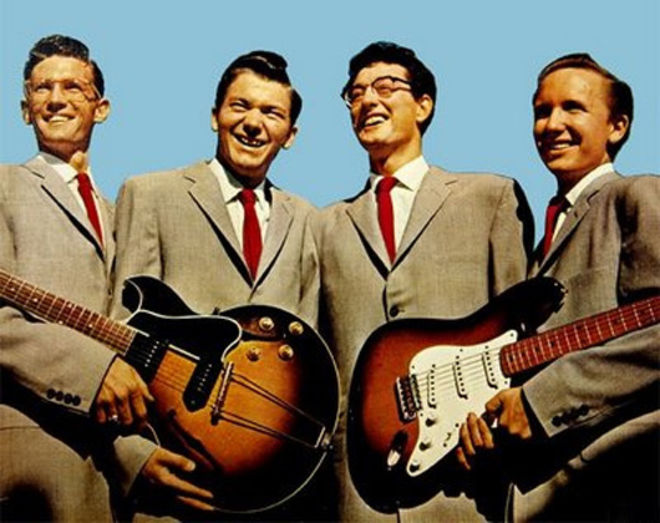
Buddy Holly: Buddy Holly was a singer and songwriter from Lubbock, Texas who gained popularity in the late 1950's with songs like "Peggy Sue" and "That'll Be The Day". Buddy's unique look (the geeky horn-rimmed spectacles combined with the space-age electric guitar) was captivating, and the 100 songs he recorded with his combo the Crickets combined country, pop and in some cases, the Bo Diddley beat. Sadly, Buddy Holly perished in a plane crash following a gig in 1959, along with young guitar slinger Ritchie Valens and DJ J.P. Richardson, a/k/a "The Big Bopper".  Holly, who was only 22 at the time of his death, has had a lasting influence, especially on four young Liverpudlian rockers, who also chose an entomological name for their band, The Beatles.


Buddy Guy: Legendary Chicago bluesman Buddy Guy has played a bunch of different axes in his long career, but he is probably best-known for playing a Strat (often a polka-dot one).  Songs like "The First Time I Met The Blues" and "Damn Right I've Got The Blues" are rightfully classics of the genre.  He is also a prolific coverer of songs by other bluesmen, such as "Five Long Years".  I first got into the blues in the mid-1980's after seeing a PBS special about Buddy, and I have seen him live several times.  Buddy was a huge influence on other guitarists, and his wild live performances are renowned. He is a remarkably modest and kind man as well as a brilliant musician.  Check him out if he comes to your town!


Jimi Hendrix
: Psychedelic blues shaman James
Marshall "Jimi" Hendrix was heavily influenced by Buddy Guy. Though he was left-handed, Hendrix often played right-handed guitars upside down, notably Fender Strats. After years of playing as a sideman with groups like the Isley Brothers and Little Richard, he was "discovered" by Animals bassist Chas Chandler (whose fear of flying motivated him to switch from performing to managing).  Hendrix went to England and took London by storm in 1966.  His wild Buddy Guy-isms (playing the guitar behind his back or with his teeth) and inventive use of distortion, feedback and the tremolo bar quickly brought him the reputation as rock's greatest guitarist.  Sadly, Jimi died in 1970 at the age of 27 as a casualty of drugs; on the night of his death, British guitarist Eric Clapton was planning to give him the gift of a left-handed Stratocaster.  Jimi died too soon, but his live performances of blues like "Red House", rock numbers like "Wild Thing" and his mindblowing rendition of the "Star Spangled Banner" as the sun rose on the multitudes at Woodstock will never cease to amaze.

Eric Clapton: One of my all-time favorite musicians, Eric Clapton was one of the original guitar heroes.  During his time as lead guitarist with John Mayall's Bluesbreakers, London walls were covered with the graffito "Clapton is God". Eric was only 20 years old at the time!  He went on from there to get inducted into the Rock and Roll Hall of Fame three different times, and to record what I think is the greatest album of all time. Clapton has recorded a wide variety of music, but the blues is his homebase, and the Stratocaster is the guitar with which he is most often associated.  He once described playing "Blackie" (his main axe through the 1970's) as "like diving into a pool of warm water".  Clapton was heavily influenced by Buddy Guy (in fact, seeing Guy live led Clapton to form legendary power trio Cream), was friends with Hendrix, and in his turn has influenced just about everyone.  Songs like "After Midnight", "Wonderful Tonight" and "Layla" are classics that show "Slowhand's" chops.


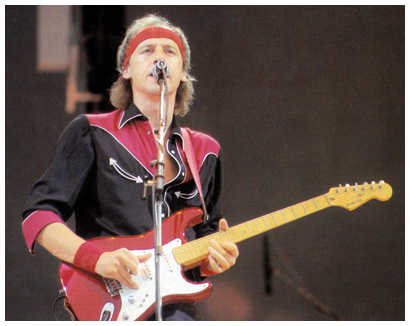
Mark Knopfler: When I was a teenager, I had pictures on my wall of several guitarists, including Clapton, Hendrix, Chuck Berry and Mark Knopfler. Knopfler, the leader of Dire Straits, is a brilliant songwriter and guitarist whose crystal clear fingerstyle Strat playing is unmistakeable. Besides being a great player, he also loves the instrument, as is made clear in this wonderful movie made by Dire Straits bassist John Illsley. Must-hear songs from Mark Knopfler include "Tunnel of Love", "Lady Writer" and "Sultans of Swing".  Mark is still recording and touring--don't miss the chance to see this legendary musician if he comes through your area. 


Stevie Ray Vaughn: Back in the 1980's, after punk, and with the rise of synthesizer based New Wave it seemed like the guitar was falling into disrepute. But a guitar-slinging young bluesman from Texas changed that.  Whether on his own records, or playing lead for David Bowie, Stevie Ray Vaughn restored guitar (and the blues) to their place of prominence in American music. Stevie was famous for playing the battered Stratocaster he called "Number One" on songs like "Pride and Joy" and "Texas Flood" while he featured a maple necked Strat (signed by Mickey Mantle!) on "Lenny", which was the name of his wife, and of the guitar she bought for him.  SRV was a longtime drug addict who got his life under control and was making his best music when he died in a helicopter crash following a concert with Eric Clapton, Buddy Guy and Robert Cray in August of 1990.  He was 35 years old. He is the only guitarist whose picture is currently on my wall

**************


In the summer of 1990, under the influence of Stevie Ray Vaughn and Eric Clapton I bought my Fender Strat.  It was an "American Standard" model, made at the new factory in Corona, California after the company's employees purchased the brand from CBS. I got it in the "Pewter" finish that Clapton was using at the time, and named it "Penelope", trusting that it would always be faithful. I have other guitars, but my Strat is first among equals.


It is also the guitar I have relied on the most in live performances.  Every time I have played with my wife in the audience (including before we were married), the Strat was there. When it is important to sound and look good, no other instrument will do a better job than my Stratocaster.

I love the way it looks, the way it feels and the way it sounds.  To me it looks like a grayscale picture with a tinted neck.  I just got the frets leveled and crowned after 23 years of use, and it plays like butter--I can't put it down.

Stratocasters have inspired people since 1954, and I look forward to playing mine for the next 60 years.