Showing posts with label Jimi Hendrix. Show all posts

Sunday, June 17, 2018

My Back Pages: Thirty Years Ago in Guitar Player (June 1988)


Welcome back to "30 Years Ago", where I take a close look at the issue of Guitar Player magazine from exactly thirty years prior to discuss what I gleaned from the issue at the time and what I learned from re-reading it so many decades later. I also provide a Spotify playlist that includes music that was mentioned in the month's issue. Click here to see all of the previous posts!


June 1988 is when I graduated from high school, and just as that marked a major epoch in my life, there was a lot in the June, 1988 issue of Guitar Player that reminds me very vividly of what I was doing musically at the time. As I've mentioned before, I was taking weekly guitar lessons with a recent GIT graduate whose teacher in Hollywood was this month's cover star, Frank Gambale. Most readers of the magazine might have first heard of The Thunder From Down Under in the previous September's issue on "Speed And How To Get It", but I got to listen to Frank at my weekly lessons, and also goggle at my teacher, Jim McCarthy's amazing sweep picking skills. In fact, I remember bringing this issue to our lesson and Jim greeting me at the door with his own copy and a huge smile on his face.


Even though I came to Jim to learn how to play blues like Eric Clapton, he really worked to open my ears to more advanced music. The two people he talked about the most were Frank Gambale and Larry Carlton. Consequently, I remember being totally shocked to see the short blurb about Carlton being shot in the throat during a home invasion. Fortunately he made a full recovery and still makes great music three decades later. Oh, and speaking of Clapton, this issue of GP  had a full page ad for the five LP Crossroads box set, which later that summer became my 18th birthday present from my sister and is unquestionably the album I've listened to more than any other in my life. More on that in next month's post.

The issue has far too much to get into in this post, but some of the other highlights include two articles by LA gear guru Andy Brauer, a "track by track" of Ted Nugent's new album, a feature on Jethro Tull's guitar god Martin Barre, and a "Spotlight" feature that has two young men who went on to have very successful music careers. 


******************

If you haven't heard of Andy Brauer before, he was (and is) an expert on guitar gear and tone who has rented equipment to nearly everyone you can think of over the past four decades. In the June, 1988 Guitar Player we were treated to an "as told to Vic Trigger" article as well as the first of Brauer's monthly "Guitar Tech" columns. Trigger's article notes that the then 30 years old Brauer is "highly opinionated, but he has the knowledge and the background to back him up. He has carved a career for himself as L.A.'s guitar specialist." When I first read this as a teenager I'm sure that I was eager to glean whatever I could about how to get great tone (which is funny, because not only did I not really understand tone, but my Peavey Audition 10 probably couldn't help me get it even if I did!). And there were lots of really cool tips in the article. Brauer describes moving to L.A. at the age of 18 (maybe this caught my eye!) and became a repairman and tech at a music store, which led to a job touring with The Brothers Johnson and then as the guitar tech for Michael Jackson's "Thriller" album. As Brauer put it:
I was in the right place at the right time. Not only was I carting gear around for guys, supplying my own special pieces at times, but I was offering a personally specialized and knowledgeable service. It started in the backseat of my car, and now I have a great staff of six guys, who all play guitar, busting their butts for our clients. I have over 50 individually selected guitars, over 100 handpicked amps, racks, speakers and so forth, all of which allow me to offer that much more of a personalized service. 
For an Eric Clapton session on "Behind The Sun", I selected a Mitchell Tweed Deluxe amp that Howard Dumble modified for me. In my opinion it was the ultimate blues amp. You play hard, and it's nasty; you soften up, and it's sweet. Sure enough, Eric fell in love with it and eventually I was convinced to sell it to him....That's what I do: I collect magic and rent it.
Later in the article Brauer dispensed some words of wisdom which would seem perfectly at home on 21st century online guitar forums, and while not necessarily applicable to a 1980's teenager, are definitely resonant with me now decades later (I've added emphasis) .
There is no single best sound. The best sound is whatever makes you the most happy, and one man's honey can be another man's poison....The trick is to get the sound coming out of your hands by the way the can manipulate the sound without an amp. 
 ...[t]he Japanese have never gotten it right for pickups. They even use American wire, bobbins and everything, yet they still can't get them to sound great....You've got to find the pickup that works well with your own playing techniques.
The Howard Dumble Overdrive 50 was my ticket to success in the studios. I would be an obnoxious nuisance and bug Steve Lukather, Lee Ritenour, Larry Carlton and Jay Graydon until they would plug into the Dumble. And then I had them, because they needed me to rent this amp that they loved. 
By actually seeing what is renting out of my shop, I can see what the trends are. I'd say we are about three years ahead of what is hitting the mainstream now. Just recently, I've noticed a drop in rack usage and an increase in Vox and old Marshall rentals....[p]retty soon, guys are going to be getting back to the thing of just plugging in.
If you missed that last bit, Brauer basically predicted the grunge movement!   
 ******************
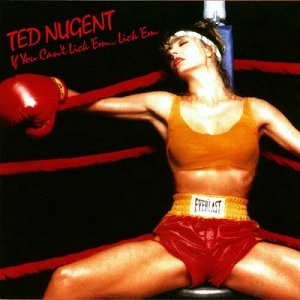
It's possible (likely?) that teenagers in 2018 who know of Ted Nugent associate him for his outspoken political views, his friendship with President Trump, and his enthusiasm for firearms and bow hunting more than for his rock guitar stylings. At the time, I was used to hearing some of his classic songs like "Journey To The Center Of The Mind" and "Cat Scratch Fever" on classic rock radio. In this issue Nugent is featured in an "as told to Jas Obrecht" piece as well as a track by track run down of his new album, the salaciously titled "If You Can't Lick 'Em...Lick 'Em". You can listen to the record on the Spotify playlist below--it is very engaging 80's guitar rock. 

For anyone who might think that the Nuge was a newcomer to his interest in weapons, this article will quickly dispel that notion. Obrecht notes the decor of Nugent's home studio:
"Behind him, a stuffed bear stands frozen beneath a mantel stuck full of knives. Shelves are neatly divided: one for cassettes, one for live ammo. VCRs and amps are scattered among chainsaw, critter skulls, venison sausage and a rocket launcher. For Ted Nugent, music and hunting are serious business. 'If I weren't a rock and roller,' he asserts, 'I'd probably be a special weapons expert in the Detroit SWAT team, or a commando in an elite anti-terrorist squad.'"
While Ted Nugent was famous for rocking hard on a Gibson Byrdland, a short-scale, fully hollow guitar that few would consider for such loud music, by the time of this piece he had started using a Paul Reed Smith solidbody. Nugent was very enthusiastic about the PRS, and what he said would seem right at home on modern guitar forums.
...[t]he new Paul Rivera stereo tube amplifier and the Paul Reed Smith guitar...is just wonderful, and you have to hear it live to really appreciate it. It is the richest, thickest, creamiest guitar tone you've ever heard in your life. I'm telling you, it's unbelievable.
The appeal of the Paul Reed Smith guitar is touch. I'm a utilitarian, basically, and I'm also a seat-of-the-pants liver. I like to live by function and feel. My cars have to handle precisely, my firearms have to respond flawlessly. There's a 'player's touch' to Paul Reed Smith's approach to the instrument that I am convinced is unique in the industry. There's no other neck that you can consistently pick up like you can a Paul Reed Smith and feel at home with immediately. The body configuration and tone are just the best--that's all there is to it. 
Later in the piece, Nugent mentions that PRS "does something to the Marshall 100-watt head that gives it a full richness", which is followed by this comment from what the forums call Paul Reed Smith himself:
"New Marshalls don't sound like old Marshalls, and I modified a bunch of Ted's tops so that they sound much more like old Marshalls. I'm not going to tell people what I did, because then my business modifying Marshalls would just be gone. I charge $100 per top. Ted has three or four of our straight PRS guitars. His Pearl Black mahogany one has a Hot Vintage pickup in the treble position and our Standard bass pickup. His curly maple guitar has a prototype of the very powerful H.F.S. pickup in the treble position. These pickups were intended to make his guitars a little less shrill and more singing....His guitars use our straight tremolo system which doesn't need Allen wrenches."
Obviously this was the young, hungry always hustling Paul Reed Smith decades before his eponymous company became America's third biggest guitar manufacturer. I love seeing him trying to protect his $100 a pop line in amp tweaking!

Two more quick hits from Ted. By now, having been rereading so many of these issues, it's not surprising to see another personal reminiscence of Jimi Hendrix, and Nugent's are not too different from Carlos Santana's a few months before:
Jimi and I jammed quite a bit back in the '60s and we did a couple of dressing room things....You know, thinking back about Jimi, you don't know what was his personality and what were the manifestations of the drugs that he was doing at the time. That was always the real shame; that's what really angered me. He was overtly reclusive, and he was real difficult to communicate with. That was one of the reasons I never did any drugs, because I saw this incredible power sadly abused and embarrassingly hampered by all this chemical bullshit. It really pissed me off, because man, could he play! Oh, my God!
If you had seen what he accomplished in one night in New York when I played with him it would have changed your life. It changed mine. The way he played, the notes he chose, the borders he broke down, and th eground that he created, it was absolutely earth-shattering....And Jimi was amazed that I could actually get a Byrdland in control like that, because he tried and was completely lost with it. He couldn't play it!
So, at this point the only two rock legends I can think of who never did drugs are Ted Nugent and Bruce Springsteen. At least they have something in common.

Finally, as a fan of This Is Spinal Tap, I can't ignore Ted's description of the title track to his LP:
"If You Can't Lick 'Em...Lick 'Em". What do you think of that? Is that the greatest or what? At first the record company was a little reluctant about the title--they thought it was a little too nasty. But it's not really. It's just a play on words. It's like saying, "If you can't beat 'em, join 'em". That really is the essence of it. Also, it has to do with the specific combat mode with women. I mean, if you can't lick 'em, at least you can lick 'em. The whole song was romantically ignited. We've always got a lot of miniskirts in the studios...."
Or as Nigel Tufnel once said, "What's wrong with being sexy?" 

**********************
Speaking of guitar forums, recently in a thread on The Gear Page that discussed the continued decline of Guitar Player, a poster remarked "put Martin Barre on the cover and I'll subscribe". I don't know if Jethro Tull's longtime guitar slinger was ever on the cover, but 30 years ago this month he was the recipient of a full-page feature. Check it out--it's a nice feature, and if Barre is ever in your town, I hear he puts on a good show. 


***********************


The cover story on Frank Gambale was really interesting to re-read. When I was a teen, much of what he had to talk about went over my head, and I mainly appreciated in the context of the "teacher of my teacher".  But now, it's clear that the Australian fusion phenom had lots of valuable information to impart. 

As GP editor Jim Ferguson notes at the beginning of the article, "Of course Frank Gambale has amazing chops, but leaving it at that does him an injustice. Gambale is a top player, and a technical innovator who only uses his facility to execute ideas. In short, he is a remarkable musician."  In his 20's Frank saved his money to be able to attend the Guitar Institute of Technology, where he was the Student of the Year in 1983 and worked for three years, including 1985-86 when he taught my teacher Jim McCarthy. At the time of this article, Gambale had published two books (Sweep Picking and The Frank Gambale Technique Book) and was working on a video, which you can still find on YouTube:


Some highlights of the article for me touch on Frank's musicianship and the importance of listening to other instruments.

You seemed to get labeled as a technically oriented player....Were there any drawbacks to having that kind of reputation early in your career?
 Not really, but it irritated me a lot. I got lumped in the same old guitar category, where you get evaluated in relation to the guitar and not in terms of what other musicians are doing. It might sound strange, but I'm at the stage where I don't even want to be categorized as a guitarist; I'd rather be classified as a musician who happens to play the guitar. I'm trying to go beyond the nature of the instrument in terms of the way that I play. My whole style comes from the notes I choose, rather than the physicality of the instrument.
In other words, my technique developed as a result of wanting to play certain notes. When people hear me at a gig, their reaction is usually "How do you play that?" But when Allan Holdsworth opened for the Electrik Band during a tour last year, he said "Man, I really dig the notes you play." He's a phenomenal musician, so that was a very high compliment. He didn't care how the hell I did what he heard because he was listening to the notes. You have to have good ears to discern the difference between content and technique. I don't play for the guitarists in the audience, I play for the musicians.
You have a rock sound and look about you, but your playing draws from the jazz vocabulary. How do you like to be described?
The term jazz is used very loosely these days, and it doesn't mean a damn thing. My records include everything from funk to Brazilian stuff to swing to rock ballads. I write whatever I want and I don't worry about labels.....Music theory is very interesting, and finding new chord changes is important. There's nothing wrong with a I-IV-V progression, but I couldn't play it with conviction. Over the years I've done a lot of different kinds of music, including rock, country, disco and funk, so that's where my compositions come from.
A lot of your single-note style is sax-derived. What are the basic differences between a sax player's approach and that of a guitarist?
The guitar's fretboard is conducive to things based on positions and shapes, so you find yourself falling into ruts and playing the same ideas over and over. In other words, you see a shape, rather than invent it in your head. Now I'm not a sax player, but I assume that the nature of the instrument doesn't encourage that so much....The beautiful thing about transcribing saxophone or piano solos is that there's no pre-conceived way of playing those notes. Since they don't fall into the usual fretboard patterns, you have to find new ways to find them on the instrument.
What do you suggest for developing a vocabulary that's more horn-like?
Start listening to saxophonists, obviously. There's a number of great players; Michael Brecker is probably the kingpin. Few of his solos are very easy, so they're always a challenge. Playing any of his solos from beginning to end on the guitar is a considerable achievement. Even his slow passages are beautifully played, and the note content is always fresh and exciting. 

This really hits home now, and I can remember my teacher urging me to transcribe sax solos. Obviously my limited musical facility made that impossible, but in the past few years I've reached the point where I can learn phrases and passages from horn players, and it really does help. 

  ***********************

Finally, one of my favorite parts of re-reading the old magazines is looking at Mike Varney's Spotlight feature: I love to look online to see what these guitarists and bassists have been doing for the last thirty years. This month's issue features two pretty prominent musicians, composer Craig Garfinkle and guitar wizard, gear guy and all-around super musician Richie Kotzen (who seems to have grown up just an hour or so from me). Varney was pretty on target noting Kotzen's hope to "play in a band on a national level" and Garfinkle's "compositional skills".  Good stuff!


***********************
That's all for this month. I hope you enjoyed it, and that you'll come back for next month's cover story on Jerry Garcia of the Grateful Dead. Until then, keep on picking!

Sunday, April 29, 2018

My Back Pages: Thirty Years Ago in Guitar Player (April 1988)

Welcome back to "30 Years Ago", where I take a close look at the issue of Guitar Player magazine from exactly thirty years prior to discuss what I gleaned from the issue at the time and what I learned from re-reading it so many decades later. I also provide a Spotify playlist that includes music that was mentioned in the month's issue. Click here to see all of the previous posts!

April of 1988 was a big month for me, as it was when I decided to attend Hampshire College in the fall; that was a life-altering decision in many ways, not least of which being that it is where I met my wife! Guitar wise I was continuing my lessons with my GIT trained teacher and learning how to play the blues on my Epiphone Sheraton II, my Peavey T-15 and my Fender Avalon Acoustic. I absorbed music wherever I could, listening to jazz and rock radio in the Philadelphia area, watching MTV, and the Nashville Network on television and reading about music all the time.

The April, 1988 Guitar Player issue really stood out for me as an eye opener. It was where I first learned about slide genius Sonny Landreth (at the time a sideman for John Hiatt, but just beginning his solo career) and fingerstyle jazz titan Tuck Andress (whose first album with his wife Patti Cathcart was released that year) and the cover story with Joe Walsh really stuck with me, along with his "12 Greatest Guitar Solos of All Time" featurette.

I remember being totally amazed by the articles on Landreth (who described his style which involves fretting the guitar behind the slide) and Andress (who famously can simultaneously play independent bass, rhythm and lead lines on his Gibson L5); in fact, I cut out the full page picture of Tuck Andress and added it to my bedroom wall gallery of the greats (along with Clapton, Knopfler, BB King, Carlos Santana and Chuck Berry). To this day, I STILL cannot begin to understand how these musicians manage to do what they do!


The Sonny Landreth article was written by Dan Forte, and does a great job of explaining how the Louisiana slide genius developed his style, and his role playing lead guitar for John Hiatt (a role that had been filled on record by Ry Cooder). Landreth was 37 years old in 1988, so he was far from a novice, but the Hiatt gig and this article really brought him to national prominence. The Spotify playlist below has a live set from around this time, and you can also appreciate his playing on this contemporary video:


It's not always too easy to see in the video, but the behind the slide playing of Sonny Landreth is truly amazing. Now, I've been playing for more than three decades and I can't really even play regular slide guitar, but even so, Landreth blows my mind. The article has a separate pictorial feature showing how Landreth plays certain lines, but for this blog post I'll share a couple of excerpts from the interview where he describes the genesis of his style. It's truly a case of "necessity being the mother of invention", and shows how a gigging musician (with only one guitar) had to come up with clever ideas to be able to play the music he wanted to play.

"Basically, I played slide the conventional way for a while, and then in early '71 I was in a blues band with David Ranson. I was really frustrated because to play minor chords I had to retune the whole guitar to a minor---like in E tuning, lower the G# to a G, which is a really nifty sound.  I still love it and still use it, but at that point I was playing slide on some tunes and regular guitar on others, so to make the transition, I wasn't used to it. Then I found that instead of having to retune, you could stay in open E and just play the three low strings open (E,B,E) and the three high strings with the bottleneck at the 3rd fret (B,D,G) which all together is an Em7 chord. To get the IV chord minor, I'd place the bottleneck at the 8th fret (E,G,C), which implies an Am7 chord.
So I'd been in E tuning, and I'd look and think 'If I could just get this note' [the third string, one fret behind the slide, with the bottleneck at the 12th fret]. So I just ended up pressing it, and presto! I freaked out. It was just out of frustration. I could see the note-there it is- but didn't know how to get to it. Then it was like 'Wow, I never thought of that.'...Then I started thinking, 'Well, there's a lot more notes back there'. Hunt and destroy! I started finding the notes I could play and eventually worked into playing two at a time, chord melodies, minor keys, major 7ths, chord clusters."
One thing that always strikes me when re-reading these articles is how important formal musical training was for so many of the musicians, and Sonny Landreth was no exception. Interestingly, Landreth's musical schooling was not on guitar:
"Trumpet was my academic instrument. I studied it from 5th grade to my two years of college at University of Southwest Louisiana in Lafayette, and by the time I was in college I was also taking piano. I was really fortunate; I had good teachers. Studying trumpet influenced me a lot in the way I play guitar, because I think more like a wind instrument. I phrase like I'm taking a breath. Melody and phrasing have always been the things I'm into. Combining sliding and fretting adds another dimension, in terms of phrasing--and melody too. When you start fretting behind the bar, that's just another dimension. Once I went into that, I never came back. It opened up the door. Harmonically, it opened up so much.
The jazz horn players I grew up listening to emulated the human voice, and that's always appealed to me as a guitar player. There's a vocal quality to their playing--like Louis Armstrong. I didn't start playing guitar until I was 13, and I could never read as well on guitar as I could on trumpet. But the theory I'd had really did help a lot, in terms of the positions and how it all related. I still consider myself a fairly primitive musician; I'm not like these studio players who can just go and read anything. It's a funny thing: on trumpet I could read, but I never could improvise; on guitar I could improvise, but I couldn't read very well. I never had the chops as comfortably on trumpet as I did on guitar. I could never just play from the heart, but I felt an immediate thing on guitar."
Amazing stuff, and if this guy at age 37 considered himself to be a "fairly primitive musician" then at nearly 48 I haven't even figured out how to bang the rocks together!
********** 
Tuck Andress was 35 years old in 1988, with years of professional experience but he was another genius who seemed to emerge fully formed from the pages of Guitar Player to blow my mind. Andress played in a duo with his wife, jazz vocalist Patti Cathcart; their duo was reminiscent of Joe Pass and Ella Fitzgerald, but with a more modern style. I immediately bought the Tuck and Patti album (it's in the playlist below) and was fortunate enough to see them play a concert about a year later (it's one of my most indelible musical memories).  There's a concert video from around this time on YouTube which I've embedded below; I've set it to start before a solo number (because the camera does a great job showing Tuck's hands), but do yourself a favor and watch the whole show--it's so impressive!


The article was titled "A Private Lesson with the Amazing Tuck Andress--Radical Fingerstyle Jazz", and was written in the first person. It covers 14 pages (including several transcriptions), and it is hard for me to explain, but when I first read it, I basically didn't understand anything he was talking about! I mean, he's describing how he plays independent basslines with up and downstrokes of his thumb while playing chord stabs in the middle strings and melodies on the high ones, and I could barely play barre chords at the time! Now, decades later, I'm a pretty competent guitarist, but I STILL find this article baffling. There's no way that my brain works like Tuck's, and I'm ok with that.

That said, one thing that I can take away from this article is the value of practice and of perseverance. He frequently describes his experiences in ways that make clear that he was never far from the instrument (emphasis mine):
I reached the turning point when I realized that I had often been going for ideas at the expense of feel, trying to jam without enough foundation.  So I began to shift my practice away from specific techniques and spontaneous jamming to very carefully worked out patterns designed to give me flexibility while maintaining carefully enforced feel. I began to practice single phrases, such as the one from "Everything's Gonna Be Alright" for hundreds of hours perfecting the feel. Now when I approach a tune that has multiple parts, I start by practicing each element until it feels great. Then I work on each possible pair of parts, until the feel is equally great, no matter how long it takes, and regardless of the weird combinations of techniques required to produce the proper feel. Next, I work on all combinations of three, and depending on the tune, four parts.
Once I attain the correct feel, I work on developing as much freedom as possible. Improvising is particularly dangerous with solo funk grooves, because as soon as you change one element, the whole thing falls apart--just like when an inexperienced player has to start over after losing his place. My solution to this problem is to identify the type of  improvisation I want, and then devise exercises to promote flexibility. Most of these involve alternate versions of the same tune, with one part varied. The rationale for this method is that if you work out enough variations, even if each requires starting from scratch, you'll gradually become freer. 
Once I achieve feel and some freedom with a new part, I often discover that what sounds great at home is hideous in public. For instance, at one time my best solution to a particularly troublesome section of Chaka Khan's "Ain't Nobody" involved an intricate two-handed fingertapped texture, with the four parts (bass, backbeat, sustained keyboard part, and percolator-style muted single-note line) shifting between the two hands as often as every sixteenth-note and my hands crossing over each other several times in the space of two bars.  Combine the complexity of the part with my high action and almost total lack of right-hand fretting experience, and what I got was a piece that depended on everything going right, with no surprises--in other words, certain doom. After blowing it on the gig for several nights, I went back to the drawing board. It took about six such trips to get a solution that actually worked. 
Where do I start with this? I mean, it's next level stuff, for sure. But while I can't imagine executing Tuck's musical vision, it's inspiring to see him describe multiple public failures ("blowing it on the gig") and his persistence to try to get it right. I think we can all relate to parts we've practiced that didn't work in front of an audience, and seeing the dedication with which Tuck Andress approached mastering his music is amazingly inspirational to me. As you may know, Andress is the uncle of Annie Clark, who is the amazing musician known as St. Vincent. I can only imagine that he was a great inspiration to her, as well.

Update: Tuck Andress wrote back to me on Twitter about this post--he said that he and Patti remembered the gig in the video above, but hadn't seen it before. How neat is that?  By the way, go to the 12:00 mark of the video to catch them doing "Ain't Nobody". Tuck told me (I love saying that!) that the "rap" section is embarrassing, but it's pretty amazing to see him do it, and the audience seemed to dig it.


**********

Joe Walsh was a 41 year old legend when this article was published. Just his work with the James Gang, or his solo records, or his work with the Eagles on Hotel California and The Long Run would have cemented his status. But of course he was also a great friend of other guitarists--it was Walsh who gave Jimmy Page his sunburst Les Paul, and Pete Townshend the Gretsch he used on Who's Next.  Looking back on this three decades later, however, I realize that this article (which was in part promoting his new solo record Got Any Gum?) was not a valedictory piece, but one trying to show that Walsh was a mid-career musician who still had new creativity to share.

Jas Obrecht interviewed Joe Walsh for this cover story, and did his usual excellent job. That said, one thing that does not really come out in the article was Walsh's substance abuse issues. It wasn't until five years after this magazine came out that Joe Walsh achieved sobriety (which he has fortunately maintained ever since). I recently read Stephen Davis' Gold Dust Woman, a biography of Stevie Nicks, and learned that Walsh and Nicks had a long-term relationship in the mid-80's that ended right around the time of this article, in part due to Walsh's drinking. None of that is a part of the article, and maybe it shouldn't have been. But it does make me wonder what else was left unsaid in this interview (and how much that seems judgmental might have been said differently in a different headspace). Here are some highlights, followed by Walsh's description of what he considered to be the 12 greatest guitar solos of all time.

Your soloing is very song-oriented. You always seem to be playing for the song rather than showing off your chops.
Thank you. That's just the way I am. At this point, I am really a musician, besides being a guitar player. I hear a lot of things in a keyboard format. I hear a lot of tones and textures and such. I know I'm known mostly for my guitar work, but in terms of being a musician, there are other vehicles that I am quite capable of playing, and sometimes that ain't guitar. The song tells me what to play.
Do you have advice for people who find themselves overplaying?
Yeah. In my experience, when you're playing in a big hall--a 10,000 seater or something--at some point the flashiness, playing incredibly fast, and being technically capable starts to be a blur.  For example, Albert King can blow Eddie Van Halen off the stage with his amp on standby, even though technically Eddie Van Halen is probably the most overwhelming guitar player alive. You know, Eddie Van Halen can pretty much play circles around anybody existing. But Albert King can blow him away with two notes. I have nothing but respect for Eddie; I can't even comprehend what he does. But why would anybody want to play like that? After two or three solos it's a blur. Heavy metal is one format, and the important thing there is to really kick ass. It takes time, but after a while, you should just settle down and get your intellect out of the way and just let the guitar play itself.
What are your favorite Joe Walsh solos?
I would think the overall guitar work in "Rocky Mountain Way", especially the talk box....Peter Frampton asked me how to use it and he went and got rich with it and never even thanked me....I'm very proud of the guitar work in "Hotel California". I pretty much had to deal with the planning and organization of that. Don Felder brought in the descending chord structure, so I can't say that I had anything to do with writing "Hotel California". I was commissioned as a specialist to arrange the order of the solos--who played what where, who went up high. It was tough figuring out how much momentum we needed compared to what we were going to end up with at the end of the song. When the solos start, it's just here we go, and it goes all the way to the end of the song. Felder is tremendously underrated.
What can you advise struggling musicians?
Get out and play in front of other people. Otherwise, you can end up being a legend in your parents' basement. You could be great rehearsing, but when you get in front of people, you freeze up. You have to find out how to do it and how to fix your own stuff when it breaks.
Was there more of a cameraderie among guitarists back in the '60s than there is today?
Yeah, a little bit more. The way I got to know most of the guitar players was at gigs. We would all be playing, and I would see people regularly because there were three- and four-act shows. But anymore with the economy and all, you don't see people unless you're on the road. Everyone is so darn busy. Back in the '60's the bulk of the jamming was backstage. While someone else was on, we'd get together and jam and warm up. It seems that now people don't get together....One of my bitches with LA is that people don't get together and sing old Beatles songs and work out harmonies and stuff. Everyone has made it and they're very busy or spoiled-rotten session men. 
It's not like the old days, and I miss that a lot. But I do see Townshend and Clapton from time to time, and it's always a pleasure....There's nothing like a good, old, couple-of-guitar-players jam to blow out the cobwebs.
What's the best band lineup you've ever worked with?
The Eagles. That was a fine, fine band. We were a damn good band for awhile. I'm proud of having been a part of that and Hotel California. Besides the royalties and everything, jus the fact that that was a special album for a lot of people on the planet. I feel that I was part of a true band, and that we made a very valid musical statement for the generation that we represent. That makes me feel very good.   


 Finally, as is often the case, reading the "Spotlight" feature on up and coming guitarists and bassists reveals someone I know now when they were just starting out. I've seen Larry Mitchell endorse a bunch of gear over the years, and have enjoyed his music solo and with others without remembering seeing this profile from 1988:


Pretty cool!  I enjoyed re-reading this issue, and I hope you found it interesting. Stay tuned for next month's issue, featuring blues great Albert Collins on the cover--until then, keep on picking!

***********************

Sunday, January 28, 2018

My Back Pages: Thirty Years Ago in Guitar Player Magazine (January 1988)


Welcome back to "30 Years Ago", where I take a close look at the issue of Guitar Player magazine from exactly thirty years prior to discuss what I gleaned from the issue at the time and what I can learn from rereading so many decades later.  I also provide a Spotify playlist that includes music that was mentioned in the month's issue. Click here to see all of the previous posts!

Welcome also to 1988! This was a landmark year for me: I graduated high school, moved to college, met my future wife, and joined my first band in 1988. I look forward to revisiting this time period with you.

January is a time of beginnings, and some of the highlights of January, 1988 include the first Royal Rumble for the (then) World Wrestling Federation, the Broadway debut of Andrew Lloyd Weber's Phantom of the Opera (which my theatre friends and I were obsessed with), and Vice-President George Bush's Presidential career got a boost with his antagonistic interview on CBS news (I watched this live!) when he seemingly vanquished his reputation as a "wimp" by refusing to answer questions about his role in Iran-Contra. Unfortunately it was also a time for some noteworthy deaths, including Greg "Pappy" Boyington, who was portrayed by Robert Conrad on TVs Black Sheep Squadron (a favorite of my military-obsessed friends and mine), basketball star Pete Maravich, who was only 40 when he died playing a pick-up basketball game as a result of an undiscovered, congenital heart defect.  Guitar wise, I was digging my new Epiphone Sheraton II semi-hollow and trying to progress musically with my GIT-trained teacher Jim McCarthy and my high school "Music Theory I" class.

The January, 1988 issue of Guitar Player was chock full of interesting content. The cover touted the return of Lynyrd Skynryd to touring a decade after the devastating plane crash the band experienced in 1977, as well as interviews with Carlos Santana, Richard Lloyd, Omar Dykes of Omar and the Howlers, and a review of the amp now known as the Fender "Evil Twin". Inside the issue, the Spotlight section touted a young guitarist from Easton, PA named Greg Howe, a short interview with Steve Katz yielded a remarkably interesting trivia factoid, and there was a flexidisc recording of Carlos Santana playing "Blues for Salvador".

I doubt that I paid much attention to the interviews of producer Steve Katz (late of the 1960's group The Blues Project and co-founder of Blood, Sweat and Tears), and guitarist Richard Lloyd (late of 1970's group Television) since I wasn't interested in record production at the time, and I was totally unaware of Lloyd (who I didn't really grok until he contributed fiery leads on 1992's Matthew Sweet record, Girlfriend. This was a mistake, because I missed out on some good stuff. Katz described his techniques for live recording (one highlight, separate tracks for live amp and direct signal for guitarists) and related a very interesting fact about Lou Reed's Rock n Roll Animal (now one of my favorite live albums, totally unknown to me at the time). In Katz' words:

"During the recording of Rock n Roll Animal, a trumpet player friend of mine came back to the remote truck and almost fell over the 2" tape machine. Very few people know this, but we lost half the applause to that concert. The audience noise on that record is actually from a John Denver concert that RCA had in its vaults!" 
How about that!   The interview with Lloyd touts his live record "Real Time" (for which Katz was the producer), recorded at New York's CBGB club. If you haven't heard it--check it out in this month's Spotify playlist--killer songs! Lloyd comes across as an enthusiastic devotee of the guitar, and I definitely plan on listening to more of his records having re-read this interview. Some of the best quotes are:

"A Stratocaster is a guitar you can make a fist around.  A Strat asks you to play a certain way; it demands a certain grasp. It's just the way the neck is shaped, I guess. That kind of neck is really conducive to a certain kind of string bending that you can't get on most guitars; it's a really narrow neck with a slightly curved fretboard. And one of the first things I was told, and that I've held on to, is that what makes the electric guitar a special instrument is the bent note."
"When I was in junior high I was at this guy Zeke's house and he said there was somebody coming over who said he knew Jimi Hendrix. Everybody laughed. I mean, we were kids; who could know Jimi Hendrix? Hendrix was, like, somebody from outer space. Well, this guy's name was Velvert, and it turned out he was one of Jimi's best friends; Jimi called him his 'little brother'....Jimi was trying to teach Velvert things in a mirror, and Velvert would show me that stuff second-hand, But at the time I couldn't really play the guitar, so there's very little that I got from Jimi, except energy. My playing isn't like his at all, in terms of phrasing and turnarounds. But what he did for the electric guitar, historically was just awesome. 
I just listened to that "Live at the Winterland" CD recently, and it reminded me of why I've played guitar for 20-odd years. Here's this cat, running hard with the guitar, and I saw it. I started chasing him and I'm still chasing him and I still haven't caught up with where was back then. But that's okay. There are 50 million guys who are more technically proficient than I am, but there's something special about putting your heart and soul on the line the way Hendrix did, and I believe I've got some of what he had, in that sense."
Interestingly, Lloyd recorded a record in 2009 called "The Jamie Neverts Story", on which he cuts his own versions of several Hendrix classics. It's also in the playlist below if you want to check it out. This contemporary article from Guitar World indicates that Lloyd has had some troubles in his life, but also sheds light on his more recent recording approach.

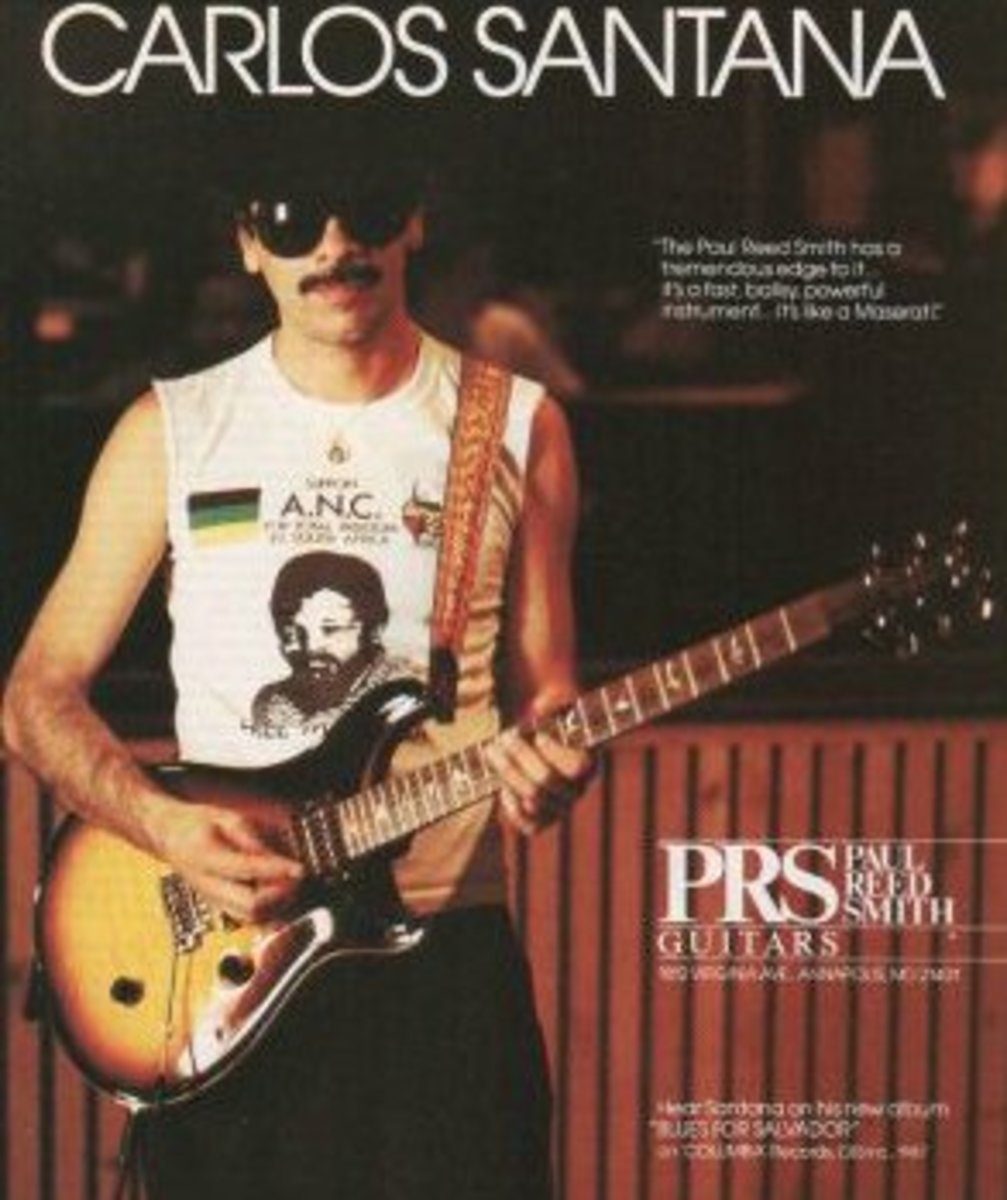
I wish I could have included the picture of Carlos Santana from the article in this magazine, but I cut it out and hung it on my bedroom wall back in 1988! Carlos was joined with Eric Clapton, Mark Knopfler and BB King on my personal wall of fame. Sadly, not only is the picture missing, but so is a full page of the interview. In retrospect I should have cut out this ad instead...oh well. This was the first of many interviews I've read from Carlos, and his earthy spirituality and deep sense of the power of music have never failed to inspire me.

Jas Obrecht wrote the Santana piece, so that already tells me to expect an in-depth interview that covers all aspects of the musician's approach. The article starts with Carlos walking into the Record Plant studio (boldface is my emphasis):

"Remember when we used to go see a band in the '60s? You'd see Wes Montgomery play at the Matador from 9:00 to 1:00, and then you'd follow him to another funky club on the other side of town, and he would play there until 4:00 in the morning. Well, that's the kind of feeling I'm trying to get lately on certain ballads. It's funny, because 4:00 in the morning is 4:00 in the morning. What do you do at 8:00 at night? How do you capture that after-the-party feeling? It's challenging. Somebody from the Grateful Dead said to me 'When music starts playing you, don't play music anymore,' which makes a lot of sense. Music starts playing itself through you, instead of you having to make it happen."
You're one of the few guitarists who is instantly recognizable. Why is that?
 "It's an accumulation of a lot of things man. My love for John Coltrane and his tone. My love for B.B. [King] and his tone, or Aretha [Franklin]. All the things that my father passed on to me. My father is a musician; he taught me everything I know on the guitar, as far as technical chords and stuff like that goes. His father before him was a musician, and my grand-grandfather was a musician. The main thing is the cry. It's not whining. You know, sometimes you go to a funeral, and maybe the guy wasn't such a good guy, but people still want to say something nice about him. Well, the tone in the music I'm trying to write now is for people to learn to let go gently and quietly. It's to enhance the beauty that, let's say, Jaco Pastorius had. I immediately erase all the National Enquirer stuff out of my mind, so all I remember is the great times I had with Jaco Pastorius when we did get to jam and spend some time together. That's what I'm trying to do with the tone. It's the cry of exalt the elegance in humanity. 

Santana goes on to answer questions about gear, and his preference for tube amps and triangular-shaped picks (this might be where I started using those kinds of plectra) and his trick of using pencil lead to lubricate the guitar's nut (which I also do). The discussion of tone leads Carlos to praise Eric Johnson as having "the best sound I've heard lately":
"He had the most beautiful tone all the way around. It was very, very masculine, and round and warm and dark. And his playing is great, man. I'd like to record with him someday, because he is very pure. You can tell what people have in their eyes--malice, expectations, the beauty of things, this or that. With Eric it's 'OK, I've got my tone and my vision and that's enough. The Lord will provide the rest.' He has a beautiful soul. Even though he is from Texas, he doesn't have the gunslinger mentality 'I'm going to kick your butt with my gun.' When we jam, we both complement each other, which is what musicians are supposed to do. Eric is somebody who should be playing with Joe Zawinul, Miles Davis and people like that."

Carlos later explains his vision of something that is more than "mortal music", beginning with a discussion of his regret at never playing with Bola Sete:
"Mortal music deals with my baby left me, I can't pay the rent or whatever. Bola's music tells you that inside we have roaring cosmic lions and that we're elegant and beautiful. His music enhanced the beautiful side of humanity to a supreme extent....If I was going to a Santana concert, what would I want? I want joy and a lot of vitality. I want the spirit of when a pastor tells you something really precious at church that applies to your life--something that's not condemning you or making you feel like you should apologize for being a human being. Whether in a cry or in a party atmosphere, the music should exalt humanity and the spirit of humanity, which is the Lord. That's enough, because anything else will be the crust. This is the real pure water. 
Later in the lengthy interview, Obrecht asks several questions about what kind of advice Santana would give to young musicians and other guitarists. The answers are, as you probably can expect by now, flowing and expansive:
"My son is four-and-a-half years old, and he's already asking me, 'Is Jimi Hendrix badder than Michael Jackson?' First of all, I would just give him heavy doses of John Lee Hooker, Muddy Waters, Jimmy Reed and Lightnin' Hopkins for two or three years. Once I feel that he's got that combination, then I'll say Muddy Waters is the Miles Davis of Chicago, and Little Walter is the John Coltrane. By the time my son is listening to something like 'A Love Supreme' by John Coltrane, he would have understood the order all the way from Django Reinhardt to Charlie Christian to Wes Montgomery. I want him to understand the order, because I don't want my son to be fooled by fool's gold. And there is a lot of it out there for kids, a lot of flash and guys who have the right poses for the right strokes on the guitar. But that stuff doesn't cut it when you really know how to play, and you put the note where it's supposed to be. I want to teach my son not to fake anything, but to earn it. "
"I saw Jimi Hendrix two or three times in person. The first time I was with him was a real shocker. He was in the studio overdubbing "Roomful of Mirrors". He said 'Okay, let's roll it,' and started recording and it was incredible. But within 15 or 20 seconds into the song he just went out. All of a sudden the music that was coming out of the speakers was way beyond the song, like he was freaking out having a gigantic battle in the sky with somebody. It just didn't make any sense with the song anymore, so the roadies looked at each other, the producer looked at him, and they said 'Go get him'. I'm not making this up. They separated him from the amplifier and the guitar, and it was like he was having an epileptic attack. I said 'Do I have to go through these changes just to play my guitar? I'm just a kid!' When they separated him, his eyes were read and he was almost foaming at the mouth. He was gone.
To me, it was a combination of the lifestyle--staying up all night, chicks, too much drugs, all kinds of stuff. It was a combination of all the intensities he felt, along with a lack of discipline. In the rock style of that time, there was no discipline. You took everything all the time. I know one thing man--it drained me. It made me realize that, like John McLaughlin, I needed to know about discipline. Now I know that out of discipline comes freedom. When you've got discipline in your pocket you've got punctuality, regularity, meditation. When things get too crazy with the record, the companies or the world you can flick a switch and go into your own sanctuary and play music that is stronger than the news.  
"Whether you are doing it in the bar, the church, the strip joint or the Himalayas, the first duty of music is to complement and enhance life. And once you approach it like that then there is order....People come up to me, and tell me that I [changed their lives]. Someone said to me 'Man, I was ready to check out, put the gun to my head, and I heard this song. It made me cry and it made me want to try it again. Now I feel better.' That's not me though, it's a spirit through me that wants to exalt itself. It says 'Don't take that out. Don't treasure frustration. Don't treasure depression. This is an imposter--don't make friends with him. You're more than that. Don't focus on the negative things in life--accentuate the positive; otherwise you become darkened. Light up a candle.' That's the tone; that's the story that I want to do through my music as much as possible....What means something is to be able to tell a story and put wings in people's hearts."
Over the years I've re-read this and other interviews with Carlos Santana multiple times (his autobiography is also quite excellent). I know that many people find him to be kind of weird, but his words move me as much as his music, and I believe that both are equally genuine.

The cover story was about the re-formed, newly touring edition of Lynyrd Skynyrd. Titled "10 Years Later, Lynryd Skynyrd Rocks Again", Jon Sievert's article was a good overview of the band's history leading to the tragic plane crash, what the musicians did afterwards, and a summary of the new tour. The article is quite interesting if only because Gary Rossington opines freely on topics like songwriting, and the role of Al Kooper (Steve Katz' co-founder of Blood, Sweat and Tears) in the band's success. I recently watched a documentary called "Gone With The Wind", which was a nice band biography, but Rossington was conspicuous in his absence. The movie would have been better if he was in it, even if only to share his feelings about the crash (in which he broke both arms, both legs, both wrists, both feet and his pelvis), "Plus my heart got broke real bad. It took me a long time to even want to play again."

According to the article, "At the beginning of the tour, the goal was clear. Lynyrd Skynyrd would play 33 concerts in 40 days; then the members and crew would return to what they were doing before it all happened. The response to Skynyrd's return has changed all that." It sure has. Though the band has announced that 2018 will be the end of the road as a touring entity, the hard traveling band has thrilled (and formed) millions of new fans in the last thirty years. While I've not been a big fan of what has sometimes seemed to be an ersatz tribute band, I have to tip my hat to the group for staying true to the music and their audience for so many decades. Well done, Lynyrd Skynryd.


During the '80s Mike Varney, who owned Shrapnel Records, had a section of every issue of Guitar Player to give capsule descriptions of guitarists or bassists who had submitted demo tapes to him. I used to love reading these at the time, and now it's fun to try to find the musicians on Spotify to see how their careers turned out. But sometimes, a famous name jumps out at you. For instance, this month Varney showcased Greg Howe. Only four years older than me, and living about 40 miles to the north, Howe was already on the way to fame as one of the decades' most talented shredders. Varney notes that "Greg's demo tape is among the most exciting I've received, featuring great chops and strong original instrumental compositions. His diverse yet cohesive style is hard to categorize. It successfully combines both legato and speed-picking techniques similar to Allan Holdsworth's and Yngwie Malmsteen's respectively, but it's still jazzy and bluesy, at times sounding like Larry Carlton with a George Lynch feel....Well worth checking out." You can hear the resulting Shrapnel Records album in the playlist to this post. Greg Howe's career is still flourishing, and his signature guitar is pretty rad looking. Check him out if he comes to your town, or hit him up for an online lesson to take your playing to the next level.

This was a really excellent issue. I find it particularly interesting that two of the featured musicians (Lloyd and Santana) both had the chance to see Jimi Hendrix recording and both had similar experiences of shock at his ability to channel his music, with both men trying to take that energy and apply it to their own art.  Meanwhile, to see what guitarists were listening to in January of 1988, check out the playlist below for some of the music featured in articles, reviews or ads--the Omar and the Howler record is really good.  Jas Obrecht reviewed Joe Satriani's breakthrough "Surfing With The Alien" in this issue, praising its "ten inspired instrumentals from rock guitar's outer limits" and hailing a "major new guitar voice". But more on that next month, when Satch was on the cover of the February, 1988 issue. I'll see you here next month; until then, keep on picking!

***********************

Monday, September 25, 2017

My Back Pages: Thirty Years Ago in Guitar Player Magazine (September 1987)


Welcome back to "30 Years Ago", where I take a close look at the issue of Guitar Player magazine from exactly thirty years prior to discuss what I gleaned from the issue at the time and what I can learn from rereading so many decades later.  I also provide a Spotify playlist that includes music that was mentioned in the month's issue.

September 1987 had a few highlights. The late Jerry Lewis' annual telethon raised $39 million to fight muscular dystrophy; erstwhile presidential candidate Gary Hart admitted to cheating on his wife; while future President Donald Trump gained some attention by complaining about what he perceived as Japan's unfair trading practices. Peter Gabriel took home Video of the Year in the MTV awards (his collaborator/guitarist David Rhodes is featured in the September 1987 Guitar Player); the United States celebrated the bicentennial of the Constitution; the NFL began a month-long players' strike (pro footballers are only now beginning to unify again 30 years later against issues such as police brutality and Donald Trump). "Start Trek: The Next Generation" premiered on syndicated tv (30 years later, this month, a new Star Trek series is premiering in an online, streaming service).  On the personal level, I began my senior year of high school that month and continued my lessons with fusion guitar player Jim McCarthy, whose hero (and teacher at G.I.T.) Frank Gambale was also featured in this month's Guitar Player.

If you remember the music of the 1980's, several things were prevalent: hard rock; synthesizers; excessive over production of drums and guitars; and, most of all, speedy guitar playing. The 1980's represented the rise of instrumental virtuosity as measured by notes per measure. Where the 1960's and 1970's guitarists would sometimes play quite fast (think Alvin Lee or Neal Shon), in most cases they were still trying to play melodies that supported the song. But in the 1980's the growing tendency to "shred" led to faster and faster arpeggiated solos that often lacked any melodic or emotional content. But it sure was attention grabbing! Of course looking back now and seeing this era displaced by the grunge of the 1990's to be replaced by the electronica of this century also lends a somewhat wistful air to the recollections of what might have been "peak rock guitar".

As you can see, the focus of this month's issue was speed. At this time it's worth pointing out that I have never been able to play fast (though I could play a lot faster in my 20's than I do now), and to a certain degree I used that as an excuse to not try. On the other hand, I've known people who focused 100% on speed and fluid playing but who have never been in a band or performed in public and I'd rather have had my experiences on stage and studio than be a bedroom guitar hero. Re-reading this issue I was caught by a quote from classical guitarist John Duarte:
"Just because you can play fast doesn't necessarily mean that you'll ever need to reach your top speed, but the higher it is the more comfortable you'll be at lower ones. A good reserve of speed means that you can play with more relaxation, knowing that you aren't being uncomfortably stressed....If you've got speed, display it, but only as one faced of your ability and as a means of getting maximum variety in your performances. It is only when speed is just about all you have to offer that it becomes empty."
I think this is quite deep, and is both a good argument for building technical proficiency and musical fluency. I also take it as a rebuke to myself for not trying to at least maintain my ability to play fast, and will have to try to rectify that in my practicing.

My memory of this issue is that it was all about speed, and that Frank Gambale was all over it. I was sort of right, as the "Thunder From Down Under" was part of the vinyl flexidisc soundpage, wrote an article about his system of "sweep picking" and was featured in an advertisement from Ibanez guitars. Sweep picking, by the way, is a system where instead of traditional alternate picking (up stroke, down stroke, upstroke, etc.) one minimizes pick movement by moving across the strings with similar strokes. A proficient sweeper (like my teacher) seems to hardly move the picking hand while the fretting hand appears to be working twice as fast. It sounds cool, and looks amazing. By the way: if you haven't seen Frank play, you're missing out. I saw him as part of Chick Corea's Electrik Band in 1990 and it was literally the best concert I've ever attended. Check out this video to see what a band of virtuosi can do when they team up--it's humbling for sure!

The other articles this month were quite interesting. There was a factory tour of St. Louis Music's Ampeg bass amp facility and a lengthy interview with eclectic musician Henry Kaiser (a member of GP's advisory board who lived near the magazine's Cupertino offices) that I doubt would ever be published today (though Premier Guitar has profiled other similarly obscure instrumentalists). But what really stands out to me is three profiles of musicians who were emblematic of what it means to be a real pro. The musicians were Billy Cox (who had played with Jimi Hendrix when they were both in the Army, and later was the bassist in Band of Gypsys), Brian Stoltz (who was then playing lead guitar for New Orleans legends the Neville Brothers, and John Jorgenson, who was playing lead guitar for The Desert Rose Band. 

What stood out to me about these profiles was how music was absolutely everything to these men, and they had persevered through lots of difficult times and small gigs to get to where they were thanks to hard work and patience and a real understanding of music. Billy Cox, who played with Jimi Hendrix as a young musician in the early '60s and also at Woodstock and the Isle of Wight saw his career fall down several pegs after the guitarist's death in 1970:
Billy moved back to Nashville during the fall of '70 and formed the short lived Nitro Function. "We put out a record," he says, "but we didn't have any control over it. That band had personality problems, business problems and everything else." He then enrolled at Tennessee State University to study medicine. A year later, a call from his friend Charlie Daniels brought him back on the road.... 
During the next few years, Billy worked clubs with keyboardist Lee Martel under the billing of Billy and Lee. Meanwhile, a flood of his recordings with Jimi hit the stands...By the late '70s, circumstances had forced Billy to take a job with an insurance company. "I was still playing on the side with a little high-society group," he points out. "We did all the semi-formals around Nashville. I also played with Bob Holmes' Jazz Excursion and another group called the Clubmen. And I always had quite a few recording sessions. I worked with JJ Cale on several things and I did a lot of demos."

The article understandably deals a lot with Cox's recollections of Jimi Hendrix, but also asks about his bass gear and his then current record. As of this writing Cox is still alive and continues to tour with the Experience Hendrix shows.

Brian Stoltz has also continued to play and record (most recently with the Funky Meters) New Orleans soul music, but thirty decades ago the Crescent City native was six years into his tenure as the Neville Brothers' lead guitarist. Stoltz described how he came to join the band and to master New Orleans style playing:

"Art Neville had seen me playing in the Quarter with a great saxophone player named Gary Brown, who's on records by the Bee Gees and tons of stuff. After that I had to have an operation on my hand because I had carpal tunnel syndrome--couldn't play for about six months. Right when I was healing up, Art called me and asked if I wanted to work. I did two rehearsals with them, we did a gig at Tipitina's went to Texas for two nights, then we got a call to go and open for the Stones in Louisville, Kentucky." 
[To learn the Neville's funkified parade rhythms he took his cue] "not from other guitarists so much, but from other instruments--mainly percussion and drums. You know, the big thing with New Orleans music is the drums. You don't hear anyone else in the world play like New Orleans drummers. I look at everything in the Neville Brothers as being a rhythmic instrument--even the ways the voices are used--and that's the way I approach the guitar, especially the older stuff. The notes--not that they don't make a difference--but you don't have to play melodically; it's just the rhythm."

I thought it was very interesting to re-read this breakdown. For the last couple of years I've been fortunate to play (mainly for fun) with a rotating group of musicians here in Richmond, Virginia. What's been great is to learn songs and continue to rehearse them, because the more of this I do the more I can identify with what Stoltz observed about the importance of rhythm in lots of rock contexts.

The article about John Jorgenson was fantastic. Jorgenson has been a mainstay with the Desert Rose Band and the Hellecasters, and a prolific sideman has also been known as a top interpreter of Django Rhinehardt style "gypsy jazz". Reading about his early career gives the impression of a uniquely gifted musician who never stopped working, hustling and improving. Pardon the lengthy quote, but this is really quite amazing: 


What a dedicated person! I was a schoolteacher for 18 years and I knew lots of talented kids who played "in the school band, woodwind ensembles, state honor bands" and "attended summer music camps" but only a small percentage were able to become professionals. And how cool that he turned a degree in bassoon, clarinet and saxophone into a paying gig at Disneyland, which in turn gave him entree to the larger world of recordings. And the chutzpah for a reed player to fake his way into a gig as a mandolinist. Great story, and makes me want to listen to more of his playing.


Finally, as you can see, the cover promised a centerfold poster of the plectra (picks) used by famous guitarists. I can't show it to you, because it adorned my teenage bedroom wall and was thrown away decades ago. What I can show you, however, is my first ever guitar pick. I got this at my first lesson in 1986 and have kept it ever since. I don't use it anymore (I prefer a bigger Fender 346 pick) but I still have it. I've been through a LOT of guitar gear in my time, but this little guy has always been close at hand.  That's it for this month. I'll see you in October; in the meantime, keep on picking!