Saturday, July 2, 2011

"No Really, I Need It For Work"

You have no idea how many times I've uttered those words in regards to my latest computer acquisition.  It comes up a lot, because I've been a user (more likely) or owner (less likely) of a LOT of different computers over the past 30 years.  Inspired by a retrospective on all the guitar gear I've owned in my life, the following little trip through memory lane will cover some of the computers I've had my mitts on, and was inspired by my recent acquisition of an Apple iPad 2--which was paid for by my employer, and I need it for work!


My first exposure to computers came from watching reruns of the original Star Trek in the early 1970's.  The show resonated greatly with me, and even though it was impossible to tell how the computers really worked, it seemed like common sense to me that people could/should use computers to answer any and all questions.


Unfortunately, the voice activated computers with colorful toggle switches were only science fiction when I got my first computer in 1982.  My father was in the midst of compiling a book listing every piece of software available for the Apple II, MS-DOS and CP/M operating systems, and he decided that I should learn how to use a computer.  His computer at the time was a powerful CP/M machine called an Eagle II. This powerhouse machine sported a 4 MHz processor and 64KB of memory.  Considering that my father was using it on a daily basis to write and layout his book, I needed something more appropriate for a young beginner.  So, one day when I was in 6th grade, my father came home with a Radio Shack Color Computer.
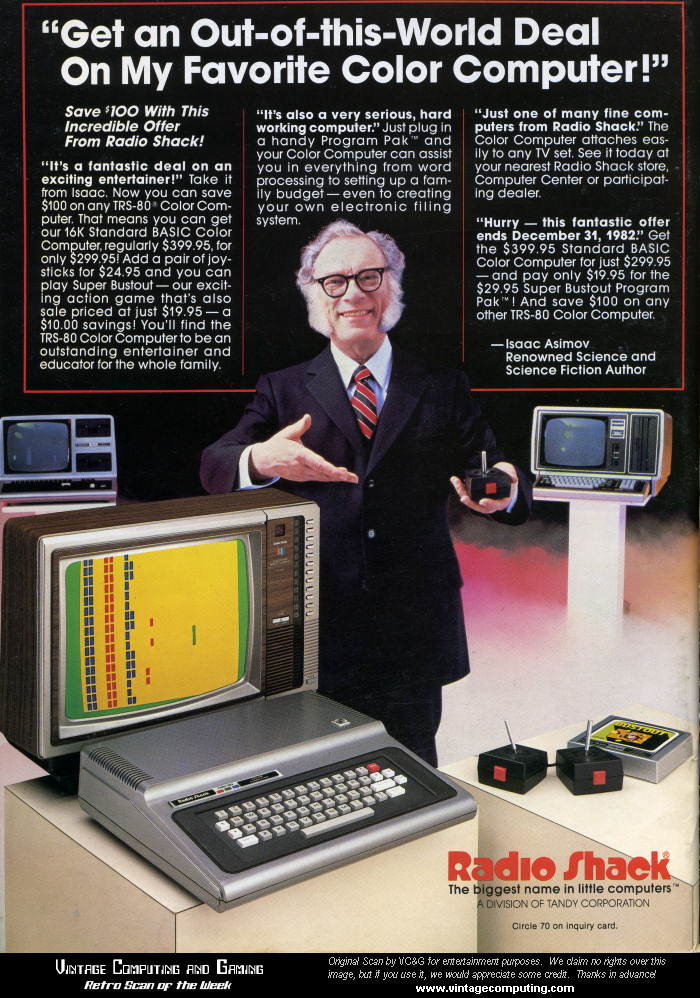

While my machine didn't come with a sideburned sci-fi author to give me lessons, and we had to hook it up to an old color tv, it did come with a cassette deck (for storage) and the joystick that Isaac Asimov is holding in the ad at left.  To my undying regret, instead of working hard to learn BASIC coding (my father got me every book in the local library about programming) I spent my time playing an Asteroids knock-off called Microbes along with chess and Zaxxon.  If you are interested, you can see the CoCo in action in the movie This is Spinal Tap, when the band are playing computer games on the tour bus.

The games were fun, (considering the .89 MHz processor) but I can't help feeling that I missed the boat.  So many people of my generation wound up being involved in software design, but because of my weak will and poor choices, I have been relegated to the status of "computer user" instead.  But I have tried to make up for it by using a lot of computers.


When I went to Hampshire College in 1988 I was part of one of the last groups of students to go to school with typewriters.  (Unlike my friend Sascha, who had the first laptop I ever saw in person).  But after struggling on my electric typewriter for a semester, my father bought me a "word processor" from Brother.  It featured a built-in daisy wheel printer, floppy disk storage, and a CRT screen for previewing work prior to printing.   As you can see, the machine was kind of big and bulky, but it worked pretty well.  You had to load in pieces of paper one at a time, there were no fonts, and you couldn't add images to your papers, but I wasn't looking for any of that, so I didn't miss what I didn't have.
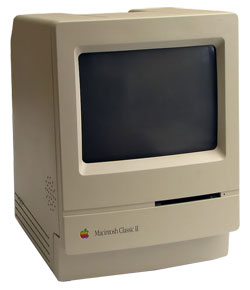
For my fourth year of college, I had to complete a major project called a Division III, which in my case took the shape of a 75 page paper (about arbitration in major league baseball).  My father was, by this time, a Macintosh enthusiast, and while he had never used one, he read everything he could about the brand and was convinced that his kids should have Macs.  So he found a way to get my younger sister and me new Macintosh Classic computers.  This was a major step up.  It had a 9" screen that could show 16 shades of gray.  As far as I was concerned, the display was breathtaking!  My father splurged for 2 MB of RAM, so that my computer could run Apple's new System 7 (the first one that allowed a user to run multiple programs at once).  I remember being very impressed with the 20MB hard drive, and wondering why anyone would ever need so much space!  I used this computer from 1991-1994.  During that time I did college and grad school work on it, designed flyers and documents for my job as a fire safety consultant in Boston, and wrote a weekly column for a newspaper in Northampton, MA.

By 1994 I was married and living in Indiana, going to grad school at PurdueMy wife wanted a peppier computer, especially one that could take advantage of the "Internet".  So we went to Sears and bought a Performa 550, a color computer with a modem (that came with an America Online account). The Performa was significantly faster, with a blazing 33MHz processor (a 680030, instead of a 680000) and it had a CD-ROM drive, could display 256 colors and had a 100 MB hard drive.   It weighed over 40 pounds (compared to the Classic's 16 pounds) which was a nuisance as we moved three times with this machine, but big screens meant big weight back then.   I wrote my Master's thesis on this computer, and learned how to make my first websites on it.  This computer was great for work and amusement, and during the mid-1990's I was an ardent Macintosh hobbyist.  Eventually, in 1996 my knowledge of computers got me a job at St. Paul's School in Concord, New Hampshire, where I supported 120 Macs, and helped teachers integrate computers and the internet into their curricula.

Working at St. Paul's gave me the chance to have hands on experience with a bunch of neat computers.  Each classroom had 15 Apple laptops chained to the desks for the students to use.  Among the machines I supported were computers such as:

  • the PowerBook 520c (left): a color laptop (Apple's first).  My first day at work I had to move a cart of 20 of these ($2500 each) from one building to another.  The thought of what would happened if the cart fell over had me breaking out all over in hives!


  • the PowerBook 5300cs: this computer was quite nice, but several of the first ones off the production line caught fire due to bad batteries.  This was before Steve Jobs' return to Apple and back when quality control was less than optimal.  You can see this computer in the movie Independence Day, when Jeff Goldblum uses it to save the planet.  THAT is science fiction--these computers couldn't go more than 20 minutes in a climate controlled room without freezing and needing a restart--I doubt that they could function in an alien spaceship.  But maybe I'm just bitter.. I had one of these as my own work machine for a year, and it was heavy and buggy.

     • the PowerBook Duo 2300: the Duo series was a sub-notebook.  The docking station had a CD-ROM and floppy drive, so the machine itself was very light and stripped down.  I used this computer as the controller for the campus closed-circuit TV network.


    There were also more powerful desktop machines like the PowerMac 8500, which was the first computer I ever used to edit video.  This powerhouse had a 100MHz processor, and was amazingly fast.  I was blown away when I could edit together some video, leave for the night, and come back in the morning to find that it had rendered.  Amazing!


    After spending so much time with cutting edge Macs, the Performa started feeling less than optimal, so my wife and I took a plunge on the first generation Apple iMac.  This machine (still in my attic 13 years later) was a breathtakingly designed all-in-one machine.  It ran at a sizzling 233MHz, and was the first Apple computer (and first mainstream machine from any vendor) to forego a floppy disk drive.  Steve Jobs noted that we were living in an "internet age" and no one needed to "sneaker net" small files from place to place.  Apple took a lot of flak from this at first, but no one can deny that they were correct!  The iMac was also the first computer from any vendor to feature USB ports, marking Apple's break from the venerable SCSI connection paradigm.


    In 1999 I moved from St. Paul's to Groton School, where I took the job of Academic Technology Manager, administering the email system and continuing to work with teachers at integration of technology.  My first job was leading a program where all the faculty were given Dell Latitude C600 computers.   I had to train the teachers on the use and upkeep of these machines.  Moving to a Windows computer was shocking at first--when I took the computer home the first night I kept rebooting it--I couldn't understand why the first things I saw on the screen were BIOS notifications.  Pretty embarrassing way to start!  

    At Groton I was the "Mac guy", and I was able to take charge of a cutting edge Mac lab, featuring PowerMac G4 towers and containing photo and video editing, music composition, and advanced math and physics software.  These computers were very advanced, running at over 300MHz, they were as powerful as the "super computers" of the early 1980's.  One thing I liked to do was, by rolling around the room on a wheeled office chair, hit the power switch of each machine so that the boot up chord just kept on ringing and ringing.  Through the built-in speakers of the matching monitors, the sound was pretty awesome!  
    As the Mac guy, I also persuaded my boss to let me use a PowerBook G4  I mean, I had to do "Mac stuff" right?  I needed it for work!  This computer was made of titanium, and featured a 15" wide screen display.  It was on this computer that I first used MacOS X, when I got a copy of the OS in its beta release.  Using this laptop as a test bed, I was able to get the Mac lab running securely with OS X in early 2002.  This served as sort of a credibility builder when I moved from Groton to Wyoming Seminary in 2003.  I was going to be a history teacher/technology integrator, and when I went for my interview, I brought a bootable version of my OS X image with me.  Sem was only just beginning to consider OS X (they didn't go over to the new OS until 2006) but my experience was so strong that I wouldn't go back.  I immediately put OS X on the MacBook they gave me, and it's all I've used, on all three school laptops I've had at the school.

    In the summer of 2004, my wife began to feel frustrated by some of the limitations of the iMac, so we bought a PowerMac G5. I am pretty comfortable with saying that this is the best computer I've ever used.  It has been our main computer for seven years (I wrote this blog post on it).  It has two 1.8 GHz G5 processors, and still feels fast after all these years.  In 2009 I installed an extra internal hard drive and doubled the RAM to 2.5 GB of RAM.  The computer is rock solid, and rarely gets shut down (the longest uptime I've managed is eight months).  I've been able to do some pretty serious video and graphics editing on this machine, and probably played 10,000 games of Scrabble on it as well, including my high score of 531. I've also done some audio recording, and hope to continue to do more of that in the future.

    I'm so excited about the iPad.  Since the late '90s I've been waiting for a small, instant-on device that could be used by teachers and students in a classroom to access networked files, web pages and emails, while also being a viable tool for document creation.  Over the years I have tested (and found wanting) several devices, including:

    the Apple eMate 300: this is one of the coolest things I've ever used.  It ran Apple's Newton OS, on a 25MHz processor and used a touch screen and a stylus and could (sort of) recognize handwriting. It had a PCMCIA card slot for networking, and the clamshell case was almost indestructible.  This education market-only product fell by the wayside when Steve Jobs returned to Apple and killed the Newton.  Supposedly Apple has continued to maintain development of handwriting recognition software, but it seems to be missing from the iPad as of now.

    • the Palm pilot: I've tested numerous Palm OS (created by former Newton developers) devices over the years, some with stylus inputs, others with built-in keyboards.  The OS never seemed rugged enough for kids to use in class, and the weak processors made the machines far to slow to be useful.

    • the Psion Series 7: Before the Symbian OS became a global leader in mobile telephony, it was used to power small PDA devices.  Psion tried to take the PDA software and blow it up onto a bigger machine, with a built in keyboard, color screen, and a Microsoft compatible office software suite.  The case folded into a slick little clamshell, with a leatherette covering.  The machine used a stylus/keyboard combo like the eMate, and could connect to the internet.  When I was at Groton I met twice with the American home office of Psion, and tried to get them to give me a classroom's worth to test out.  But the retail price of over $1000 made these devices cool, but more expensive than PowerBooks that were far more powerful.    I have bought an external keyboard for my iPad, and I am hoping that it will give me an eMate/Series 7 vibe.

    In closing, this sampler of some of the computers I've worked and played with over the years has made me reflect a bit about Moore's Law.  Simply put, this concept was put forth by Intel founder Gordon Moore, and says that every 18 months computer processing power doubles, and prices fall.  A simple comparison between all of the computers I've owned personally shows this.  Each machine cost between $1000 and $1800 (with educator's discount).  But each machine left its predecessor in the dust in terms of performance, stability and capabilities.  Our PowerMacintosh G5 cannot run Apple's most recent OS versions, and soon the time will come where we may have to consider "upgrading" it to something running an Intel processor like Apple's more recent products.  And if we do, the speed and performance increase will be notable.  Who knows?  Maybe it's not too long before the Star Trek computers (maybe more like the Next Generation, than the Original Series) will be a reality!

    Tuesday, March 8, 2011

    Lester Mazor, 1936-2011

    On March 6, 2011, Lester J. Mazor died after a short illness.  Lester was a major figure in my life from the first time I was a student in his class (January 1989) until his death.  He and I corresponded regularly, especially during the fall of 2010, as he and I rooted for the Philadelphia Phillies in the baseball playoffs (Lester would watch the games in Berlin, and email me at 5:00 AM his time to analyze what had happened).  During the 21 years that I knew Lester (more than half my life) he served as a mentor, role model and father figure.  Many people are sharing their reminiscences about Lester lately, from Hampshire's press release, to the wonderfully elegaic effort by my friend Sascha Freudenheim, which really captures a lot of Lester's essence.  Having made certain to share with Lester over the years just how important he was to me, I thought I would take this opportunity to share some memories of my time with Lester, and give a sense of what he has taught me.

    ******

    When I arrived at Hampshire in the fall of 1988, many of the "original" professors were still there, and most were still energetic in their early 50's.  I frequently played (rather cutthroat) softball against Ray Coppinger and Lynn Miller, and while I never took the court myself, my friends had lots of stories to tell of Lynn and Lester Mazor's rough play in basketball games.  My friend Chris Glawe, F'85 did a killer Lester impression, and would frequently have me in stitches with his stories of the exploits of "Lester the molester".  

    To that end, I was a little nervous to take my first class with Lester in my second semester.  The course was called "Law and Labor in U.S. History", and it is not going too far to say that it changed my life.  I had always been interested in labor history, and the "hidden history" of America, but this class showed me that in many cases, the most overtly anti-labor actions in the country were carried out in judicial opinions and statute books; which are not as obvious as army troops shooting strikers, but in many cases are more far-reaching.  To this day, I have never worked harder for a class than I did in this one.  As I wrote in my Div. II self-evaluation, "even though I left every afternoon at 3:00 feeling like a two year old" I was proud of how much I learned.  What was most inspiring is that Lester (and co-teacher Flavio Risech) expected us to do the kind of work that law school students did.  Trying to live up to these expectations was a lot of pressure, but also very gratifying.

    In the last two years I have taught a high school class called "The American Century: Constitutional Issues", in which students read over 20 Supreme Court decisions from the period 1954-2000.  Students read the full decisions, including concurrences and dissents, which is pretty rare for 11th and 12th graders.  I have been pleased by the effort the kids have put out, and by the number who have thanked me for challenging them.  Lester's influence on this class stretched back to that class in 1989, but also went on up through this past December, as he would frequently debrief me about issues coming up in the class via email.  I will really miss being able to discuss next year's version of the course with him.

    In 1990 I also took a class with Lester and Jim Wald called "From Potsdam to Perestroika: East Central Europe since 1945".  I thought this course would just add balance to the heavily American tilt to my studies, but it did much more than that.  Lester would frequently give me articles or books to copy, but knowing that he would want to talk about it, I read the things first myself. Lester also made sure that we understood that popular culture was an important way of understanding these societies.  We read novels by Kundera, Kozinski and others (inspiring my early desire to write a mash-up of the works of Oscar Wilde in the style of Milan Kundera-- "The Unbearable Lightness of Being Earnest").  Throughout the course, Lester promised that he would eventually reveal to us the reason why communism fell.  We all expected  a long, wordy answer.  On the final day of the class Lester came in (10 minutes late, as usual) with a boom box.  He walked to the front of the room, pushed Play and the first notes of the Beatles' Revolution rang out through the class.  Lester just gave us one of his "hmm" sounds and walked out.  I have actually stolen this (with slight adaptations) for classes of my own.

    In 2006 I returned to Hampshire to attend the final in a series of law lectures organized by Lester.  Before it took place I sat in on a class in that year's version of the East Central Europe class.  It was very odd to be in the same place, listening to Lester's Socratic method again.  And he still took the time to teach me! In the class he discussed how "signals" sent by Gorbachev's USSR gave Poles, East Germans and Hungarians the freedom to start the rebellions that wound up bringing down the Iron Curtain.  Afterwards I asked him what these "signals" were like, and said that I didn't think we had them in our society.  Lester chided me, referring to a story in that morning's paper about the report of the Iraq Study Group.  He said all I have to do is keep my eyes open to see the signals.

    During the Spring of 1991 I took an independent study with Lester.  Over the course of 14 weeks I read 12 major works of political philosophy, writing 10 papers.  Each week I would sit across from Lester's desk while he grilled me on what I had read, from Hobbes to Locke, to Marx to Foucault.  During these sessions I was always awed with Lester's grip on history.  He would always ask "what was going on" during the time we were discussing. Sadly, I often didn't know, which would send me back to my books so I could come in the next morning and give a better answer.  Now, at the age of 40, after teaching history for so many years, I can do what Lester demonstrated in those independent study sessions.  And whenever I ask a student "what was going on then?" I think of Lester.

    In the Fall of 1992 I did part two of this independent study, along with Sascha Freudenheim and a few others.  Sascha has described this in his eulogy, but the "D.W.E.M. Sem" (Dead White European Male Seminar) was a very rewarding experience.  Sascha and I were basically the leaders, and Lester supervised.  Sascha was (and is) much smarter than I, and more attuned to philosophy, but I am proud of having had the chance to do my bit.  Around this time Lester assigned us to drive his Ford Focus to Amherst for some reason (flowers?  dry cleaning? pastry?), and since neither of us drove manual transmissions, it was very exhilirating (and dangerous).  Lester's trust for us was only matched by his impatience at how long it took us to complete the errand. 

    In my Div. III year I had few classes, and nothing before 1pm.  I would usually stay up working until my favorite radio station went off the air at 2AM.  But it was around then that I changed my daily habits, so that I would wake up at 7, have breakfast with Lester, clip articles until 9, and then go to sleep again until the afternoon.  I always enjoyed watching Lester chat with the dining hall staff.  Lester often impressed upon me that success at a school was much more likely if one was friendly with mail room, dining hall and maintenance workers.  I have tried to heed these words at the schools I've worked at, and I am sure that Lester was right, as usual.

    ******

    During that pivotal Spring '89 semester, Lester hired me as his assistant.  This work-study job entailed my making numerous photocopies for his classes, clipping and filing countless newspaper articles (pre-WWW), and trying to clean and organize Lester's office.  For those of you who went to Lester's end of Franklin Patterson Hall back in the day, you will recall that books, papers and other detritus covered every surface in the room.  And he had over 20 cartons of "Hampshiriana" in the storage room downstairs. I do not exaggerate when I say that one day, while cleaning up, I came across Lester's first grade report card!  While I was boggling, Lester and Stan Warner came in.  I waved the paper accusingly before Lester, and Stan said "only Lester could figure out how to get a document older than the college buried in this office", perhaps a reference to the courses Lester taught about the philosophy of time.  Lester seemed to appreciate my nagging that he clean his office, but no progress was made.  Imagine my surprise when I came back to visit him in 1995 and found the room clean as a whistle!  He just shrugged and gave one of his trademark "hmm" noises.  He was full of surprises.

    Working for Lester was deeply rewarding.  Basically, every morning I got a private session with Lester.  He would have NPR on the radio and would expound about the stories, or the newspaper articles, or about an upcoming speaker he was hosting in a Law Lunch.  The Law Lunches were afternoon sessions in the Merrill House living room, and they were very informative.  Lester particularly tried to bring in speakers who could talk about issues in Europe, which was very eye-opening to a provincial naïf like me.  

    One of Lester's favorite activities then was the "Divided City" trip, when he would take students to both sides of the Berlin Wall during Jan. Term.  I was able to go on this trip in 1991 (by then it was called "Divided City Reunited"--ultimately Lester set up a Hampshire campus at the Free University of Berlin).  It was my first (and only) time traveling abroad, and the trip was another instance where Lester helped change my life.  In the first place, he managed to finagle funding from the school to pay for my trip--all my parents had to come up with was spending money for my two weeks in Berlin.  In the second place, he was confident enough in me to let me have more freedom than I'd ever had before.  I spoke no German, had never been on my own in a city, and yet I had to travel from my hostesses home to all kinds of places all over the city.  I was embarrassingly provincial (years later, Lester tried to lure me back to visit Berlin, saying "they sell Cheerios here now") but I learned a lifetime's worth of lessons.

    All my life, I had been taught to dislike (and fear) Germans.  In fact, my discomfort was so high that I never planned to go--I only put my name on the list for the trip because Lester kept asking me too (all the time I knew that I couldn't afford it).  When Lester came up with the $1400 to pay for the trip I was chagrined, to say the least.  On my first day in Berlin, I went to dinner with Lester and Professor Hermann Klenner, who had been in the Wehrmacht in WWII.  As I wrote in my self evaluation, "I was confronted with my bogey-man.  And I liked him!"  During the visit, the U.S. Congress was debating whether to give the first President Bush permission to launch the first Gulf War.  On the night before I left, the allied bombing campaign began.  When I returned to my hostess' home, she was crying before the TV.  I asked what had happened and she said "you're bombing Iraq".  I blustered a demurral (after all, I was opposed to the war!) but it was too late.  Birgit had done to me what I had been doing to Germans my whole life, and the lesson I learned that moment about the dangers of stereotyping, generalizing, and rushing to judgement is one I think about all the time.

    ****** 

    The last time I saw Lester was in the end of September, 2008.  He had written me out of the blue, saying that he would be at a conference in Villanova, PA (about 100 miles away) and that he'd like to see me.  I immediately made plans to visit him for breakfast at his hotel, where I was surprised to learn that Lester also expected that the visit would entail my driving him to the airport.   Lester was physicaly diminished (gout, arthritis, and weight gain made it impossible for him to bend his legs., and heart trouble limited his movements.  He regretted not being able to play basketball anymore) but mentally as sharp as ever.  I have to confess to having been nervous during the drive down--after all those years, I didn't want to sound silly or not smart!  We discussed the upcoming election.  Lester, of course, was famous for advocating ballots with a "none of the above" option.  I shared with him my wary distrust of Barack Obama, and was impressed when he analyzed the Senator's character, career and campaign, concluding with an admission that he was planning to vote for Obama.  Lester acknowledged that politicians will always disappoint, and that they rarely live up to their stated principles, but concluded that it was important to have hope.  I found this very thought provoking and inspiring.

    I have 75 saved emails between Lester and me, dating back to 1997.  Early ones vacillate between complaints about this new technology (Lester had always done all of his typing on a typewriter) and fascination about what he could do with it.  In the late 1990s he began spending half of the year in Berlin with his wife Anne (Sascha and I attended their wedding, which was a great honor--Sascha has some pictures of the event) and Lester would write to tell me how helpful the internet was to follow NBA and NCAA basketball. Lester was a gracious, empathetic friend as I wrote to him about my job changes, the death of my father, and the lengthy, chronic illness of my wife.  Lester shared with me the stories of his own declining health, including multiple heart attacks and a serious stroke.  

    While I am sure that he corresponded with other former students on more intellectually meaningful topics, it always made me feel good to get another missive from Lester, (even when he was chiding me for not taking care of my injured back "after all", he said, "you're not getting any younger") with his usual closing "All my love, Lester".  I regret that I won't have the chance to get another of these messages, but I hope that wherever he is now, he knows that he has "all my love".

    Friday, December 24, 2010

    The War on (Merry) Christmas

    Depending on the circles you travel in, you may be aware that some right-wing types believe that there is a concerted "War on Christmas" that has been going on for years. Just Google "War on Christmas" and you will find over 2 million hits. Or you could go to Amazon.com and buy Fox News personality John Gibson's screed "The War on Christmas: How The Liberal Plot To Ban The Sacred Christian Holiday Is Worse Than You Think".


    Many people are terrified that before (or after) Barack Hussein Obama comes to confiscate our guns, he will also take away Christmas.  In their perfervid imaginations they can probably already envision a Kwanzaa tree on the National Mall. Ultimately, I think no one has anything to worry about here.  The reason is that government wars just don't work. Don't forget that there was a liberal "war on poverty" that started 44 years ago, and poverty rates are worse now than they were then.

    Liberals aren't the only ones who screw these things up.  Don't forget the conservative War on Drugs (40 years old) and War on Terror (9 years) that have been equally as unsuccessful.  In fact, I'm sure that there are a large number of poverty stricken Americans living in bad neigborhoods being terrorized by drug addicts right now.  They must be the independents we hear so much about.

    But hey, it's Christmas, right?  Why don't I just lighten up and give in to the holiday spirit?  Well, believe me I'd like to.  But there is something holding me back.  The phrase "Merry Christmas".

    I have been bothered by the expression "Merry Christmas" for decades.   My biggest gripe about it is that I have trouble quantifying just what people mean by "merry".  The dictionary definition of the word doesn't help that much:

    merry |ˈmerē |  adjective ( merrier , merriest )
    cheerful and lively : the narrow streets were dense with merry throngs of students | a merry grin.
    • (of an occasion or season) characterized by festivity and rejoicing : he wished me a merry Christmas.
    • [ predic. ] Brit., informal slightly and good-humoredly drunk : after the third bottle of beer he began to feel quite merry.

    I mean, I know what it is to be cheerful and I'm usually fairly lively, but I don't think that people really wish others a "cheerful and lively Christmas".  And as a non-drinker, I don't really relate to wishing people a "slightly and good humoredly drunk Christmas".

    Further, when one thinks of personages associated with Christmas, "merry" isn't the first word that comes to mind.  Santa Claus, for instance, is usually described as "jolly". Ebeneezer Scrooge required haunting by no less than three ectoplasmic spirits before he could bring himself to be a mensch.  George Bailey was basically suicidal. And don't get me started on the Grinch...

    But there is an alternative that I think could work for everybody.  In coming up with this, I decided to look to England.  As the progenitors of our language the British have a gift of the pithy phrase.  Such as "French Leave" to describe someone who departs without permission, or a deserter.  On the other hand they call french fries "chips", which is confusing.  But English antipathy for their Gallic neighbors is a topic for another day.  The main point for right now is that in England, people greet each other in December with a hearty "Happy Christmas".  This phrase is simple, direct and to the point.  I believe that we should adapt this for ourselves. 

    I've been happy, I know what happiness is, and I want everyone to be happy all the time.  Especially on such a special holiday.   So, from me to you, please accept my best wishes for a

    Happy Christmas.

      
    War is Over (if you want it...)

    Friday, November 26, 2010

    Desert Island Discs, #1--Layla and Other Assorted Love Songs

    Every year as an icebreaker exercise I ask students to name which record album they would want with them if they were trapped on a desert island (with an infinite supply of electricity).  Parenthetically, I've been doing this so long that I've had to change the question from "record album" to "CD" and now I come across lots of kids who say they don't listen to CD's.  The answers always vary, ranging from pop stars du jour to classic rock to some equivalent of "mixed tape" (the most creative students).  But I thought I would take some time here to delve into my choices.

    I will write about other albums in the future, but for most of my life there has only been one true "desert island disc" for me: Layla and Other Assorted Love Songs by Derek and the Dominos.  The album was released in the Fall of 1970 (40 years ago), just three months after I was born.  I picked up my first copy of the album on vinyl at the local Pathmark supermarket when I was 14.  The album cover has a bewitching image of a mysteriously beautiful woman on the front, and "Brownie" Eric Clapton's sunburst Fender Stratocaster on the back, surrounded by dominos.


    "Derek and the Dominos" was a group fronted by English guitar legend Eric Clapton.  Clapton, who was born in 1945 (12 days before my mother) fell in love with American blues music in his early teens and became obsessed with learning how to play like his heroes (in due course during my early teens I fell in love with Clapton's music, and he became the gateway to my own blues obsession).  He played lead guitar in the Yardbirds (who later featured future superstars Jeff Beck and Jimmy Page in the lead guitar chair), leaving them after they became, in his words, "too commercial".  Clapton went on to play for a year with British blues patriarch John Mayall in his Bluesbreakers.  During this time the 19 year old Clapton blazed his way to fame on the "Beano" album, which prompted London graffiti artists to scrawl "Clapton is God" on the walls of the metropolis.

    Clapton left Mayall to start the first "supergroup", Cream, with former Graham Bond Organisation drummer Ginger Baker and bassist Jack Bruce, who had played with the GBO and the Bluesbreakers, among other outfits.  Cream had a short, meteoric career, demarcated by thrilling live performances and vicious infighting between the rhythm section members.  Clapton had envisioned a true blues group, while the others preferred jazz oriented free-form explorations.  Clapton soon tired of this conflict, and began looking for new outlets for his creativity.

    One example of this was enabled due to his close friendship with Beatle George Harrison. In the late 1960's, as the Beatles were also starting to grow apart following their withdrawal from the road, Harrison felt that his contributions were being denigrated by John Lennon and Paul McCartney.  During the tracking of what became the double LP known as the White Album, Harrison brought Clapton in to play the leads on the stirring number "While My Guitar Gently Weeps".  Clapton also began listening to the first album by The Band, Music From Big Pink.  The rootsy, folksy music emanating from what critic Greil Marcus later called the "Old, Weird America" (recorded by a group made up of four Canadians and an American) inspired him almost as much as the concept of musicians living communally in an idyllic, country setting.  Once again, Clapton decided to leave the group which brought him fortune and fame to seek his muse.

    By now, Clapton had met up with Delaney and Bonnie Bramlett, who led a band that played with Joe Cocker on his "Mad Dogs and Englishmen" tour.  Delaney and Bonnie and Friends, featuring a crack rhythm section from Oklahoma (bassist Carl Radle, organist Bobby Whitlock and drummer Jim Gordon) had the authentic Americana vibe, and seemed to be a mix of communalism and professionalism that attracted Eric Clapton.  He hired them as the opening act on the only tour for his next band, Blind Faith.  The experiment with Blind Faith died out quickly due to Ginger Baker's drug addiction and the fact that Clapton preferred being a sideman for Delaney and Bonnie than the frontman of his own group.  After Blind Faith fell apart, Delaney produced Clapton's eponymous first solo record, which featured hits like "Let it Rain" and "After Midnight", songs that represented a departure from the blues pyrotechnics EC had made the basis of his renown.

    During this time, as described in painful detail in his autobiography, Clapton, Eric Clapton's frustrations were not only musical in origin.  He had fallen deeply in love with Pattie Boyd Harrison, the wife of his best friend, the Beatle George Harrison.  The Harrison marriage was not very strong, but Clapton was conflicted with worries of being disloyal, and Patti was not ready to leave her husband despite his infidelities.  As a way of hiding from the stresses of his passions, Clapton hid in a haze of heroin with his teenage girlfriend Alice Ormsby-Gore and obsessed over Patti.

    One source of this obsession was reading the classic Arabic story of the doomed love of Layla and Majnun, making the rounds of swinging London's newly multi-culturally aware youth.  Soon Clapton had written several songs based on the idea of hopeless, forbidden love and put together a group with Radle, Whitlock and Gordon to record them.  Hoping to remain incognito, the group was billed as "Derek and The Dominos" (though the concept was ruined when a nervous record company released posters proclaiming "Derek is Eric").  After a week of recording at Criterion Studios in Miami, the Dominos were joined by Duane Allman of the Allman Brothers Band.  The 24 year-old slide guitar wizard pushed Clapton to new heights of songwriting, arranging and soloing in their ensuing collaboration.  After weeks of marathon sessions combined with ingestion of massive quantities of drugs, one of the greatest albums ever made was finished.  The following is my summary and description of the tracks on the record.


    Side One
    "I Looked Away": This song begins with a simple melody in the key of C played on a Stratocaster, with counterpoint lines overdubbed.  Eric Clapton played all of the guitar on the first three songs of the album, even though the music does bear some resemblance to Allman Brothers-style twin lead guitar work.  This is likely due to the influence of producer Tom Dowd.   Clapton sings the bulk of the song, until Bobby Whitlock bursts in with a soulful change of tone:

    Seems a sin
    To love another man's woman
    I guess I'll keep on sinning and loving you Lord
    'til my very last day

    This is one of the first of many hints that the theme of unrequited (or at least, unanswerable) love would permeate the album.

    ************************

    "Bell Bottom Blues": This song was reputedly written for Patti by Eric (see more about this at "Layla" below).  The lyrics of this song never fail to pull at my heart.  When Clapton sings "if I could choose a place to die, it would be in your arms", or "it's all wrong, but it's all right" I choke up.  He is so passionately in love with her, but he doesn't know what it will take to have her.  In the chorus of the song he cries:


    Do you want to see me crawl across the floor to you?
    Do you want to hear me beg you to take me back?
    I'd gladly do it
    Because I don't want to fade away 
    Give me one more day please
    I don't want to fade away
    In your heart I want to stay

    The solo in this song is deceptively simple, switching from C major to A minor and featuring emotional, plucked harmonics (influenced by Robbie Robertson of the Band) that sound like angels.  The song features a long fade out which repeats the chorus.  After listening to this song I am drained emotionally.
    ************************
    "Keep on Growing": This mid-tempo rocker has a groove more like the work Clapton did with Delaney and Bonnie. Clapton shares the vocals with Whitlock again, and in this song he seems to describe how he needed to move on from Alice and be fully available to Patti. Clapton sings:

    I was standing
    Looking in the face of one who loved me
    Feeling so ashamed.
    Hoping, and praying Lord that she could understand me
    But I didn't know her name

    then Whitlock comes in with:


    She took my hand in hers and 
    Told me I was wrong.
    Said, you're gonna be alright boy
    Just as long
    As you keep on growing

    Many have argued that the duelling guitars solo on this number must be Clapton and Allman, but studio logs seem to indicate that Clapton did all of this work himself, though he consciously played in an Allmanesque vein.  Either way, this song is a major burst of hi-energy to pick the listener up.

    ************************

    "Nobody Knows You When You're Down and Out": Clapton put classic blues numbers at the end of sides 1-3, and this was the first.  "Nobody Knows You When Your're Down and Out" was originally recorded by Bessie Smith in the Depression, and it's world weary acknowledgement that popularity follows fame and fortune, but without it one has nothing is another drop back into the abyss of sorrow that Clapton seemed to be feeling.  Interestingly, just a short while after singing "I began to fall so low / Lost all my good friends, I did not have nowhere to go" Clapton descended into near hermit like existence with nothing but Alice and heroin to get by (when Patti rejected him even after listening to this album). There is slide guitar on this song played by Duane Allman, making his first appearance on the record.

    ************************

     Side Two
    "I Am Yours": The beautiful lyrics of this song, which are repeated twice, come straight from Layla and Majnun:

    I am yours
    However distant you may be
    There blows no wind but wafts your scent to me
    There sings no bird but calls your name to me
    Each memory that has left its trace with me
    Lingers forever as a part of me.

    The musical accompaniment includes Indian style percussion and Duane's slide guitar, both repeating the melody line and embellishing it.  This song is lovely, and it always makes me think of my wife.  It is one of the most gorgeous love songs I've ever heard.

    ************************

     "Anyday" : Beginning with an emphatic combo of Hammond organ and slide guitar, this song rises to crescendo after crescendo.  Clapton seems to be feeling optimistic about his chances in this song, as he sings:

    If you believe in me
    Like I believe in you
    We could have a love so true
    It would go on endlessly
    And I know, anyday, anyday
    I will see you smile
    Anyway, anyway
    If only for a little while

    This is followed by Whitlock's gruff, soul-inflected voice trying to supplement the optimism with bravado:

    I know someday baby you're gonna need me
    When this old world has got you down
    I'll be right here so woman call me
    And I'll never, ever
    Let you down

    The instrumental highlight of the song is the intertwining of Duane's slide with Clapton's standard guitar playing.  They seem to raise each other to new heights of expressiveness and joy in each chorus. Clapton takes the first solo, sounding similar to that which he played in "While My Guitar Gently Weeps", and then Duane takes over with screaming slide action.  

    ************************

    "Key to the Highway": This blues in A was recorded live, and in fact it fades in during a solo chorus.  The song was originally recorded by one of Clapton's early heroes, Big Bill Broonzy, but the guitar duel between EC and Duane lift this into one of the epic blues rock songs ever.  Clapton plays standard guitar while Duane plays slide, and each man's solos wring the last drops of emotion from the common blues structure (though this is an 8-bar blues, not a 12-bar song).  The song describes a man having to hit the "highway" after having been "driven from home".  In general the lyrics are in keeping with the themes of the album, but the passionate playing is even more evidence of just how strongly Clapton was feeling the need for "one more kiss mama, before I go". 

    This is the most played song on my iTunes playlist, as I often put it on and play along on my guitar. 

    ************************

    Side Three
    "Tell the Truth": This song also brings some funky, countrified Oklahoma sound to the album.  Bobby Whitlock has described the writing of this song as coming out of the creative, drug fuelled ferment of the apartment the band all shared.  The song was the single for the album, and it seems like a single.  Frankly I've never felt that this song really fits with the rest of the record, and as a youngster I would often skip over this song (the old fashioned way, by lifting the tone arm) to get to the next one.  As a result my vinyl copy was scratched a lot at this point.

    ************************

    "Why Does Love Got to Be So Sad?": This is one of my favorite songs on the album, and one of the all-time great "twin lead guitar" songs.  My theory is that Duane Allman plays most of the lead on this song, though many people disagree.  To me the expressive soloing sounds so much like Duane, and so not like Eric that it is plain.  But either way, the song is a rollicking treat of guitar soloing.

    Starting with jet speed guitars responding to every lyrical line, along with a swinging bass and pumping Hammond organ, Clapton plaintively demands "why does love got to be sad?"

    Like a moth to a flame
    Like a song without a name
    I've never been the same since I met you
    Like a bird on the wing
    I've got a brand new song to sing
    I can't keep on singing about you

    The main solo that starts at 1:16 into the song blazes with passion. It is clearly Duane (without slide) who takes the first solo on his Gibson, with Clapton answering later on the Strat. The solos on this song (and on the next one) sound like the melodies to new songs.  They are so vocal that I often imagine new words in my head while they play circles around each other.  The fade out of this song is sort of a nice foreshadowing for the extended coda of "Layla" on the flip side of the record.


    ************************

    "Have You Ever Loved A Woman": the third blues standard on the album (also in the key of C), this song by Billy Myles had been famously covered by Freddie King, a Texas bluesman who had long been one of Clapton's heroes.  The words to the song describe a terrible situation, but one that I felt very deeply as a young man.  In college, I was secretly in love with the girlfriend of one of my best friends.  Eventually it worked out, and she and I have been married since 1994, but whenever I heard this song I felt deep down the pain and confusion of the singer:

    Have you ever loved a woman
    So much, you tremble in pain?
    Have you ever loved a woman
    So much, you tremble in pain?
    But all the time you know
    She bears another man's name

    But you just love that woman
    So much, it's a shame and a sin
    You just love that woman
    So much, it's a shame and a sin
    But all the time you know
    But all the time you know
    She belongs to your very best friend

    Have you ever loved a woman
    And you know you can't leave her alone?
    Have you ever loved a woman
    And you know you can't leave her alone?
    But something deep inside of you
    Won't let you wreck your best friend's home


    The song follows a typical blues "call and response" pattern, and Clapton's fills after each line sting and burn.  Duane Allman plays the first solo on slide guitar, taking two choruses to play a slow, stately lead.  Meanwhile, Clapton's rhythm work behind him is getting more pungent and insistent.  Finally Clapton screams into action, ripping off the most emotionally charged guitar solo I've ever heard.  To me, he is singing the words "I just love you woman, and it's a shame and a sin, but I have to have you.  I won't stop til I do.  I love you and I will tell you all my life"--I can hear how these words fit with the melody and rhythm he is playing.  At one point Clapton speeds up so fast he almost overtakes the beat, and he slows down while still milking each bended note for all the emotional content he can.  This is a solo for the ages.

    ************************
    Side Four
     "Little Wing"  Clapton was a great friend of Jimi Hendrix, who wrote this song.  The Dominoes recorded this song in the summer of 1970, only a few weeks before Hendrix died.  While in America Clapton had bought a left-handed Stratocaster for Jimi, and he hoped to give it as a gift at a nightclub that September night when Hendrix died at the age of 27.  This version of "Little Wing" is more of a rocking version than the Curtis Mayfield, soul inspired version that Hendrix had recorded.  This version is to "Little Wing", in some ways, as Hendrix' version of "All Along the Watchtower" was to Bob Dylan's original version (except that unlike AATW, the Dominos version of "Little Wing" has not become the canonical form of the song.  Originally meant as a tribute to a fellow guitar hero, by the time the album came out Hendrix had passed and this came to be seen as a memorial to a fallen legend.  Personally I've always preferred this version of the song, but I am definitely in the minority in that respect.

    ************************

    "It's Too Late": Written by early rock and roll songsmith Chuck Willis, this slow, 1950's -sh rocker is like the sorbet one eats to cleanse the palate before the next course, which is one of the greatest rock songs ever.  Over a simple chord pattern, Clapton sings with a bluesy voice:

    It's too late, she's gone
    It's too late, my baby's gone
    Wish I had told her she was my only one
    It's too late
    She's gone.
     .....
    I wonder does she know
    When she left me
    It hurt me so
    I need your love babe
    Please don't make me wait
    Tell me
    It's not too late.

    The song features good solos on standard (EC) and slide (DA) guitars over a rock and roll shuffle beat.  And while you can't hear this on digital versions of the song, on the original vinyl album, the last drum kick of this tune led without pause into the iconic opening lick of "Layla".

    ************************

    "Layla": The greatest rock song ever?  Rolling Stone magazine ranked it 27th, and it's hard to argue with many of the songs they list higher (except for "Smells Like Teen Spirit"), but I think it's the best.  Clapton's voice is blasted by booze, drugs, sleeplessness and longing.  I can't think of another song where the singer is so clearly opening his heart to the listener.  The words of the song come straight from his relationship with Patti, who becomes Layla for the course of the record.

    Parenthetically, Patti Harrison Clapton was the inspiration for several great love songs.  George wrote "Something" for her (the second most-covered Beatles song), Eric wrote "Bell Bottom Blues", "Layla" and "Wonderful Tonight" in her honor.  That must feel amazing.  But Patti says that when she hears these songs they make her sad for the loves she lost.

    The tough guitar, with soaring harmony leads introduces the song, which has poignant lyrics:

    What'll you do when you get lonely
    And no one's waiting by your side?
    You've been running and hiding much too long
    You know it's just your foolish pride.

    Layla--you've got me on my knees
    Layla--I'm begging darling please
    Layla--darling won't you ease my worried mind.

    Tried to give you consolation
    When your old man had let you down.
    Like a fool, I fell in love with you.
    You've turned my whole world upside down.

    Layla--you've got me on my knees
    Layla--I'm begging darling please
    Layla--darling won't you ease my worried mind.

    Let's make the best of the situation
    Before I finally go insane
    Please don't say we'll never find a way
    And tell me all my love's in vain.

    Layla--you've got me on my knees
    Layla--I'm begging darling please
    Layla--darling won't you ease my worried mind.

     According to Patti, Eric invited her to his flat and played her the record. Patti says:

    ...he wanted me to listen to a new number he had written. He switched on the tape machine, turned up the volume and played me the most powerful, moving song I had ever heard. It was "Layla".  He played it to me two or three times, all the while watching my face intently for my reaction. My first thought was, "Oh God, everyone's going to know this is about me." I was married to Eric's close friend George Harrison, but Eric had been making his desire for me clear for months. But with the realisation that I had inspired such passion and creativity, the song got the better of me. I could resist no longer.

    Though in reality she did resist, and in desperation Clapton threw himself headfirst into the pool of heroin that he wouldn't leave for years.

    The beautiful coda to the song, played on piano with Duane's bird-like trills on slide guitar was written by drummer Jim Gordon as part of another, unnamed tune.  But Clapton encouraged him to donate it for this record.  To me it is a lovely melody that hints at hope, redemption and endless possibilities.  In a lot of ways, "Layla" is two records in one, the hard rocker and the contemplative coda, but together they are even greater than the sum of their parts.

    ************************

    "Thorn Tree In the Garden": If you look up "anti-climax" in the dictionary you see this song.  It is a pretty song, plaintively sung by Bobby Whitlock, but after "Layla" who needs it?  Listening to the words more carefully shows that it fits lyrically and conceptually with the album, but it is hard to listen to this song (which sounds better suited for Harry Nilsson or B.J. Thomas) at the end of the record. 
     

    WHERE ARE THEY NOW?

    Eric Clapton: Clapton continues to record and tour.  After kicking heroin he married Patti, but the marriage was spoiled by both of their alcoholism.  While Eric marrying Patti seems like a dream come true, it was more of a nightmare.  Clapton has been sober since the late 1980's, and has founded a drug and alcohol rehabilitation center in Antigua.  He auctioned off nearly all of his guitars to pay for the center, including "Brownie", the guitar used on this album, which fetched over $450,000 in 1999.

    George Harrison: George remarried after Patti left him, raising a family and enjoying a life in movie making and seclusion.  He released several albums, including one as part of the Travelling Willburys, a "supergroup" with Bob Dylan, Roy Orbison, Tom Petty and Jeff Lynne.  He and Clapton remained friends, and EC coaxed George out for a co-headlining tour of Japan in 1991.  George died in 2001.

    Patti Boyd Harrison Clapton: Patti is still alive, and recently wrote a memoir of her interesting life.  She is a well-regarded photographer.

    Alice Ormsby-Gore: The daughter of the British ambassador to the US, who fell in love with Clapton at the age of 17 never recovered from what was ultimately unrequited passion for EC and an addiction to heroin.  She died in 1996 from an overdose, living in poverty in a bedsitter apartment outside of London.

    Delaney and Bonnie: Their marriage broke up, but each stayed in entertainment.  Delaney died in 2008, and Bonnie is still alive, occasionally acting and singing.

    Carl Radle: Radle died in 1980 as a result of years of drug and alcohol abuse.  His girlfriend (who found his body) later committed suicide.

    Bobby Whitlock: Is still in the music business, and has a memoir coming out soon.  It should be a good read. 

    Jim Gordon: Murdered his mother with a knife and hammer in 1983.  Diagnosed as a schizophrenic, he has been imprisoned ever since.

    Duane Allman:Less than a year after recording "Layla", Allman died from injuries sustained during a motorcycle accident.  He was 25 years old.

    Thursday, November 4, 2010

    It's A Small World After All...

    Sometimes I like to play the "What Do They Have In Common" game.  Like, it's cool to know that the members of Steely Dan and Larry Hagman all went to Bard College.  Or that Thomas Jefferson and John Adams both died on July 4, 1826, 50 years to the day after they signed the Declaration of Independence.  Or that Carol Channing and Joe Namath were both on Richard Nixon's enemies list (and, presumably) both wore pantyhose.  But every so often, something new pops up that amuses and amazes in the same breath.