Sunday, August 21, 2011

Everything I Needed To Know I Learned From Pro Wrestling (Pt. 2--Cage Matches)

As I've already noted in this space, I have been a fan of professional wrestling for over thirty years.  One of the things I appreciate about wrestling is the storyline aspect of a good match.  When things are done right, two grapplers will battle over and over again, sometimes exchanging victories, until there is a final showdown.  This showdown (known as the "blow-off" in wrestling vernacular) is often timed to take place at a major event; which in the case of large national promotions like the WWE,  would be a Pay Per View (PPV) event.

Of course, it isn't always cut and dried.  Many times the rivalry is between a good guy (a "babyface") and a bad guy (a "heel").  In these cases, you can never expect the heel to play by the rules.  Chances are, at some point in the build up he will have won by cheating, perhaps using one of the following methods:
  • using a foreign object, like a chair
  • getting assistance from a partner, a manager, or a valet
  • distracting the referee so that he misses an obvious violation of the rules
Regardless of how it happens, if enough tension has built up between the two wrestlers, the blow-off needs to be something that guarantees a final victory for one of the contestants.  For decades, the best way to ensure this is to have the match take place "inside a steel cage". In a cage match, the wrestling ring is enclosed in a cage, and the victory can only be had by pinfall, submission or escaping the cage.  In many cases the referee is actually OUTSIDE the cage, so inside the walls, anything goes.  

********************************************************************
Recently the Sassy Librarian and I got a treadmill for our house. I have come to enjoy using it in conjunction with Netflix on my iPad.  I just set up a video to stream, and the miles go by in a snap.  Today I traversed my 4+ miles while watching WWE: The Greatest Cage Matches of All Time.  I hadn't previously watched any of the WWE sets on Netflix, but I was quite impressed with this one.  It contained a half dozen matches covering the mid-1970's through 2009 (the actual DVD set has many more matches, but this is 2 hours of fun for free).  I was worried that I wouldn't be able to get into the matches, since I wasn't party to the build up of the rivalries, but I was quite wrong.  Hall of Fame announcer Jim Ross provided so much plot exposition that I quickly caught on to the excitement. Two matches stood out in particular:

  1.  Lex Luger v. Ric Flair (1990) for the WCW Heavyweight Championship
  2. The Rock v. Triple H (1999) for the WWF World Title
 ********************************************************************

In the first match,  the challenger Lex Luger came down to the ring first, followed by WCW champ Ric Flair.  Parenthetically, I was on an airplane with Flair the previous year, and it was amazing to see him maintain his persona in the airport and during the flight.  He was "stylin' and profilin'" with the flight attendants--it was a sight to see! 

For this match, Flair was accompanied by his valet, "Woman".  Woman later went on to marry wrestler Chris Benoit, who tragically murdered her and their son before taking his own life.  Before the match went on, the referee frisked both wrestlers, looking for foreign objects.  Luger demanded that the ref check Woman, which caused Flair to erupt in anger.  But when a blade was found in Woman's glove, it proved to have been a wise move.  

The cage used in this match was not like the one pictured above--it also had a roof.  There was no way out of this cage--a final victory by pinfall or submission was the only way to win.  As the match began, Ross told us that Luger had only just got out of the hospital, where a knee infection had kept him for the past two weeks.  The announcers wondered whether this would restrict his legendary strength, but when Luger slammed Flair twice with military presses, it seemed that his knee was fine.  This was important, of course, because Flair's most famous move, the "figure four leg lock" was known to target weak knees. 

Luger dominated the match early on, with Flair showing his craven cowardice (like all heels) by trying vainly to escape the steel structure.  During one of these attempts, Luger slammed his head repeatedly ("like a tennis ball" as we were told) into the cage, busting Flair's head open, and making him wear the crimson mask. Eventually Flair turned the tide while working over Luger's knee, illegally using the ropes for leverage while the ref's back was turned.  Then suddenly all Hell broke loose!  Flair's posse, the Four Horsemen ran down to the ring and tried to get into the cage.  And they succeeded!  As the cage rose, they ran into the ring to attack Luger.  Then Luger's fellow "Dude With Attitude", Sting (in real life, business partners in a well known bodybuilding gym in Atlanta) came down with the late "El Gigante" to make the save.  Flair was disqualified, but you can't lose a title by DQ, so he was able to leave with the belt, while making a frightening spectacle (something like the one above) in the post match interview.

What made this match so cool, of course was the swerve. We had been conditioned to believe that the cage was impregnable, and that a final verdict would have to come (and, of course, that justice would be served with a Flair loss), but it didn't happen.   Despite this match being over 20 years old, from a promotion that doesn't exist anymore, I was totally gripped by this match.  The wrestlers (with the help of the announcers and referee) told a great story.

 ********************************************************************
The second match took place in the WWF (now WWE, after complaints from the World Wildlife Fund), during a PPV from Manchester, England in 1999.  This match pitted two "young" (according to JR) superstars against each other, the emerging face hero "The Rock", versus the villianous Triple H.  HHH was affiliated at the time with his real-life girlfriend Chyna, a very muscular female bodybuilder who now does X-rated movies. HHH's name comes from his initials, which stand for "Hunter Hearst Helmsley".  Back in the '90's this was supposed to symbolize his wealth (like Leona Helmsley).  What is ironic about this is that in 2003 he married Stephanie McMahon, whose father owns the WWE.  This marriage was for real, unlike the storyline marriage they had in the 90's.  Now in 2011, HHH is in senior management of the company, and even campaigned heavily for his mother-in-law when she ran for the Senate. During this match, the announcers went back and forth between calling him Triple H and "Helmsley".  Nowadays, while some wrestlers call him "Hunter", the other two H's are forgotten.

Anyway, back to the match.  It was a back and forth affair for quite a long time, with several false-finishes where each man NEARLY, but not quite, escaped over the top of the cage.  At one point, HHH had his head and arms out the door, with The Rock hanging on to his feet.  While the door was open, HHH "accidentally" punched the referee, Earl Hebner, knocking him unconscious.  While the ref lay prone, The Rock managed to escape, earning him the victory.  But the official did not see it!  When Rocky realized what had happened, he and HHH took the match outside the ring, beating each other into the crowd and over to the announcer's table.  Then The Rock grabbed a microphone, and treated us all to a little "Attitude Era" dialogue:  

ROCK: Now The Rock obviously had the match won, but that jabroni, rooty-toot candy-ass obviously didn't see The Rock win.  So before The Rock whips your monkey-ass some more, in front of all of his fans, The People's Champ's got a little gift, compliments of The Rock and the fans of Birmingham...

FANS: (cheer)

HHH: (rolls around barely conscious)

ROCK: (picks up a chair, and beats HHH over the head)

JIM ROSS: Oh my God!  Great God Almighty! The Rock just hit HHH with a steel chair!

ROCK: (putting on announcer's headphones conveniently waiting for him): You're damn right that's what The Rock did.  That's exactly what The Rock does best: lays the smack down on his candy ass! Look at his ass!  There's the blood---the blood of HHH.  It's not the People's blood; it's monkey piss!  Monkey piss is oozing out of his head! Come here jabroni!  Have some more you sonofabitch (slamming HHH into the tv monitor). What do you think of that?

And then, after setting HHH ("deeply lacerated") onto the announce table, The Rock climbed onto the ring apron and leaped onto HHH, shattering the table.

At this point, The Rock  (to loud "Rocky Rocky") chants dragged his opponent back into the ring, while Hebner slowly regained his consciousness.  Then, just as The Rock had nearly climbed out of the cage, out of the back came England's own British Bulldog, Davey Boy Smith! The Bulldog was a heel at this time, and he began fighting with The Rock. And then Shane McMahon (now HHH's real life brother-in-law) came down and assaulted the Bulldog, until he was viciously bodyslammed onto the concrete floor.  Then the British Bulldog went into the ring to keep fighting the Rock, while Chyna came down to help.  At one point she slammed the door into The Rock's face so hard that the whole cage shuddered--pretty sick!  While The Rock was being assaulted by the Bulldog, HHH escaped the cage over the top.  

Then, to cap things off, while a bloody HHH was celebrating with Chyna, a pissed-off looking Vince McMahon (who at that time was a regular character on the show, as well as real-life boss) stalked to the ring, and padlocked the door while The Rock and the Bulldog were inside!  At that point The Rock proceeded to beat Davey Boy senseless, ending the match with his trademark raised eyebrow.

What made this match so engaging was that it was kind of like two matches in one.  As Jim Ross noted, "The Rock had this match won twice", but to no avail.  We were treated to two (at least) cage matches AND the brawl outside.  And while The Rock and his fans got satisfaction from his pummeling HHH, the heel still left with the gold.  While contemporary viewers were ensured further storyline development for the coming weeks, this match is great on its own.  With excitement, brutality and two wrestlers fully exploiting their characters, this was a lot of fun to watch.

 ********************************************************************

This video was very enjoyable (the multi-DVD set might be better) to watch, and you'll get to see some fine matches.  One of the great things about professional wrestling is that the more often you watch, the more conditioned you are to certain tropes of dialogue, movements and match outcomes.  But skillful wrestlers will always find a way to surprise viewers and confound their expectations.  That's why I'll never stop watching.

Thursday, August 11, 2011

I, Robot?

 I've always loved science fiction.  Full disclosure time here: I just spent hours trying to make my iPad look like a PADD from Star Trek!  Anyway, as a young person I spent a lot of time watching Star Trek and Jetsons reruns.   To the point that I found it very depressing that we didn't have rocket jet packs by the year 2000.  Another feature of sci- fi that always interested me was the idea of a future where robots would be our servants and humans would be freed from the mundane aspects of life.


Of course, everyone shared this belief.  I mean, Ringo even wanted Gort to become the fifth Beatle, if the album cover at left tells us anything.  And who can blame him?  Everyone wants a piece of famous robots.  To people growing up in the 1970's, the most compelling characters of the Star Wars movies were R2D2 and C3P0.  You can buy a replica R2 unit for yourself from high-end retailers, and women can even purchase the most un-sexy bathing suits of all time, if they so choose.


But let's be honest: to be able to delegate mundane tasks to a robot just makes so much sense.  This, of course, is why modern industrial robots (and there are over 8 million of them) have increased manufacturing efficiency (at the cost of jobs for real humans, of course). 

I've been particularly interested in this since my first visit to the Subaru plant in Lafayette, Indiana in the early '90's. First of all, if you have the chance to go to a car factory, you really should.  They are massive places, and you can actually watch a car go from random pieces of metal to driving out the door.  And besides the overhead conveyor belts carrying automobile carcasses through the facility, there are lots of really cool robots doing painting, assembly, welding and other tasks.  Ever since, I wondered when smaller robots would come to our aid around the home.

And then, a couple of years later, they proliferated!  The first one I heard of was the robotic swimming pool cleaner. These little chaps walk along the bottom of your pool (under water) and clean it for you.   Then came the robot vacuum cleaner, which can be programmed to sweep your floors, and even moves around your furniture.  Considering that vacuuming has always been one of my household chores, this seems very intriguing.  Plus, it could give the cats some amusement...

Since the Sassy Librarian and I bought to our dream house, I have come to love the process of mowing the lawn--something I had never done before we moved here.  I love riding around on my lawn tractor and I look forward all week to getting some "seat time".  But what if---I mean, you don't think--oh my!  They make robot lawnmowers now, too!  They wouldn't work on our property (too much land) but for a typical suburban house, this would be unbelievably awesome. I'm sure it won't be long before a professional sports team fires their head groundskeeper and replaces him with one of these babies.  I can hear the announcers talking now: "The umpires just consulted with the Robot Lawnmower to see what the rain forecast is."  The future is right around the corner.

So just as I had begun to think that there were very few jobs left that were safe from robots, I almost drove my car off the road when I saw a billboard promoting the local hospital's new service: Robotic Hysterectomies.  At first I scoffed, in my typical Phil Donahue feminist style, "I bet you won't find them doing robot vasectomies." But apparently the hospital uses robots for lots of other procedures, too, including some that only apply to men.  The surgeries actually employ a human doctor to operate the robot, but still, it just sounds so unpleasant.  I mean, if I was going to go have a major organ removed, I would prefer that a person was responsible, not a machine.  And what if you got a robot with problems, like Marvin, the Paranoid Android? I would hate to have my robot surgeon whining "brain the size of a planet, and all they ask me to do is remove this guy's enlarged prostate."  And who do you sue when they screw up?  I mean, medical malpractice is as close as most of us will ever come to winning the lottery.  And I bet Marvin has a brilliant team of lawyers, too...


Thursday, August 4, 2011

Pulling the Plug on Cable TV

In the fall of 1981, just as I was beginning 6th grade, my father surprised us by hooking the house up for cable tv.  I think that we were only the second house on our block to get cable, and it was wonderful.  Suddenly we didn't have to get up and adjust the large, steerable antenna on the rooftop, and we had access to channels (does anyone remember PRISM?)
that showed Phillies games, professional wrestling and feature films--without commercials!  Then there were other channels, such as MTV (which had begun airing the previous August), which gave me access to music videos, concert films, and interviews with musicians.

It is definitely true that for me (and many of my friends), cable provided the same shared cultural references that were supplied to previous generations by literature, theatre or the Bible.  It isn't going to far to say that the person I became was highly influenced by the large amounts of television I watched on cable in the 1980's. And since then I have always had cable--in college dorms, in summer housing, in numerous rented apartments, through thick and thin I always paid for cable television. 

But over the past twelve months or more, I have begun to question my cable purchase.  Since we moved to our dream house two years ago, the Sassy Librarian and I have been customers of Comcast (we get high speed internet from them, as well as tv).  The picture has been good, but the price is rather high--to be able to get Comcast SportsNet in HD, we have to buy no less than three different tiers of service, paying over $85 just for the tv part of the bill.  Over the years our tv watching has become more refined, to the point where pretty much all that we ever have on is sports and professional wrestling.  Lately it has been harder and harder for me to justify paying so much money to watch Phillies games and Monday Night Raw.  So I tried an experiment.

After doing some research at AntennaWeb.org, I became convinced that with an indoor tv antenna I could probably get some channels in HD (I can definitely do it with a roof antenna, but we aren't prepared to install one at this time).  I went to the local BuyMore, and picked up a reasonably priced amplified antenna, and was pleased to see that I can get about a dozen channels, with super reception (including ABC, NBC, CBS, Fox, CW, WB, ION and 3 PBS channels)! And the major networks are all in beautiful High Definition!

So I called Comcast first thing Monday morning and cancelled the tv coverage. Initially I had a bad case of television withdrawal, but a few days later, I have to say that I feel pretty good!  A major reason is that it isn't as hard as I had feared to find the stuff I want to watch.  Within a day of the tv show, the WWE posts their Raw and Smackdown shows on YouTube in HD. I can watch those shows on my computer, or my iPad, or (by plugging an HDMI cable to the iPad) on my actual television set.  On the down side I have to wait for the clips to load, but on the upside there are no commercials and I don't have to watch matches that don't interest me.  I simply read the summary of RAW and Smackdown on the Lords of Pain website, and look at the sections that seem like they'll be compelling.

For watching Phillies games, I have a slight dilemma. Even though we live 130 miles from Philadelphia, we are still technically in their blackout zone (also the blackout zone for both New York teams and the Pittsburgh Pirates).  This means that even if we purchased MLB.TV, we couldn't watch live web telecasts of games for the Phillies, Pirates, Mets or Yankees.  This has been the gating factor keeping me from dropping cable for quite some time.

But lately I've begun to listen to the Phillies radio broadcast using MLB At Bat (we get terrible radio reception at the house), and I realize that I like listening to the games on the radio.    While former Phillie Gary "Sarge" Matthews provides excellent color coverage on tv, he's only on for the middle three innings.  Otherwise, the play by play duties are handled by the very bland and boring Tom McCarthy and color is done by Chris Wheeler. Wheeler has been with the Phils my whole life, and while he is a great fan and has a great memory for old players, his style on the mic is not felicitous.  On the other hand, the Phils radio duo of Scott Franzke and Larry Anderson is quite good--they have a wonderful rapport with each other, and they don't let their boring stories get in the way of the game, like McCarthy does.  Listening on the radio, I find that I can go an entire game without saying "God, what a bad announcer"--which hasn't happened since I moved away from Don Orsillo and Jerry Remy's Red Sox games in 2003.

This week I've listened to the Phils on the "radio" (actually my iPad), and it has been a fun experience.  Besides better announcing, I also found that it was easier to read while listening on the radio than watching on tv.  Also, instead of being chained to the television, I was able to consume the game in my office, on my porch watching the sunset, in bed, and on the treadmill doing a brisk two miles.  I even signed up for a one month trial of MLB.TV.  Last night we watched the "archived" version of yesterday's day game from Colorado (the games are available to watch 90 minutes after the final pitch).  It was pretty cool!

I'm sure that the adjustment will continue to take time, but this first week has been much easier than I expected.  A quick perusal of the NFL schedule shows me that the Iggles should be on a channel that I get in HD 15 of 16 games, so I shouldn't miss much there, though I did always like watching Comcast's post game show starring "V-Heb" (Vaughn Hebron), "R-Diddy" (Ray Didinger) and "The Gov" (Ed Rendell).

It seems that this concept of dropping cable tv is growing in popularity.  Maybe it's the terrible economy, or the "57 channels and nothing on" phenomenon, but I definitely feel good about having made this decision (and saving over $800 per year sounds pretty good right now).  At least so far, Comcast seems to be doing ok, so I guess you could call this one Win-Win-Win.

Friday, July 15, 2011

Old Movie Stars

I had a small realization the other day that blew my mind.  The Sassy Librarian and I were watching one of our favorite movies, "On The Town", a 1949 Gene Kelly-Stanley Donen musical about three naive sailors given 24 hours shore leave in postwar New York City.  They don't have much time to see the sights (and find some girls) but they manage to do all of that and more, along with great songs and genuinely funny slapstick humor.   One of the sailors ("Chip") is played by Frank Sinatra, who in the course of the movie falls in love with a vivacious lady taxi driver ("Brunhilde Esterhazy") played by the late Betty Garrett.

It occurred to me that when I think of Betty Garrett, I don't think of her as the singing, dancing star of
 '40's and '50's musicals, or as the longtime wife of blacklisted actor Larry Parks;
instead I think of her from the 1970's sitcoms she acted in when I was a kid.  I don't think of "Hildy" from on the town, as much as I think of Laverne and Shirley's landlady Edna Babish.  This makes a certain amount of sense.  After all, they say that "first impressions are lasting impressions" and I was an avid viewer of tv and movies when I was young.  But I realize that people of, say, my parents' generation, would think of Betty Garrett as she was when she was young.


Honestly, my image of Frank Sinatra is similarly confused.  To me growing up, Sinatra was an old, bloated former star who had a suspect relationship with Nancy Reagan and made a noteworthy guest appearance on Magnum, P.I.  But, of course, when Ol' Blue Eyes guested on Magnum in 1987, it was the last of 61 acting credits he racked, up, not to mention being one of the most famous and iconic singers of the WWII era.  Clearly, my grandparents would think of Sinatra as he looked when THEY were young, not as he did at the end of his life.


So, now that I'm getting old, it makes me think about stars of my youth.  For instance, when I was growing up in the 1980's Madonna was a huge star.  She also came out with a new look in every video for her songs, and continually pushed the limits of decency and sexiness.

  When I think of Madonna, I automatically think of her from her mid-1980's heyday.  But Madonna has continued her career, to the point now where she has recorded in four different decades, along with writing books, acting and being a celebrity (especially in Britain, where they love to call her "Madge", to her lasting displeasure).  Do kids today think of her as she was, or as a muscle-bound old lady?  Or just as Lourdes' mom?


Thought provoking, no?  How's this?  What will the children of today's kids think of when they see this 21st century star?

Saturday, July 9, 2011

Courtney's First Phillies Game--History Was Made

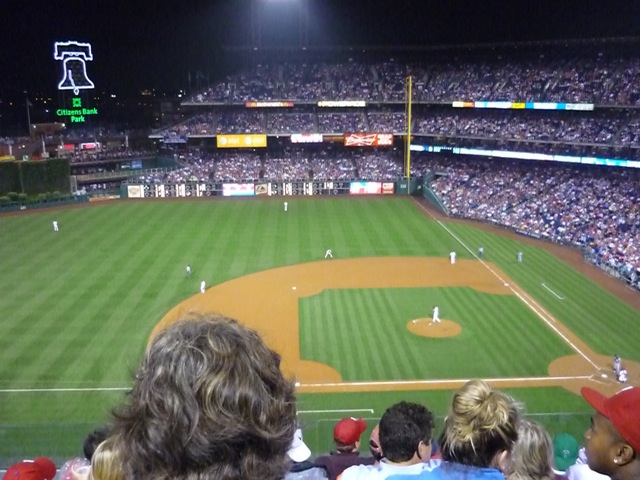
On Friday, July 8, 2011, the Sassy Librarian and I went to Citizen's Bank Park for her first ever Phillies game.  Courtney has become a devoted and passionate Phillies fan (after 18 years with me, it was only a matter of time!) and we were thrilled to be able to go to the game tonight.


Especially when it was a showdown between the first place Phils and the red-hot 'Lanta Braves, who came into the game in second place, 2.5 games back.  We were even more excited to learn that Cy Young personified, Roy Halladay, would be toeing the slab for the Fighting Phils.

Nothing could dampen our spirits.  Not even three inches of rain that fell, flooding area roadways and adding 2 hours to our 130 mile trip to the park.  Not even the soaking wet denim of our jeans (and in my case, my sodden socks).  Not even the two rain delays that pushed the start time from 7:05 to 8:59 pm.  Despite the rain, the field looked beautiful, as did Courtney, in her stylish new Phillies cap.

The game was a nailbiter, with Braves scoring first, the Phillies answering, and then the process repeating itself.  Halladay gave a gutty performance, and despite two wild pitches and a passed ball, was still very good.  The went to extra innings, and by the bottom of the 10th, Courtney couldn't take any more--she had to go to the ladies' room!  I left my seat with her, and watched the rest of the action from the concourse.  Ryan Howard was robbed of a double by a diving catch, but then Raul Ibanez sent us all home happy with a resounding solo shot walk-off homerun to right.  As soon as the ball landed in the seats I turned my back to the field, to see Courtney dashing out of the rest room with a huge smile on her face.  They have the radio broadcast playing in the concourses, so she had heard everything.  There is no way around it, Courtney going to the bathroom is a good luck charm!

In addition to a thrilling win, we also saw history.  Phillies journeyman reliever Juan Perez got the win, pitching a scoreless 10th inning.  More than that, he pitched an immaculate inning (three strikeouts on a total of 9 pitches).  This has only happened 43 times in all of major league history, and the last time it happened in extra innings was 1923!  It goes to show you, you never know what you'll see when you go to a ballgame.

Wednesday, July 6, 2011

My Ethan Lewis problem

I have a guilty secret.  I am an ego-surfer.  "Ego-surfers" periodically type their names into major search engines to see what comes up.  According to Wikipedia, this term has been around since 1995, which is approximately how long I've been doing this for, back when I would get different results on Lycos (now powered by Bing), AltaVista (ditto), Yahoo! (same story) and other search engines that no longer really exist.  Why do I do this?  Well, there are a few reasons, but mainly they revolve around my unquenchable need to know what strangers are saying about me.  Also, my name is not that common, which makes it easier to search for.  According to HowManyofMe.com, there are only 49 people named "Ethan Lewis" (besides yours truly) in the country.  I don't know if this is totally accurate, but I think it is safe to say that there are fewer "Ethan Lewis"-es than there are "Richard Brown"-s, for instance.


On the other hand, in a disturbing trend, "Ethan" is becoming a much more popular name.  When I was a kid, I never knew any other Ethans.  My mother gave me my name because her hero, John Wayne, had named his son Ethan, and "if it's good enough for the Duke, it's good enough for me".  I met my first Ethan at Downtown Sounds in Northampton, Massachusetts in 1991.  He was working there, and when one of his colleagues walked by and said "Ethan", we both turned and said "yes?"  Interestingly, I was his first Ethan as well.  But that's not a big surprise, since according to the Social Security Administration, Ethan was the 494th most popular boy's name in 1970, the year of my birth.  Now, however, it is the 2nd most popular, in both 2009 and 2010--I better get ready for some verbal whiplash.

Another thing that affects my ego-surfing is that I want to be the top result on Google when searching for "Ethan Lewis", but I don't want to do any work to get there. As you probably know, part of what makes a search result higher on Google is how many other pages link to that page.  I've had my own domain (www.ethanlewis.org) for over a decade now, but I have never made a concerted effort to "optimize" the site to trick Google into making me #1.  If I get there, I want to earn it!  This is somewhat analogous to when my father used to try to pass people on the highway using nothing but the cruise control.  He said that he was willing the car to pass the other one, no human intervention necessary.  Try it sometime, it's fun!

Getting back on topic, the Bing search engine has been out (actually since the second week of Bing), I HAVE been the top "Ethan Lewis" on that search engine.  But Bing is less easy to use, because of my reflexive reliance on Google (due partly to using their Chrome web browser, and mostly due to force of habit).  Sometimes to streamline searches I use Bing-vs-Google.com, which is pretty cool.

As you can see if you clicked the previous link, my bête noire is an economics professor at Dartmouth named Ethan G. Lewis.  For years, Ethan G. Lewis has been number one on Google, and I am number three or four (the top places belonged to "Big G", as I like to think of him).  Lately I've been picking up the pace, but I still lag behind Big G.  "Big G" seems like a nice enough chap; I've read some of his papers, and considering that I've been following him since his college days, I feel like I know him.  And while he and I are not Facebook friends, it seems that we have a number of things (besides our first and last names) in common.  So, while I would never wish him ill, and I am glad that he continues to find success in his professional life, I do sort of hope that "Big G" will go on sabbatical soon, giving me a chance to overtake him on Google.  Wait a second!  Google is often referred to as "Big G".  Could this be why they've ranked Ethan G. higher than Ethan me?  Sounds like a conspiracy to me...


**********************************
Update:  My friend, über-blogger Sascha Freudenheim (the #1 Sascha Freudenheim on Google) has some thoughts about this post at his site: www.sascha.com.  Check it out!

Saturday, July 2, 2011

"No Really, I Need It For Work"

You have no idea how many times I've uttered those words in regards to my latest computer acquisition.  It comes up a lot, because I've been a user (more likely) or owner (less likely) of a LOT of different computers over the past 30 years.  Inspired by a retrospective on all the guitar gear I've owned in my life, the following little trip through memory lane will cover some of the computers I've had my mitts on, and was inspired by my recent acquisition of an Apple iPad 2--which was paid for by my employer, and I need it for work!


My first exposure to computers came from watching reruns of the original Star Trek in the early 1970's.  The show resonated greatly with me, and even though it was impossible to tell how the computers really worked, it seemed like common sense to me that people could/should use computers to answer any and all questions.


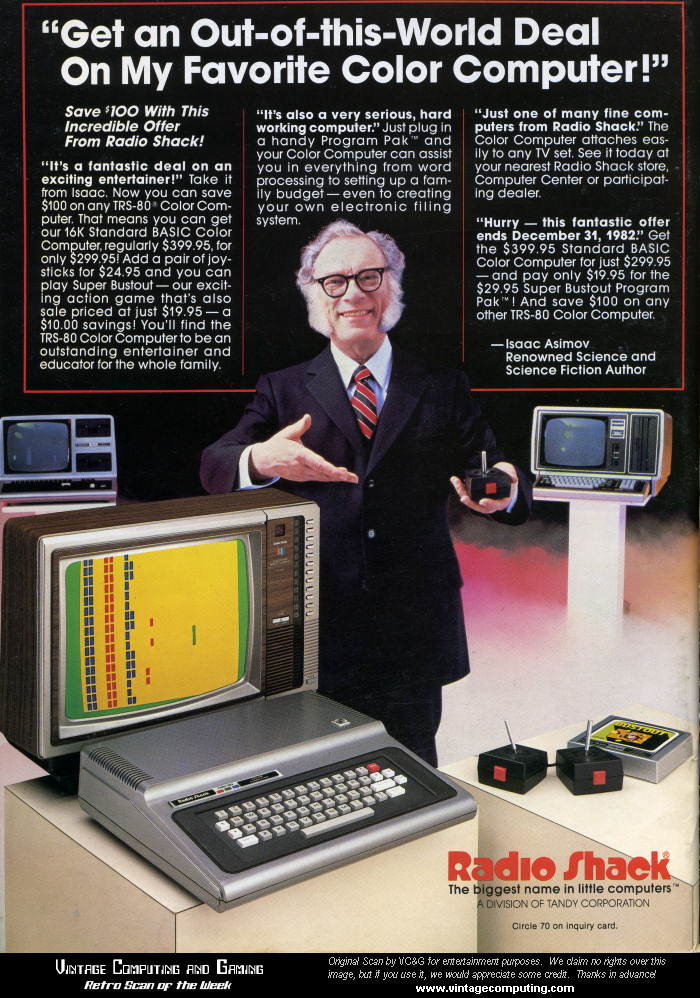
Unfortunately, the voice activated computers with colorful toggle switches were only science fiction when I got my first computer in 1982.  My father was in the midst of compiling a book listing every piece of software available for the Apple II, MS-DOS and CP/M operating systems, and he decided that I should learn how to use a computer.  His computer at the time was a powerful CP/M machine called an Eagle II. This powerhouse machine sported a 4 MHz processor and 64KB of memory.  Considering that my father was using it on a daily basis to write and layout his book, I needed something more appropriate for a young beginner.  So, one day when I was in 6th grade, my father came home with a Radio Shack Color Computer.


While my machine didn't come with a sideburned sci-fi author to give me lessons, and we had to hook it up to an old color tv, it did come with a cassette deck (for storage) and the joystick that Isaac Asimov is holding in the ad at left.  To my undying regret, instead of working hard to learn BASIC coding (my father got me every book in the local library about programming) I spent my time playing an Asteroids knock-off called Microbes along with chess and Zaxxon.  If you are interested, you can see the CoCo in action in the movie This is Spinal Tap, when the band are playing computer games on the tour bus.

The games were fun, (considering the .89 MHz processor) but I can't help feeling that I missed the boat.  So many people of my generation wound up being involved in software design, but because of my weak will and poor choices, I have been relegated to the status of "computer user" instead.  But I have tried to make up for it by using a lot of computers.


When I went to Hampshire College in 1988 I was part of one of the last groups of students to go to school with typewriters.  (Unlike my friend Sascha, who had the first laptop I ever saw in person).  But after struggling on my electric typewriter for a semester, my father bought me a "word processor" from Brother.  It featured a built-in daisy wheel printer, floppy disk storage, and a CRT screen for previewing work prior to printing.   As you can see, the machine was kind of big and bulky, but it worked pretty well.  You had to load in pieces of paper one at a time, there were no fonts, and you couldn't add images to your papers, but I wasn't looking for any of that, so I didn't miss what I didn't have.

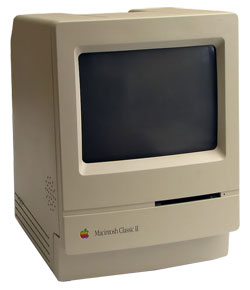
For my fourth year of college, I had to complete a major project called a Division III, which in my case took the shape of a 75 page paper (about arbitration in major league baseball).  My father was, by this time, a Macintosh enthusiast, and while he had never used one, he read everything he could about the brand and was convinced that his kids should have Macs.  So he found a way to get my younger sister and me new Macintosh Classic computers.  This was a major step up.  It had a 9" screen that could show 16 shades of gray.  As far as I was concerned, the display was breathtaking!  My father splurged for 2 MB of RAM, so that my computer could run Apple's new System 7 (the first one that allowed a user to run multiple programs at once).  I remember being very impressed with the 20MB hard drive, and wondering why anyone would ever need so much space!  I used this computer from 1991-1994.  During that time I did college and grad school work on it, designed flyers and documents for my job as a fire safety consultant in Boston, and wrote a weekly column for a newspaper in Northampton, MA.

By 1994 I was married and living in Indiana, going to grad school at PurdueMy wife wanted a peppier computer, especially one that could take advantage of the "Internet".  So we went to Sears and bought a Performa 550, a color computer with a modem (that came with an America Online account). The Performa was significantly faster, with a blazing 33MHz processor (a 680030, instead of a 680000) and it had a CD-ROM drive, could display 256 colors and had a 100 MB hard drive.   It weighed over 40 pounds (compared to the Classic's 16 pounds) which was a nuisance as we moved three times with this machine, but big screens meant big weight back then.   I wrote my Master's thesis on this computer, and learned how to make my first websites on it.  This computer was great for work and amusement, and during the mid-1990's I was an ardent Macintosh hobbyist.  Eventually, in 1996 my knowledge of computers got me a job at St. Paul's School in Concord, New Hampshire, where I supported 120 Macs, and helped teachers integrate computers and the internet into their curricula.

Working at St. Paul's gave me the chance to have hands on experience with a bunch of neat computers.  Each classroom had 15 Apple laptops chained to the desks for the students to use.  Among the machines I supported were computers such as:

  • the PowerBook 520c (left): a color laptop (Apple's first).  My first day at work I had to move a cart of 20 of these ($2500 each) from one building to another.  The thought of what would happened if the cart fell over had me breaking out all over in hives!


  • the PowerBook 5300cs: this computer was quite nice, but several of the first ones off the production line caught fire due to bad batteries.  This was before Steve Jobs' return to Apple and back when quality control was less than optimal.  You can see this computer in the movie Independence Day, when Jeff Goldblum uses it to save the planet.  THAT is science fiction--these computers couldn't go more than 20 minutes in a climate controlled room without freezing and needing a restart--I doubt that they could function in an alien spaceship.  But maybe I'm just bitter.. I had one of these as my own work machine for a year, and it was heavy and buggy.

     • the PowerBook Duo 2300: the Duo series was a sub-notebook.  The docking station had a CD-ROM and floppy drive, so the machine itself was very light and stripped down.  I used this computer as the controller for the campus closed-circuit TV network.


    There were also more powerful desktop machines like the PowerMac 8500, which was the first computer I ever used to edit video.  This powerhouse had a 100MHz processor, and was amazingly fast.  I was blown away when I could edit together some video, leave for the night, and come back in the morning to find that it had rendered.  Amazing!


    After spending so much time with cutting edge Macs, the Performa started feeling less than optimal, so my wife and I took a plunge on the first generation Apple iMac.  This machine (still in my attic 13 years later) was a breathtakingly designed all-in-one machine.  It ran at a sizzling 233MHz, and was the first Apple computer (and first mainstream machine from any vendor) to forego a floppy disk drive.  Steve Jobs noted that we were living in an "internet age" and no one needed to "sneaker net" small files from place to place.  Apple took a lot of flak from this at first, but no one can deny that they were correct!  The iMac was also the first computer from any vendor to feature USB ports, marking Apple's break from the venerable SCSI connection paradigm.


    In 1999 I moved from St. Paul's to Groton School, where I took the job of Academic Technology Manager, administering the email system and continuing to work with teachers at integration of technology.  My first job was leading a program where all the faculty were given Dell Latitude C600 computers.   I had to train the teachers on the use and upkeep of these machines.  Moving to a Windows computer was shocking at first--when I took the computer home the first night I kept rebooting it--I couldn't understand why the first things I saw on the screen were BIOS notifications.  Pretty embarrassing way to start!  

    At Groton I was the "Mac guy", and I was able to take charge of a cutting edge Mac lab, featuring PowerMac G4 towers and containing photo and video editing, music composition, and advanced math and physics software.  These computers were very advanced, running at over 300MHz, they were as powerful as the "super computers" of the early 1980's.  One thing I liked to do was, by rolling around the room on a wheeled office chair, hit the power switch of each machine so that the boot up chord just kept on ringing and ringing.  Through the built-in speakers of the matching monitors, the sound was pretty awesome!  
    As the Mac guy, I also persuaded my boss to let me use a PowerBook G4  I mean, I had to do "Mac stuff" right?  I needed it for work!  This computer was made of titanium, and featured a 15" wide screen display.  It was on this computer that I first used MacOS X, when I got a copy of the OS in its beta release.  Using this laptop as a test bed, I was able to get the Mac lab running securely with OS X in early 2002.  This served as sort of a credibility builder when I moved from Groton to Wyoming Seminary in 2003.  I was going to be a history teacher/technology integrator, and when I went for my interview, I brought a bootable version of my OS X image with me.  Sem was only just beginning to consider OS X (they didn't go over to the new OS until 2006) but my experience was so strong that I wouldn't go back.  I immediately put OS X on the MacBook they gave me, and it's all I've used, on all three school laptops I've had at the school.

    In the summer of 2004, my wife began to feel frustrated by some of the limitations of the iMac, so we bought a PowerMac G5. I am pretty comfortable with saying that this is the best computer I've ever used.  It has been our main computer for seven years (I wrote this blog post on it).  It has two 1.8 GHz G5 processors, and still feels fast after all these years.  In 2009 I installed an extra internal hard drive and doubled the RAM to 2.5 GB of RAM.  The computer is rock solid, and rarely gets shut down (the longest uptime I've managed is eight months).  I've been able to do some pretty serious video and graphics editing on this machine, and probably played 10,000 games of Scrabble on it as well, including my high score of 531. I've also done some audio recording, and hope to continue to do more of that in the future.

    I'm so excited about the iPad.  Since the late '90s I've been waiting for a small, instant-on device that could be used by teachers and students in a classroom to access networked files, web pages and emails, while also being a viable tool for document creation.  Over the years I have tested (and found wanting) several devices, including:

    the Apple eMate 300: this is one of the coolest things I've ever used.  It ran Apple's Newton OS, on a 25MHz processor and used a touch screen and a stylus and could (sort of) recognize handwriting. It had a PCMCIA card slot for networking, and the clamshell case was almost indestructible.  This education market-only product fell by the wayside when Steve Jobs returned to Apple and killed the Newton.  Supposedly Apple has continued to maintain development of handwriting recognition software, but it seems to be missing from the iPad as of now.

    • the Palm pilot: I've tested numerous Palm OS (created by former Newton developers) devices over the years, some with stylus inputs, others with built-in keyboards.  The OS never seemed rugged enough for kids to use in class, and the weak processors made the machines far to slow to be useful.

    • the Psion Series 7: Before the Symbian OS became a global leader in mobile telephony, it was used to power small PDA devices.  Psion tried to take the PDA software and blow it up onto a bigger machine, with a built in keyboard, color screen, and a Microsoft compatible office software suite.  The case folded into a slick little clamshell, with a leatherette covering.  The machine used a stylus/keyboard combo like the eMate, and could connect to the internet.  When I was at Groton I met twice with the American home office of Psion, and tried to get them to give me a classroom's worth to test out.  But the retail price of over $1000 made these devices cool, but more expensive than PowerBooks that were far more powerful.    I have bought an external keyboard for my iPad, and I am hoping that it will give me an eMate/Series 7 vibe.

    In closing, this sampler of some of the computers I've worked and played with over the years has made me reflect a bit about Moore's Law.  Simply put, this concept was put forth by Intel founder Gordon Moore, and says that every 18 months computer processing power doubles, and prices fall.  A simple comparison between all of the computers I've owned personally shows this.  Each machine cost between $1000 and $1800 (with educator's discount).  But each machine left its predecessor in the dust in terms of performance, stability and capabilities.  Our PowerMacintosh G5 cannot run Apple's most recent OS versions, and soon the time will come where we may have to consider "upgrading" it to something running an Intel processor like Apple's more recent products.  And if we do, the speed and performance increase will be notable.  Who knows?  Maybe it's not too long before the Star Trek computers (maybe more like the Next Generation, than the Original Series) will be a reality!