Friday, December 5, 2014

Play Time: Video Games in the High School History Curriculum

As I've mentioned before, in my day job I am a high school history teacher (the commentaries on this blog about pro wrestling, guitar playing, rock music, movies and ridiculous letters to the editor are merely hobbies). I teach American history to students grades 10-PG at an independent school in Northeastern Pennsylvania. Throughout my two decades in the profession I've worked to find constructive uses of technology in and out of the classroom, and in the past year or so I have found that my students have derived a lot of "edutainment" from playing video games during class. I've used games in a year-long survey class on U.S. History as well as in an advanced elective on the Constitution and Supreme Court. The following is a brief summary of the games we played and how they were received by the students. 

In my U.S. History class I have had great success with the games from a company called Mission-US. These games are like super high-tech versions of the "choose-your-own-adventure" books I used to read in elementary school in the 1980s. Mission-US is a joint effort from New York City's public television channel, game designers and academic experts. As I write this in December 2014 they have produced three games so far:
  • Mission One: For Crown or Colony?: in which you play a young boy who is an apprentice in 1770 Massachusetts, who observes the Boston Massacre and has to choose between the Patriots and the Loyalists. 
  • Mission Two: Flight to Freedom: in which you play a young girl who is a slave in Kentucky in 1848. During your attempt to escape to the north you encounter fearsome slave catchers and seek out the mysterious Underground Railroad.
  • Mission Three: A Cheyenne Odyssey: in which you play a Cheyenne warrior who grows to manhood and leadership of his band. You have to help your group survive through the years and based on your choices will play different roles in the Battle of Little Bighorn. 
They will be releasing a new game early in 2014 called Mission 4: City of Immigrants  in which you would play a young Russian immigrant living on the Lower East Side of New York a century ago who gets caught up in the labor movement. I have been very impressed with the scope of these games and the effort they make to be inclusive of race, gender and economic statuses.

The games are a wonderful mix of action and information.  While I think it helps to have some background in the material, the games do a good job of getting the player up to speed. The students in my classes are quite varied, ranging in age from 15-19 and coming from many different backgrounds (our school has students from over 22 countries) but none of them have ever felt that the game was too hard to figure out, and no one complained that it pandered to them either. 

The way I like to use the games is as a supplement to our standard sequence of reading and discussion.  For Mission One, the students play the game after we've finished reading about the turbulent 1760's and 1770's.  After they play I ask them to compare the game experience to what they read in their textbooks.  The consensus seems to be that playing the role of a person around their own age was a good way of absorbing the key concepts. For Mission Two the students play the game after we finish reading "The Narrative of the Life of Frederick Douglass"; in the book he is disdainful of the boastfulness of the "underground railroad" (which he fears is becoming an "upperground railroad") and the game gives students a better point of view with which to judge this assessment. Last year I did Mission Three as part of a three-week long module between Thanksgiving and Christmas that covered the Indian Removal Act, the Indian Wars of the 1860s and 1870s and the American Indian Movement of the 1970s, culminating in a debate over whether sports teams should have nicknames derived from Native Americans. 

I am fortunate to work at a school where I can reserve an individual laptop computer for each of my students (and where most of them have their own, anyway), so I typically play these games over the course of a 50 minute long class period. If I had shorter periods, or if computers weren't as available I could see the game being played as a homework assignment.  The teachers' guides are very good at listing the estimated time required to play each game, and they also have very useful worksheets and downloadable handouts to share with students. I can't recommend these games enough, and I hope that they continue to develop new ones. 

****************************
In addition to my survey class I also teach trimester length elective classes covering the time period between 1945 and the present. One of the most popular is called "Constitutional Issues", in which students learn through the study of major Supreme Court cases of the period. Instead of a textbook, students read the unabridged opinions of the Court.  It is a very challenging, but rewarding experience for the students, who are essentially doing graduate school level work as high school juniors and seniors. To buttress the readings, and also to provide a fun way of assessing their knowledge of the Constitution and important cases, I have them play several video games from iCivics.org.  iCivics was founded by Justice Sandra Day O'Connor and they have a wide variety of games that fit under the "civics" umbrella, all of which feature entertaining graphics and several of which are quite challenging. In my class, we play the following games:
  • Argument Wars: in which you represent one of the sides in an actual Supreme Court case. Your task is to recognize the difference between strong and weak Constitutional arguments. 
  • Do I Have A Right?: a turn based game in which you create a law firm and earn points by taking and winning cases based on your knowledge of the Bill of Rights. The more cases you win the more money you have to hire associated, decorate the office, purchase advertisements and reinvest in the business. 
  • We The Jury: a turn based game in which you have to persuade the other members of a jury to agree with you in a variety of civil cases. 
The games feature clever animations and are fast moving and engrossing.  One of my students this year absolutely LOVED "Do I Have A Right" and has played it over and over trying to raise her score.  While this may be slightly aberrant behavior, the games do reward replaying. As I mentioned above, the games fit it perfectly during a class period for me, but they could also be done for homework. When the term was over the students ranked the games very highly, praising them as a fun alternative to quizzes as ways of making sure that they learned about the key Constitutional issues in these cases. 

While I doubt that I would ever be able to completely replace reading with edutaining game-play, I am glad to be able to use games as supplements to my regular routine.  When kids see on the weekly syllabus that there will be "video games" they get very excited.  While the games described in this post are not as visually stunning as, say, Assassin's Creed, they are probably more historically accurate and I have found that my students find them to be sufficiently engaging to be very focused for the entire class period. The games also stick in their memories as well as (or better) than a textbook; I can remind them months later of the games and they often have very vivid recall of scenarios from the games. I am so glad that I have these resources for my classroom and I can't wait to see what new games will continue to be developed.  Thanks for reading, and please leave a comment below with your thoughts about video games in the classroom. 

Monday, August 11, 2014

A History Teacher Visits Antietam

In my day job (when I am not thinking about professional wrestling, or guitars, or rock music, or movies, or other distractions) I am a history teacher and college counselor at Wyoming Seminary, a boarding school in Northeastern Pennsylvania. I have previously written about my teaching, and with the 2014-15 school year right around the corner, the time seemed right to do so again.  Last week my wife Courtney and I took a trip to the Antietam National Battlefield in Maryland.  It was extremely educational and quite thought provoking. It really showed me that reading about someplace for years doesn't prepare me for (or replace) visiting it in person. What follows are some impressions and pictures. 

The Battle of Antietam was one of the most significant events in the first century of our country. It put a stop to Robert E. Lee's first attempted invasion of the northern states, guaranteeing that the Civil War (then about a year and a half old) would continue on. It was the single bloodiest day in American history; more men were killed, wounded, captured or went missing on September 17, 1862 than in all of the United States' previous wars combined. It is also fitting that a battle that took place 73 years to the day after the ratification of the Constitution (during a war to preserve the Constitution) led to the most important amendments to the Constitution (the 13th, 14th and 15th, also known as the Civil Rights Amendments or the Reconstruction Amendments). The Confederate retreat at Antietam gave Abraham Lincoln the political support to issue the seceded states an ultimatum: return to the Union status quo ante by January 1, 1863 or have their slaves become "forever free". The Emancipation Proclamation was momentous in the short term (by making the war explicitly one to free the slaves, European countries like France and Britain were no longer willing to intercede on behalf, or even officially recognize the existence of the Confederacy) and in the long term.  As Civil War historian Bruce Catton wrote in 1958:
"What America is and hopes to be dates from the fight along Antietam Creek. The fight cost an enormous number of lives, and inflicted pain and disability on many thousands more; but in the infinite economy of the advance of the human race it may have been worth what it cost." 
I've occasionally used this battle as a jumping off point for a group project in my history classes; having had the chance to see the battlefield in person I know that I will do so again this year. 

The battlefield and cemetery are run by the National Park Service, and they do a fantastic job. The Visitor Center is located atop a hill that provides panoramic views of the surrounding fields, which the Park Service leases to local farmers to maintain it in a fashion similar to what it was 152 years ago.  

Photo by Courtney Lewis 2014
The Visitor Center has a museum, a lecture hall, a movie theatre and a gift shop. The movie theatre shows a 26 minute movie (© 2010) narrated by James Earl Jones in full "Darth Vader" voice that does a truly excellent job of explaining the battle from military, political and historical perspectives.  It has very good production values, showing Civil War re-enactors on the actual battlefield, with explosions and popping blood capsules to add to the verisimilitude. The store has a great selection of inexpensive books (we bought a dozen for the school library) as well as some rather tasteless apparel, such as an Abraham Lincoln beard and sweatshirts commemorating the battle. When we were there the lecture hall hosted a very interesting talk about the life of Clara Barton (the founder of the American Red Cross assuaged the wounded at Antietam). I'm a history teacher and Courtney worked for the Red Cross for several years but we both learned some things from the lecture. The audience seemed made up of "Civil War buffs"; I saw one lady nodding enthusiastically whenever familiar names were mentioned, and a man was very put out when the speaker referred to "coming back from Antietam" (under his breath he huffed "or Sharpsburg!").

After the lecture we wandered about on foot for a bit.  A few hundred yards away were the cornfields through which Union and Confederate soldiers marched and died when the battle began at 5:30am. We went on August 10th, so the sight must have been pretty similar to what they saw on September 17th; the corn was high and would have hidden the movement of the men pretty well.  Here are a couple of more pictures:

Cannon facing the cornfields. Photo by Courtney Lewis 2014
View from the cannon. Photo by Courtney Lewis 2014

It was rather spooky looking at the cornfield having just seen the movie version of the slaughter that took place on the site so long ago. I am not a believer in the supernatural, but I felt conscious of a certain weightiness there.  Over 40,000 men were part of the battle (along with unnumbered horses and other beasts of burden). All around the battlefield are plaques explaining which soldiers camped or were stationed at various sites. To think of these men marching in on the 16th, knowing (at least generally) what was in store the following day; trying to imagine how hard it must have been to sleep that night, to wake up before dawn to muster and begin the march through the corn was very heavy indeed. 

The cornfield also made me think of "The Veteran in a New Field", a powerful painting by Winslow Homer from 1865.  I use this painting in my class when I teach students how to interpret visual images. Part of the meaning of the painting is that the former soldier, who was recently reaping a different, bloody harvest in other fields has returned home to resume his life as a family, wading away from his past, leaving his army canteen (and the bad memories of the war) behind him. 


Photo by Courtney Lewis 2014


After the cornfield we moved to the Sunken Road, which became known as the "Bloody Lane" as it filled up with piles of dead men, first the Union forces who approached it from above (and were sitting ducks) and later Confederate soldiers after being outflanked. In three hours 5,500 men were killed or wounded, the road incarnadined from their blood. At the suggestion of one of the park rangers we walked along the path to be able to better picture the sight lines that the soldiers would have seen.  It is hard to imagine the terror that people on both sides must have experienced here. Whether the Union soldiers charging pell-mell toward an entrenched force with comrades falling left and right or the Confederates watching hundreds of armed men charging with violent intent while armed with a single shot rifle, it must have been horrible. Here are some pictures, first some historical ones (thanks to the NPS website) followed by some from our visit:

This is a sketch of the Sunken Road that appeared in contemporary magazines.

Alexander Gardner took this photo of dead Confederates in the Sunken Road days after the battle.
Photo by Courtney Lewis 2014

Photo by Courtney Lewis 2014
After the Sunken Road we got in our car and drove to other significant landmarks.  The Park Service has installed very unobtrusive (yet clear) directional signs telling drivers where to turn, keyed to a map that shows where everything is.  We also bought a CD and book that narrates each of the sites; I highly recommend it. One of our next stops was an observation tower.  It is located on a hill, and to reach the top requires climbing 71 winding steps.  But the views are quite breathtaking (climbing 71 steps is breathtaking too, but in a different way):


Photo by Ethan Lewis 2014

Photo by Ethan Lewis 2014

Photo by Ethan Lewis 2014

After climbing down from the tower we drove to the Burnside Bridge. 500 Confederate soldiers repulsed several attacks from 5000 Union soldiers at great cost here (the Federals were led by Gen. Ambrose Burnside, whose unique facial hair gave us the word "sideburns").  It is an exceptionally bucolic place. I couldn't help but be struck by the conflict between the glories of nature's beauty and the ugliness of human brutality. As before, some historical images followed by one of Courtney's pictures:

A sketch from a contemporary magazine

The bridge from the Confederate side by Alexander Gardner 1862

The bridge from the Confederate side by Courtney Lewis 2014
There is much more to see; we were at the park for several hours but it deserves more time. The park is open every day (except Thanksgiving, Christmas and New Year's or during a government shutdown) but as I mentioned before, I think that a visit in August or September would give the best impression.  Having seen the excellent preservation of Antietam I would like to go to other Civil War battlefields--Gettysburg is relatively close, I'll probably go there next.  

The park is beautiful, but there is a sadness permeating the area. It has made me think a lot about the war and its impact on the people who lived through it. Just a couple of days before our visit I read an article that summarized a recent study showing that American veterans of the Vietnam War who suffered from post-traumatic stress disorder (PTSD) still experienced the symptoms 40 years later, and that they had a higher than average death rate compared to their age group. As I tell my students, even though "psychology" as we know it wasn't invented yet, people in olden days still experienced (and reacted to) events the way we do today. It is hard to imagine living in the America of the decades following the 1860's.  Millions of Civil War veterans (many suffering from wounds and illness), millions of former slaves (victims of unspeakable violence and exploitation) and millions of people mourning the loss of loved ones all had to deal with the psychological aftermath of the conflict. Yet despite this, in many cases efforts were made to heal these wounds (though often at the expense of black American freedom) in the following decade. By the early years of the 20th century, former Confederates and former Union soldiers met on the battlefields of their youths, as you can can see in the following video:


It occurs to me that America's relatively easy recovery following the Civil War (restoration of essentially the same political system; rapid growth into a world economic power, and peace between the North and South for a century before the upheaval of the Civil Rights era) may have to do with the nature of the war.  At least at some level it was a political war for most of the participants. Contrast that with the violent upheaval going on in the world today, so many of which are religious or cultural. I think that those kind of divisions and hatreds are harder to overcome.  I can't easily imagine a park ranger in Fallujah in 150 years saying (to paraphrase our ranger at Antietam): "those Shiite boys and the Sunni boys sure fought hard here". 

I am very glad that I had the chance to visit Antietam.  If you have been there, or to a similar historic location, I'd love to read your comments. 

Sunday, January 12, 2014

Everything I Needed To Know I Learned From Pro Wrestling (Pt. 5--GoingTo A Live Show-What A Rush!)

On January 10, 2014, the Sassy Librarian and I were treated to a night out by our awesome friends, Harry and Meredith.  And not just any night out, but tickets to the WWE live event at our local arena in Wilkes-Barre, Pennsylvania. If you've been following this blog you know that I've been a wrestling fan for a long time, but this was my first time ever seeing professional wrestling in person. You might know that the WWE has weekly televised programs, such as Monday Night Raw, Main Event, and Friday Night Smackdown!, but they put on shows nearly every day somewhere in the world (in fact after our show the whole crew drove through the night to do it again in Buffalo the next day).  Untelevised exhibitions are known in the business as "house shows"; while the "storylines" from the televised shows are not furthered at these events, they still feature multiple high quality matches and entertaining diversions.  Some people think that house shows are more fun to attend than TV tapings; I can't vouch for that, but I can say that I had more fun at this event than I have in a month of Sundays.  It was so awesome to cheer and boo energetically--I woke up the next day hoarse from screaming. And unlike real sports, there is no danger of hurting anyone's feelings because they want us to boo them!

There are a few differences between house shows and TV tapings, mainly that during the house show the house lights are dim (which made taking pictures with my old camera phone a chore); there are no pyrotechnic displays, and the TitanTron is not there, instead there are simply comparatively smaller LCD screens at the top of the entrance ramp.  It would be pretty cool to see (and hear) what it is like with the full production values, and by the intermission halfway through the show we had agreed that we will find out the next time a TV taping takes place in Wilkes-Barre.  I'll let you know!


*********************

The video displays and music began about 15 minutes before the scheduled start time. The large video display showed pictures of Superstars and Divas who were at the show, and also tweets from members of the "WWE Universe" in attendance. They also ran a promotion where spectators could text their choice of whether the Divas tag match should be a "Divas Dance-Off" or a traditional tag match.  I voted for the regular match, but the Sassy Librarian chose the dance off. During this prelude we made a trip to the concession stand to purchase t-shirts (and a replica championship belt, in Harry's case). Though we are both members of the "Cenation", I overpaid opted for the "Property Of" shirt, while the Sassy Librarian picked the latest John Cena garment.

The show kicked off promptly at 7:30; we were welcomed by ring announcer Byron Saxton. I'd never heard of Saxton (who is a member of NXT, the developmental show for WWE), but he should be a star.  He is a handsome, well-built, charismatic guy who was good on the mike.  If he can't wrestle he could be an announcer, a manager or anything. I look forward to watching his career take off.

Having never been to a house show I didn't know what to expect, but we got seven matches in total. Four of the matches were tag team tilts; I've previously written about the dynamics of this type of contest, so it was cool to see so many in person. The matches were all technically good and some of them were real humdingers, including the two title defenses!  Here is the complete list, followed by summaries:


  1. Diego and Fernando (with El Torito) vs. Ryback and Curtis Axel
  2. Alberto Del Rio vs. Sin Cara
  3. Diva Dance Off between the Brie Bella and Nikki Bella and Alicia Fox and Aksana
  4. Goldust* and Cody Rhodes* vs. Jack Swagger and Antonio Cesaro (with Zeb Colter) for the WWE Tag Team Championship
  5. Titus O'Neill and Darren Young vs. Jinder Mahal and Drew McIntyre (with Heath Slater)
  6. Alexander Rusev vs. Justin Gabriel
  7. John Cena vs. Randy Orton* for the WWE World Heavyweight Championship
*-indicates that they entered the match as the Champion


*********************

Match #1: Los Matadores with El Torito def. Rybaxel: The cousins Primo and Epico, who had a nice career portraying Puerto Rican high flyers, have recently reappeared as masked Spanish torreadors, accompanied by an anthropomorphic bull, played by little person wrestler Mascarita Dorada. They were taking on heel wrestlers Ryback and Curtis Axel.  Ryback gave a somewhat in character interview with a local paper to hype the event; at least I hope it was in character, or he's even more of a jerk. Axel is a "third generation superstar" whose father "Mr. Perfect" Curt Hennig was a star of my youth. This match had a lot of humor right from the beginning, when one of Los Matadores stole Axel's shirt and blew his nose in it, enraging Axel, who then charged at it like an angry bull.  It was funnier in person. The tilt featured a number of athletic moves, from Ryback military pressing one of Los Matadores and holding him overhead for almost a minute to one of Los Matadores walking on his hands across the ring.  The problem with this match may be evident in the summary--because Los Matadores dress alike and wear masks, it is impossible to tell which is which.  In the end, interference from El Torito led to Axel getting pinned 1-2-3 in the center of the ring.  It was a fun match and got the crowd energized, but it was a little confusing.  Personally I liked Primo and Epico, and think this new gimmick sucks.  But I wish them luck.  Also, I don't see the appeal of Axel, and Ryback is a creep. Earlier this week on Raw he subtly insulted ring announcer Lilian Garcia.  As a result, I shouted "You suck Ryback, and I don't like what you said about Lilian!"  He pretended to ignore me--he was probably scared.  Match grade: B

Match # 2: Alberto Del Rio def. Sin Cara by submission: Personally I really like Del Rio, even though he has become a heel again (or a rudo as they would say in Mexico, as opposed to a technico). And I don't like Sin Cara, even though the Sin Cara we saw was not the Sin Cara who has been on tv for the last year or so. That's good, because the old Sin Cara sucked.  I also don't like the way that the producers change the arena lighting when Sin Cara comes out, like he's magical or something. This match was a little confusing, because even though ADR is a heel, the audience was much more into him. At one point he tried to get Sin Cara to shake hands--Sin Cara wavered on this for what seemed like an eternity, and eventually just kicked ADR instead, so we will never know if "The Mexican Aristocrat" had good intentions or not. He looked good and pretty ripped muscle-wise despite what the "dirt sheets" are reporting.  This match featured a lot of back and forth, and some athletic moves, but there wasn't much ring psychology. For instance, at one point Del Rio nearly got Sin Cara's mask off. In Mexican wrestling, this is a serious thing, but in this match it was like an afterthought.  Del Rio won with his cross arm-breaker submission hold, which looked pretty painful. Match grade: B

Match #3.1: Diva Dance Off: The Bella Twins have been fixtures on WWE for a number of years, usually playing valets or using their identical appearance to perpetrate "Twin Magic" on their opponents (one Bella would be wrestling, then when she would get tired, the other would sneak in the ring and finish the match).  They are generally "Mean Girls" but I really like them, because like me they are avid fans of the Philadelphia Eagles.  They left the business for a year or so, but have recently returned, partly to star on the reality show "Total Divas".  Since the show has been a success, (and because in real life they are romantically linked with good guys John Cena and Daniel Bryan) the WWE has been presenting the Bellas as babyfaces. The twins used to present the same problem as Los Matadores, but during their hiatus, Nikki Bella's chest was surgically enhanced, making it easy to tell them apart (and giving new meaning to the phrase "twin magic") The Bellas started the dance off with some synchronized moves, though only Nikki "twerked" as the young kids call it before they were viciously attacked by Alicia and Aksana, who then ran away up the ramp.  Brie grabbed a mic and challenged the heels to a real match and the twins physically brought them back down to the ring.

Match #3.2: Bella Twins def. Alicia Fox and Aksana: Usually Divas matches are either omitted from television, or are only given a few minutes of air time.  This match lasted almost 10 minutes, and all four women showed great athleticism and enthusiasm.  There were some downsides, however: on the one hand, Alicia and Brie are toothpicks who do not look very physically intimidating.  Aksana, on the other hand, was a power lifting champion, and looks like she could break the other women in half; unfortunately she is not a very good professional wrestler.  This was entertaining, but I think that the young boy behind us spoke for many when he asked his mom "when will this be over?".  Match grade: B  After the match the Bellas spent a lot of time signing autographs and thanking the crowd, which was nice. 

Match #4: The Brotherhood def. The Real Americans (with Zeb Colter) to retain the Tag Team Titles:  Last spring I wrote about a new angle in the WWE, where bigoted xenophobe "Zeb Colter" took hick former champ Jack Swagger under his belt and spouted lots of politically incorrect garbage. That has continued, with the inclusion of Swiss superstar Antonio Cesaro (?!) into the confusingly named tag team "The Real Americans".  Prior to the match, Colter got a lot of heel heat by calling us "Altoona", saying that the crowd was full of "ugly women and fat men", and pointing out the dozens of "illegal immigrants" in the audience.  Basically he sounded like the people who write online comments for our local newspapers.  Fortunately most of the crowd booed him, but not enough. Recently Cody Rhodes has been joined by his real-life half-brother Dustin (who is reprising his 1990's character "Goldust" without as much of the homoeroticism). 

While it is vanishingly rare for titles to change hands at a house show, it is not impossible, so it was great to see a championship match up close.  This was a really super tag match.  Goldust, at age 44, played "the face in peril"for most of the match, constantly striving for the tag with his brother to no avail.  At one point, just as he was about to make the tag, Cesaro cheap-shotted Cody off the apron, so that when Goldy reached for help there was no one there. The psychology in this match was excellent. Every man got his signature moves in (Cody Rhodes, in particular, is amazing as a high flyer, and at one point he held Cesaro in a very long vertical suplex) but the drama came from numerous missed tags and false finishes. Cody eventually got the hot tag and the place went nuts--the release of tension was palpable. The champs won by pinfall as expected after a long, exciting match. Match grade: A+  Following the match the brothers spent a lot of time signing autographs and taking pictures.  At the top of the ramp, Cody grabbed a mic and put over how great it's been to be reunited with his brother.  It was very emotional, which made me practically salivate over the possibility that one will turn on the other at the upcoming Royal Rumble. Don't forget, Cain slaying Abel was the world's first heel turn! 

Match #5: Prime Time Players def. 3MB (with Heath Slater ringside): After a 15 minute-long intermission (to sell merchandise and let everyone go to the bathroom) we were given another tag team match.  I have been very high on the Prime Time Players (PTP) for months--I think they have great chemistry, look great, and are extremely marketable. Unfortunately no one but the Sassy Librarian seems to agree with me, because they are not given much time on television, except for recently when Darren Young came out as an openly gay pro athlete, and the rest of the WWE congratulated him.  The reaction to this shouldn't be a big surprise, considering that longtime WWE figure and McMahon family consigliere Pat Patterson is one of several openly gay people in the organization; but considering the homophobia in football and basketball, to name just two other sports, it was definitely welcome.

This was a very fun match featuring lots of strength moves by Titus O'Neil.  I really "mark out" for him. Titus will be 37 this year, so he may be too old to ever become champion, but he has what it takes. We saw a lot of big men last night, but O'Neil made the strongest impression on us--he is massive! Titus pinned Jinder Mahal with a sit-down powerbomb that shook the whole ring. Match grade: B+ After the match PTP signed autographs and posed for pictures, even doing the "Millions of Dollars" dance with some fans. 

Match #6: Alexander Rusev def. Justin Gabriel by submission: This was an unexpected treat.  I have never seen Rusev on the NXT show (which is only available online or on Hulu Plus), but rumor has it that he will soon be promoted to the main roster. Who knows, he may make his television debut wrestling Justin Gabriel!  If so, it will be pretty good. The Bulgarian giant, who wrestles barefoot, met the lithe South African kick for kick, but Gabriel's speed was no match for Rusev's strength (and Rusev is very quick for a 300 pounder).  This match was interesting, and the men did a good job of selling the idea that they were not familiar with each other, which made their initial caution understandable. Match grade: B

Main Event: John Cena def. Randy Orton by DQ (Orton Retains The Championship): To paraphrase WWE announcer Michael Cole "the place was electric" when this match started.  Meredith's cellphone video of Cena's entrance might give a clue.


John Cena and Randy Orton have been WWE mainstays for 12 years and the current storyline is that Randy Orton wants to be called "the face of the company" because he's jealous of Cena's holding that status. Wrestling fans are either huge fans of Cena, or dislike him intensely which is why his arrival results in duelling chants of "Let's Go Cena!" and "Cena Sucks!" The "smarks" would have you believe that children are Cena fans and adults despise him; I've always dismissed this, but now I may have to reconsider. The Sassy One and I were chanting "Let's Go Cena", but it was interesting to note that the "Cena Sucks" chants were in a deeper vocal register.  One fun feature was the two children in front of us--the girl on the left holding a Randy Orton sign, and the boy dressed like Cena in every detail except the jorts. When the chanting started, the boy seemed so betrayed when she screamed "Cena Sucks!"

Considering that these two are among the biggest, highest paid stars in the company and that this match will be a huge highlight of the Royal Rumble in two weeks, they didn't hold anything back.  Some big bumps on the floor, crashing into the unforgiving steel steps, and lots of near falls were highlights of this action packed match that lasted for over 20 minutes.  Each man also hit his signature moves on multiple occasions, kicking out each time.

It was really amazing how much louder the arena was during this match.  It was like these two brought the night to a whole other level.  Since they broke in with the WWE in 2002 (and even before that in Ohio Valley Wrestling) Cena and Orton have probably wrestled each other hundreds of times, and it really showed.  They obviously knew each others' moves, and knew that they could trust the other man to make the match look good.  Sometimes I get bored watching Cena and Orton on television, because they often resort to the same moves over and over.  That happened in person, but the energy from the crowd was infectious and I didn't mind at all.  This was a clinic by two great stars, and I was so glad to see it in person.

At one point the two grapplers traded big blows and
it was pretty easy to see how widely Cena's punches missed. This made me really appreciate the camera operators and producers of WWE's televised product.  No matter how closely I watch on TV, the action almost always looks genuine. Another thing that was cool to see in person was how much effort the referees put in to make the matches so exciting. While it is hard to tell this on television, in person it was really cool to see how much they moved around to put themselves in a position that required them to have to run all the way around the wrestlers before counting the pin, giving the man on the bottom just enough time to kick out.

In this video from Meredith the referee was actually in a pretty good position for the count, but you can get a sense of the engagement level of the crowd. You will see Orton catch Cena in a thunderous powerslam and go for the cover, only for John to kick out at two and a half.  It was really exciting, and you can hear the enthusiasm of the spectators:


The end of the match was thrilling.  Orton had Cena on the far ropes, and as the referee came over to separate them he was knocked over.  I could see this coming (though it took the Sassy Librarian by total surprise, which made me feel like even more of a smart mark), and I couldn't stop smiling when the official was knocked over and became insensate. Cena got Orton to tap out to the STF, but the ref was down!  I shouted "Get up Chad! Get up!" and after checking on him, Cena made the "X" sign to the back to signal (to the smarks) that the ref was seriously injured and that they needed another official. At that point Orton caught Cena in the RKO and roused the ref only for Cena to kick out again!  I was breathless from screaming when Orton crotched Cena with a low blow and was disqualified. Match Grade: A+ Following the match Orton posed with his belts and then Cena sent the crowd home happy by picking up Orton and hitting the AA.  Cena posed for a long time and then the lights came up and we headed for home.

I was so impressed with the quality of the presentation and had too much fun to quantify.  Our seats were somewhat pricey (thanks again, Harry and Meredith!) but the cheap seats are still pretty close to the action and are a reasonable $15 each.  All in all, this is quality entertainment that delivers real bang for the buck.  As a longtime wrestling fan I expected to like it, but was surprised how much I loved it.  I think everyone reading this owes it to themselves to check out the WWE when they hit your neighborhood.  You won't be sorry.

Saturday, January 4, 2014

60 Years and Still Rockin'--The Fender Stratocaster

As a history teacher, I am often asked to rank and evaluate things (like "who is the best/worst President of all time?") and as a musician, the temptation to rank artists is omnipresent as well. Sometimes I combine these two identities, such as when I declare that the electric guitar was the most important invention of the 20th century.  Now obviously I am not completely serious with this; after all, the 20th century saw the invention of (to name just a few) the airplane, the internet, antibiotics and sliced bread. But as a cultural innovation, the electric guitar has had wide-ranging artistic, social and even political implications. 

You can read elsewhere about the rise of the guitar in 20th century popular music, the invention of the electric guitar, and the invention of the solid-body electric guitar, all of which happened prior to 1950. But today I want to focus on what is probably the most popular and famous electric guitar, the Fender Stratocaster, which saw its debut 60 years ago, in 1954. 


Musical instrument design genius Leo Fender designed the Stratocaster (or "Strat", as aficionados call it)  to supersede his first solid-body instrument the Telecaster. While the Strat has carved out its place in history, fortunately for everyone, the Tele is still going strong, and has been in continuous production since 1948.  The Tele is a wonderful instrument, but it had some significant issues, especially relating to poor intonation, which led Leo Fender to invent a brand new vibrato (inaccurately called a "tremolo") bridge which provided much finer adjustability.  The Strat also features three pickups, and a lusciously curved, offset body that is a pleasure to hold.  As legendary guitarist Eric Johnson has said, "once you start playing one, it's hard to play anything else".

The Strat has undergone several changes through the years (fingerboard wood, wiring, number of neck bolts, headstock size) but essentially it is the same guitar now as it was 60 years ago.  What other 1950s tech products can say the same?  Cars, appliances, furniture, and fashion have all changed dramatically in that time, but the Strat just keeps on singing.  It has also remained remarkably affordable.  In 1954 a Stratocaster cost $249.50, which is the equivalent of about $2100 today, according to the Inflation Calculator. Nowadays, an American-made Strat is around $1200, while a Fender Strat made in their Mexican factory costs about $500. Other companies make homages to the Strat that are even less expensive.  In short, it costs less to rock a Strat now than it did 60 years ago.

Interestingly, the day after I wrote this, Fender put up this interactive webpage about the Stratocaster, and about some 60th anniversary models they will be selling this year.  It's worth a look!


**************

The Strat has been a popular choice of musicians in just about every genre of music.  As Guitar Player magazine editor Tom Wheeler noted in 1987, "What more needs to be said about an instrument's versatility than that it was adopted by the guitar player with Lawrence Welk as well as the guitarist in Pink Floyd?"  Good point, Tom!  The following are just a few noteworthy Strat masters:

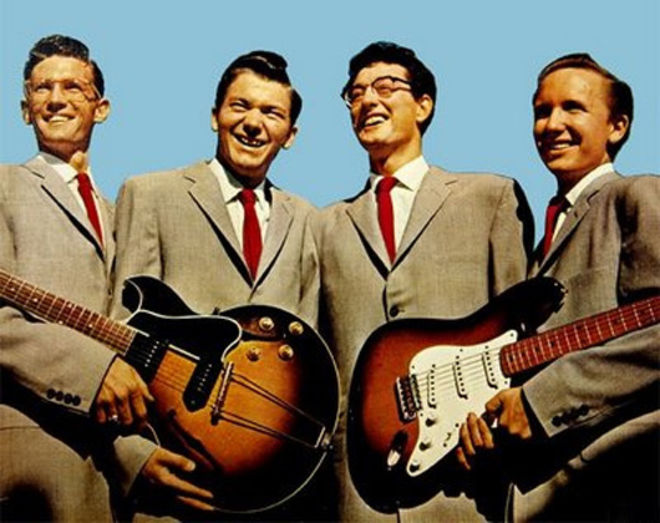
Buddy Holly: Buddy Holly was a singer and songwriter from Lubbock, Texas who gained popularity in the late 1950's with songs like "Peggy Sue" and "That'll Be The Day". Buddy's unique look (the geeky horn-rimmed spectacles combined with the space-age electric guitar) was captivating, and the 100 songs he recorded with his combo the Crickets combined country, pop and in some cases, the Bo Diddley beat. Sadly, Buddy Holly perished in a plane crash following a gig in 1959, along with young guitar slinger Ritchie Valens and DJ J.P. Richardson, a/k/a "The Big Bopper".  Holly, who was only 22 at the time of his death, has had a lasting influence, especially on four young Liverpudlian rockers, who also chose an entomological name for their band, The Beatles.


Buddy Guy: Legendary Chicago bluesman Buddy Guy has played a bunch of different axes in his long career, but he is probably best-known for playing a Strat (often a polka-dot one).  Songs like "The First Time I Met The Blues" and "Damn Right I've Got The Blues" are rightfully classics of the genre.  He is also a prolific coverer of songs by other bluesmen, such as "Five Long Years".  I first got into the blues in the mid-1980's after seeing a PBS special about Buddy, and I have seen him live several times.  Buddy was a huge influence on other guitarists, and his wild live performances are renowned. He is a remarkably modest and kind man as well as a brilliant musician.  Check him out if he comes to your town!


Jimi Hendrix
: Psychedelic blues shaman James
Marshall "Jimi" Hendrix was heavily influenced by Buddy Guy. Though he was left-handed, Hendrix often played right-handed guitars upside down, notably Fender Strats. After years of playing as a sideman with groups like the Isley Brothers and Little Richard, he was "discovered" by Animals bassist Chas Chandler (whose fear of flying motivated him to switch from performing to managing).  Hendrix went to England and took London by storm in 1966.  His wild Buddy Guy-isms (playing the guitar behind his back or with his teeth) and inventive use of distortion, feedback and the tremolo bar quickly brought him the reputation as rock's greatest guitarist.  Sadly, Jimi died in 1970 at the age of 27 as a casualty of drugs; on the night of his death, British guitarist Eric Clapton was planning to give him the gift of a left-handed Stratocaster.  Jimi died too soon, but his live performances of blues like "Red House", rock numbers like "Wild Thing" and his mindblowing rendition of the "Star Spangled Banner" as the sun rose on the multitudes at Woodstock will never cease to amaze.

Eric Clapton: One of my all-time favorite musicians, Eric Clapton was one of the original guitar heroes.  During his time as lead guitarist with John Mayall's Bluesbreakers, London walls were covered with the graffito "Clapton is God". Eric was only 20 years old at the time!  He went on from there to get inducted into the Rock and Roll Hall of Fame three different times, and to record what I think is the greatest album of all time. Clapton has recorded a wide variety of music, but the blues is his homebase, and the Stratocaster is the guitar with which he is most often associated.  He once described playing "Blackie" (his main axe through the 1970's) as "like diving into a pool of warm water".  Clapton was heavily influenced by Buddy Guy (in fact, seeing Guy live led Clapton to form legendary power trio Cream), was friends with Hendrix, and in his turn has influenced just about everyone.  Songs like "After Midnight", "Wonderful Tonight" and "Layla" are classics that show "Slowhand's" chops.


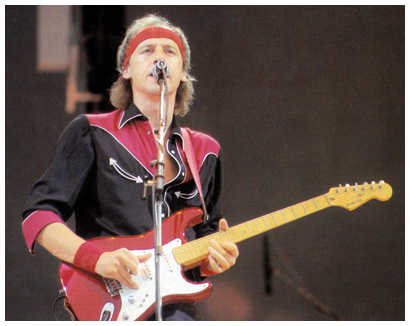
Mark Knopfler: When I was a teenager, I had pictures on my wall of several guitarists, including Clapton, Hendrix, Chuck Berry and Mark Knopfler. Knopfler, the leader of Dire Straits, is a brilliant songwriter and guitarist whose crystal clear fingerstyle Strat playing is unmistakeable. Besides being a great player, he also loves the instrument, as is made clear in this wonderful movie made by Dire Straits bassist John Illsley. Must-hear songs from Mark Knopfler include "Tunnel of Love", "Lady Writer" and "Sultans of Swing".  Mark is still recording and touring--don't miss the chance to see this legendary musician if he comes through your area. 


Stevie Ray Vaughn: Back in the 1980's, after punk, and with the rise of synthesizer based New Wave it seemed like the guitar was falling into disrepute. But a guitar-slinging young bluesman from Texas changed that.  Whether on his own records, or playing lead for David Bowie, Stevie Ray Vaughn restored guitar (and the blues) to their place of prominence in American music. Stevie was famous for playing the battered Stratocaster he called "Number One" on songs like "Pride and Joy" and "Texas Flood" while he featured a maple necked Strat (signed by Mickey Mantle!) on "Lenny", which was the name of his wife, and of the guitar she bought for him.  SRV was a longtime drug addict who got his life under control and was making his best music when he died in a helicopter crash following a concert with Eric Clapton, Buddy Guy and Robert Cray in August of 1990.  He was 35 years old. He is the only guitarist whose picture is currently on my wall. 

**************


In the summer of 1990, under the influence of Stevie Ray Vaughn and Eric Clapton I bought my Fender Strat.  It was an "American Standard" model, made at the new factory in Corona, California after the company's employees purchased the brand from CBS. I got it in the "Pewter" finish that Clapton was using at the time, and named it "Penelope", trusting that it would always be faithful. I have other guitars, but my Strat is first among equals.


It is also the guitar I have relied on the most in live performances.  Every time I have played with my wife in the audience (including before we were married), the Strat was there. When it is important to sound and look good, no other instrument will do a better job than my Stratocaster.

I love the way it looks, the way it feels and the way it sounds.  To me it looks like a grayscale picture with a tinted neck.  I just got the frets leveled and crowned after 23 years of use, and it plays like butter--I can't put it down.

Stratocasters have inspired people since 1954, and I look forward to playing mine for the next 60 years.


Thursday, July 4, 2013

Playlists Posts #2: Songs for America's Birthday


I've written about music before in this space, and those posts have proven to be among the most popular.  As of this week, my post on guitar solos has received over 230 hits, my post on songs about the radio has over 380 hits, and my post on the album Layla And Other Assorted Love Songs has been viewed over 1250 times.  Based on this success, I am returning with a timely post for today: songs  with titles that have something to do with America's birthday.  The songs below are not necessarily "patriotic" and they do not necessarily relate to the United States, but their titles make them perfect for listening to today.  Let me know if I've missed any of your favorite tunes in the comments.  Happy listening, and Happy Birthday America!

*************************

#1: "Fourth of July"--Dave Alvin

The first song on this list is by one of my favorite singer-songwriters, Dave Alvin.  Alvin, who is almost invariably referred to as "Dave Alvin, formerly of the Blasters", even though he hasn't been part of that group for decades, released this song on his first solo record, Romeo's Escape in 1987.  The lyrics paint the picture of a relationship falling apart, and the singer is grasping at whatever he can to salvage things:
She gives me her cheek
When I want her lips
And I don't have the strength to go.
On the lost side of town, in a dark apartment
We gave up trying so long ago. 
On the steps I smoke a cigarette alone
The Mexican kids are shooting fireworks below.
Hey baby, it's the Fourth of July
Hey baby, it's the Fourth of July. 
Whatever happened I apologize
So dry your tears and baby walk outside
It's the Fourth of July.


This video comes from a performance on Austin City Limits, and features some nice solos from Alvin and steel guitar wizard Greg Leisz:


#2: "Fourth of July"--Pete Droge

This song by alternative rocker  Pete Droge has a pretty melody but the message is pretty heavy, as the singer is talking to a friend who committed suicide on Independence Day.  He is saddened and disappointed by the friend's decision to take his own life, and the bittersweet refrain reveals some of his mixed emotions:

On the Fourth of July
You see the sparks in the sky
When your sick of the trying
And you're tired of the crying
Then the Fourth of July is a good day to die.
They'll celebrate each year 
Your independence from here. 

I can't find a video of the song, but you can listen to the song on Spotify:


#3: "Fourth of July"--Brian McKnight

Brian McKnight is a super talented, do-it-all musician who has written and recorded all types of music. This piece of lightweight pop music is very sweet, and the chorus is one that anyone who is in love can relate to:

When we kiss it's like Christmas
I still feel butterflies
Every time we're together
Like the fourth of July
Here is the official video on Vevo:


#4: "Fourth of July Rodeos"--Chris LeDoux

The late rodeo riding country singer Chris LeDoux put out this fun little honky-tonker on his 1975 record "Rodeo and Living Free". In the song LeDoux sings about riding in a rodeo on Independence Day, and wanting to be home with his wife.
It's the Fourth of July on the rodeo trail
And it'll drive you insane.
My wife's worried home by the telephone
I'm on the road again. 
It's the Fourth of July on the rodeo trail
If I ever make it home I swear
I'm gonna hang up my hat
Put up my rigging sack
And for a month I'm gonna stay right there.

Here is the link on Spotify:


#5: "One More Fourth of July"--Jackson Rohm

This sprightly number from country/pop songster Jackson Rohm (who looks remarkably like former Philadelphia Phillies outfielder Pat Burrell) is a song of regret for the "one that got away".  It's pretty catchy!


#6: "4th of July, Asbury Park (Sandy)"--Bruce Springsteen

No playlist of songs about America would be complete without the Boss, so the next two songs give us a double shot of songs from Bruce Springsteen and the E Street Band.  The first tune, "4th of July, Asbury Park (Sandy)", comes from his second album, The Wild, The Innocent and the E Street Shuffle.  It is a beautiful, though somewhat wistful song.  To me, it has always had a bit of a humorous aspect, as it seems like the more the singer tells Sandy about what a loser he is, the less likely it is that she will "unsnap her jeans" for him.  Here is a live clip from the 1970's:


#7: "Independence Day"--Bruce Springsteen

This song, off Springsteen's double album The River, is part of Springsteen's series of songs that relate to the father-son conflict he experienced growing up (think of songs like "Factory" from Darkness on the Edge of Town).  In this song, the son recognizes that he and his dad will never agree, and that it is time to move out of the house.  As someone who often had trouble getting along with his father, I find this song to be very moving, especially the following lines:

'Cause the darkness of this house has got the best of us
There's a darkness in this town that's got us too
But they can't touch me now
And you can't touch me now
They ain't gonna do to me
What I watched them do to you 
So say goodbye it's Independence Day
It's Independence Day all down the line
Just say goodbye it's Independence Day
It's Independence Day this time.


#8: "Independence Day"--Ellis Paul

This number by Boston singer-songwriter Ellis Paul is another one that combines freedom from a bad relationship with the national holiday. When he learns that his woman has been unfaithful, the hypocrisy of their life together causes a breakup:
I'll shed some light on the mystery
Of why I kicked her out on Independence Day
With the fireworks burning I found myself learning
Couldn't lay in my bed the same way


#9: "Independence Day"--Elliott Smith

Elliott Smith and I were contemporaries at Hampshire College in the late 1980's.  This song is a good example of how he could blend lovely melodies with inscrutable lyrics.  I recently spoke with author William Todd Schultz about what life was like at Hampshire in those days, to provide some background information for his upcoming new book "Torment Saint: The Life of Elliott Smith".


#10:"Independence Day"--Ani Difranco

Ani DiFranco's songs are often heartbreaking, and this one is no exception.  The haunting chords combine with the lyrics and the tortured vocal to describe the sadness of someone who knows that the one she loves doesn't feel the same.  The words are very evocative, especially the introduction:

We drove the car to the top of the parking ramp on the 4th of July
We sat out on the hood with a couple of warm beers
And watched the fireworks explode in the sky
And there was an exodus of birds from the trees
But they didn't know we were only pretending


#11:"Independence Day"--Martina McBride

This is an outstanding song which once again combines the national holiday of Independence Day with that of an abused woman who gains her independence from her husband by killing him.  The song is told through the eyes of the woman's daughter, who is looking back to when she was a child.  It is a great song to listen to, and the words really make you think.  On the one hand, the eight year-old narrator loses both of her parents (her mother is arrested) and is sent to to "the county home", but on the other hand, while she "ain't saying if it's right or it's wrong", she seems to think that her father deserved it.  The video below is fraught with extra meaning, as it was shot at Farm Aid in 2001, just a couple of weeks after 9/11.  One can discern a little bit of the pride and determination that Americans displayed back then when Martina McBride sings "let freedom ring".


#12:"Happy Birthday America"--the Soul Survivors

Well after all of these grim, gloomy songs, we might as well end on a positive, upbeat note.  This song, written for the 1976 Bicentennial celebration, is a great example of Philly soul and you can't argue with the lyrics.  Happy Birthday America, it's party time in the USA!!!